

Key takeaways:
- More than a quarter of patients who received guselkumab induction and maintenance therapy achieved combined fistula remission at 24 weeks.
- No new safety signals were reported.
CHICAGO — Guselkumab demonstrated significantly higher rates of combined fistula remission at 24 weeks compared with placebo among adults with perianal fistulizing Crohn’s disease, according to data from the ongoing FUZION trial.
“This is the first successful international phase 3 trial assessing the combined clinical and MRI primary points, and the first in more than 2 decades showing efficacy of an advanced therapy in perianal fistulizing Crohn’s disease,” Laurent Peyrin-Biroulet, MD, PhD, head of the IBD unit at Nancy University Hospital in France, said while presenting his research at Digestive Disease Week.

Data derived from Peyrin-Biroulet L, et al. Guselkumab for perianal fistulizing Crohn’s disease: Week 24 results from the phase 3, randomized, double-blind, placebo-controlled, multicenter FUZION study. Presented at: Digestive Disease Week; May 2-5, 2026; Chicago.
“Importantly, guselkumab was efficacious until week 24,” he added. “In the study of populations [that] were bionaive or bioexposed with perianal Crohn’s disease, there was clearly clinically meaningful difference vs. placebo during the induction, and you could see that both doses have good efficacy and close efficacies.”
Peyrin-Biroulet and colleagues conducted a randomized, multicenter study to investigate rates of combined fistula remission after 24 weeks of treatment with guselkumab (Tremfya, Janssen). Combined fistula remission was defined as complete healing of external fistulas with no new fistula development and MRI confirmation of no collections more than 2 cm.
The researchers assigned 286 adults to three treatment cohorts (2:2:1), stratified by baseline proctitis and bionaive status. No endoscopies were performed, so they used MRI to assess proctitis, Peyrin-Biroulet explained.
Participants had at least one active draining perianal fistula, Crohn’s Disease Activity Index (CDAI) of less than 350, and either intolerance or inadequate response to other treatments.
Demographics were similar across cohorts (mean age, 36.5 years; 71.7% men). Baseline disease characteristics also were balanced (mean CDAI, 148.7). More than half (58%) of participants had one open or draining fistula and 42% had multiple open or draining fistulas.
The first cohort received 200 mg guselkumab IV induction at 0, 4 and 8 weeks, with an additional 100 mg subcutaneously for maintenance every 8 weeks (Q8W, n = 113). The second group received the same induction doses and 200 mg subcutaneously every 4 weeks for maintenance (Q4W, n = 115). The third group received placebo (n = 58).
A total of 91.3% of participants completed 24 weeks of treatment.
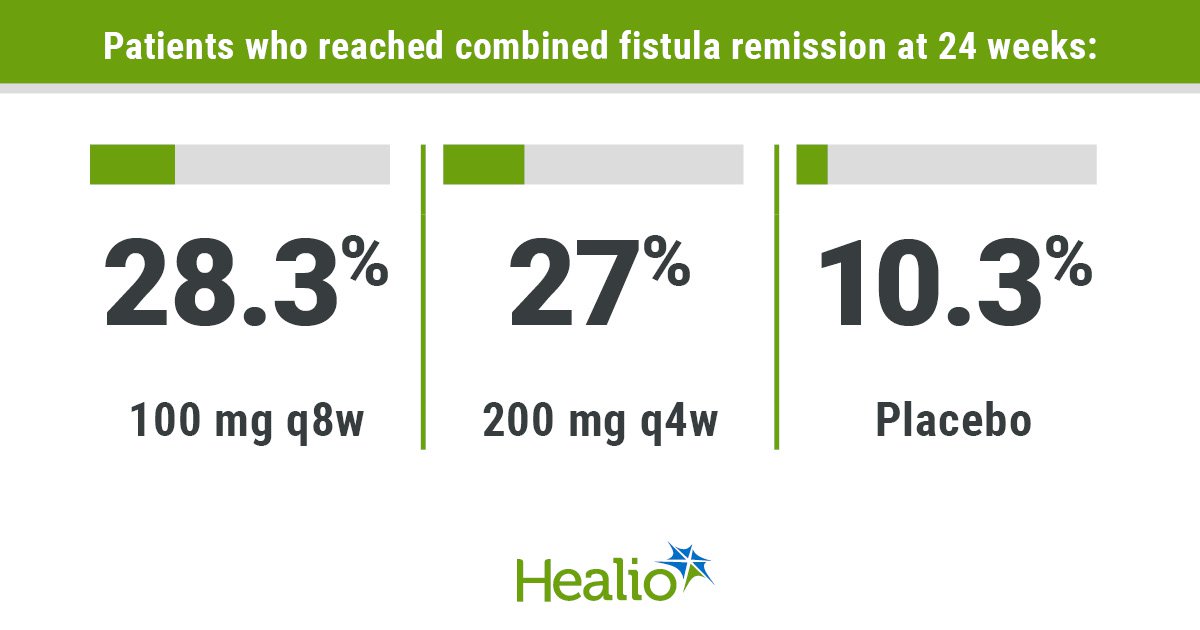
The combined fistula remission rate was 28.3% in the Q8W cohort, 27% in the Q4W cohort and 10.3% in the placebo cohort. Both Q8W (P = 0.007) and Q4W (P = 0.013) cohorts had significantly higher rates of combined fistula remission than the placebo group.
Notably, by week 12, the difference in fistula remission between placebo and treatment groups had reached statistical significance.
“I think that is very interesting for our patients, because every month matters,” Peyrin-Biroulet said.
Adverse events observed in the trial appeared consistent with the known safety profile of guselkumab, which is approved for moderate to severe CD.
Sources/Disclosures
Source:
Peyrin-Biroulet L, et al. Guselkumab for perianal fistulizing Crohn’s disease: Week 24 results from the phase 3, randomized, double-blind, placebo-controlled, multicenter FUZION study. Presented at: Digestive Disease Week; May 2-5, 2026; Chicago.
Disclosures:
Healio was unable to confirm relevant financial disclosures at time of publication.

Ask a clinical question and tap into Healio AI’s knowledge base.
- PubMed, enrolling/recruiting trials, guidelines
- Clinical Guidance, Healio CME, FDA news
- Healio’s exclusive daily news coverage of clinical data