
Obesity may have met its match in GLP-1 receptor agonists. However, the role of gastroenterologists in obesity management and the administration of this revolutionary class of drugs is complicated and has yet to be defined.
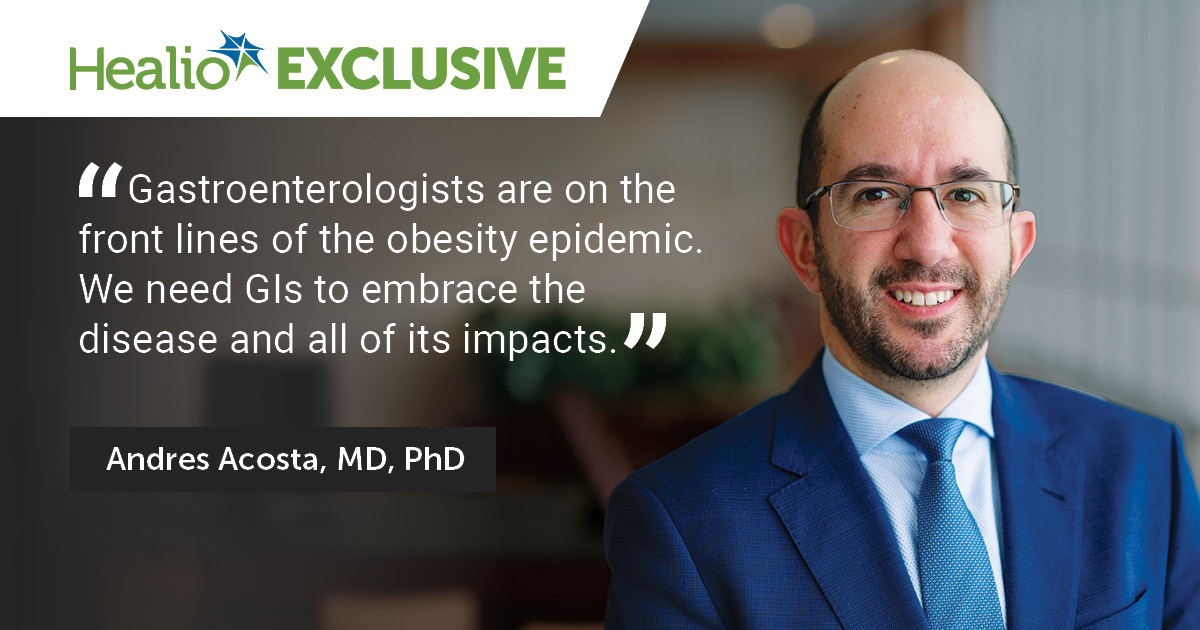
“Gastroenterologists are on the front lines of the obesity epidemic,” Andres Acosta, MD, PhD, associate professor of medicine and consultant in the division of gastroenterology and hepatology at Mayo Clinic and American Board of Obesity Medicine diplomate, told Healio. “We need GIs to embrace the disease and all of its impacts, including GERD, IBD, MASLD, fatty liver disease and obesity-related cancer risk.”

Image: Andres Acosta, MD, PhD. Reprinted with permission.
Hepatologists and primary care providers can handle some of these downstream effects of obesity. They often do, shutting gastroenterologists out of the equation.
“It is my overall impression that there still is not sufficient commitment or embrace of the idea among cardiologists, hepatologists, pulmonologists and others that there is this opportunity to treat obesity itself,” Michael Camilleri, MD, DSc, consultant in the division of gastroenterology and hepatology at Mayo Clinic and professor of medicine, pharmacology and physiology at Mayo Clinic College of Medicine and Science, said in an interview.
“A couple years ago I was almost evicted from a meeting because I suggested that hepatologists should be treating obesity and not just abnormal liver enzymes,” Camilleri said.

Michael Camilleri
There is growing recognition that gastroenterologists could play a larger role in obesity management, as well, largely because of GLP-1s. “There is this opportunity to embrace the pharmacology that is available with the FDA approval of GLP-1 receptor agonists,” Camilleri added.
As uptake of these medications expands, adverse events are sure to follow. Many of them, such as nausea, constipation, delayed gastric emptying and motility issues, are commonly managed by gastroenterologists. But because the medications are not always prescribed by gastroenterologists, they are often not involved in management of the side effects.
Also up for discussion is where GLP-1s fit into wider weight loss paradigms, from diet and exercise to bariatric surgery and endoscopic sleeve gastroplasty.
“Many people who offer bariatric and metabolic procedures see this drug class as complimentary to procedural interventions,” Marianna Papademetriou, MD, director of endoscopy and motility at Washington VA Medical Center and associate professor at Georgetown University School of Medicine, told Healio. “We are still learning how to best integrate drugs with procedures.”
The next concern is that more patients are turning to GLP-1s to manage obesity not by recommendation from their doctor, but as a result of direct-to-consumer advertising.
“The digital and DTC platforms are certainly factors that risk fragmented oversight,” Camilleri said.
‘Truly frightening’
For Sonali Paul, MD, MS, hepatologist and associate professor at University of Chicago Medicine, “fragmented oversight” with this class of drugs is an understatement.

Sonali Paul
“The rapidly growing companies that are doing digital or direct-to-consumer prescribing of GLP-1s is truly frightening,” she said. “First, these drugs are often compounded so there is a risk of contamination, inconsistent dosing and improper or unsafe formation. Additionally, often there is no virtual visit or visit with a doctor or nurse practitioner prior to prescribing. Some have only a questionnaire.”
Paul described a scenario in which a patient with an eating disorder who was severely malnourished was regularly prescribed GLP-1s for months without one consultation with a physician.
“GIs have a unique role in bringing structure and safety, but we cannot do it alone,” she said. “Given the widespread use of GLP-1s across many medical specialties, we as a physician entity need to demand better safety and prescribing parameters.”
While Papademetriou acknowledged many of these concerns, she took a more measured view. “There are plusses and minuses to online health platforms,” she said. “On the one hand, it is an effective way to improve access to care. On the other hand, many online platforms are zoomed in on the prescribing of weight management medications, and do not necessarily tailor that management to the patient’s overall medical issues.”

Marianna Papademetriou
For example, a patient with a history of erosive esophagitis and GERD who begins taking a GLP-1 may experience an escalation of symptoms that previously had been under control, according to Papademetriou. “The platforms do not appear to have the capability to work through that issue with a patient,” she said.
The complications only get more complicated from there. “That patient may go back to their PCP or their gastroenterologist, and the GLP-1 is not on their medication list, or the patient may feel stigmatized about bringing up their use of GLP-1s,” Papademetriou said. “Their physician is now trying to work through this sudden change of symptoms without having the full picture. That could lead to unnecessary procedures or medication changes that could be avoided with better integrated care.”
But there is a solution to this particular issue, according to Papademetriou. “We need to do a better job of improving access to these drugs through conventional medical pathways, and we need to reduce the stigma around these conversations with our patients,” she said.
“Many people probably assume that people utilize telehealth for weight management for the ease and convenience,” Papademetriou continued. “But I suspect a significant part of the demand for this is also the bias people experience with conversations surrounding weight in the medical setting.”
Whether that bias will decrease with more direct-to-consumer advertising and more patients taking GLP-1s remains to be seen. What is certain is that these patients are likely to experience gastrointestinal-related adverse events commonly reported with these medications.
‘Significant impact’
Patients experiencing side effects of these drugs, including nausea, vomiting, diarrhea and constipation, are commonly seen in GI clinics. “Of course we need to be part of managing them,” Acosta said.
Gastroenterologists treat an array of these effects, from events due to medications to complications arising from rheumatic, autoimmune or endocrine conditions, according to Papademetriou. “We can make a significant impact here,” she said. “The first step would be to offer evidenced-based lifestyle counseling in conjunction with GLP-1 receptor agonist medications.”
The next step would be to encourage patients to continue with these medications to gain the full benefit of weight loss. “Patients on GLP-1s who experience side effects are often very motivated by the progress they see and feel and therefore are willing to work with their physicians to persevere through the escalation phase of the drugs,” Papademetriou said. “With guidance of their gastroenterologist, patients may stay on the drugs longer through this adjustment phase. In addition, I suspect GIs are equipped to identify and diagnose these adverse events, even expected ones like biliary colic or cholelithiasis.”
However, not all gastroenterologists are convinced that the specialty should be managing every adverse event for every patient taking GLP-1s.
“The multiple indications for these medications, including type 2 diabetes, weight management, cardiovascular risk reduction, reduction in chronic kidney disease and obstructive sleep apnea, pose a challenge for GIs,” Paul said. “There is a role to prescribe in those with MASH, however. Patients are often sent for management of GI side effects, but one can argue that those who prescribe the drug should also be able to manage basic side effects to the best of their ability.”
Perhaps the most important question is whether GLP-1s are worth the risk. “The benefits of managing obesity with lifestyle interventions, plus the current drugs and surgeries we have available, certainly outweigh the risk,” Acosta said. “We know these medications have side effects, as most medications do. But the patients who can lose the body weight and get to a healthier weight will see so many benefits.”
A proportion of patients is likely to discontinue GLP-1 receptor agonists because of adverse events. But obesity tends to persist. A comprehensive, multipronged weight loss regimen is necessary for many individuals who cannot easily lose weight.
‘Everyone should have a lifetime plan’
Camilleri coauthored a paper in Gut arguing for the role of gastroenterologists in GLP-1 prescribing and obesity management in the context of other weight loss strategies.
“I had embraced this as an opportunity for gastroenterologists to enhance their practice as a bridge in the spectrum of treatments,” Camilleri said. That can start with diet and lifestyle modification and proceed to the pharmacology of induction and maintenance of weight loss, based on GLP-1s and other hormonal agonists or antagonists.
“For those not achieving the therapeutic goals, bariatric procedures are available,” he added.
While these historically useful approaches remain within the purview of gastroenterologists, patient attitudes toward them have changed in recent years, according to Camilleri. “The vast majority of patients has clearly illustrated their preference for GLP-1 receptor agonists,” he said.
Collaboration between medical specialties around these medications makes perfect sense, according to Acosta. “Obesity is a chronic, recurrent, multifactorial disease,” he said. “If you start taking medications to lose weight, you may have to change to another therapy if you do not improve, or you may need to take it for a long time. Combination therapy seems to deliver the most long-term success and be the most effective way to weather the metabolic adaptations our body goes through with weight loss. Everyone should have a lifetime plan.”
While patients may view GLP-1s as a standalone weight loss solution, Papademetriou sees opportunity for GLP-1s to be used in combination or in succession with mainstay weight loss interventions ranging from improved wellness behaviors to bariatric surgery.
“It is exciting that there are more options than ever before for patients,” she said. “What I also see as a very positive thing is that GLP-1 receptor agonists have reengaged lay conversations around obesity and metabolic disease management and risk reduction. I have seen how the popularity of the medications has influenced patients to seek care to ask these questions about what’s right for them.”
There is hope that this will lead to reduced rates of obesity and, consequently, obesity-related cancer.
GLP-1s and cancer risk
Shen and colleagues described the cancer risks linked to excess weight in a paper published in JAMA. “Overweight and obesity are associated with higher rates of cancer and account for 10% of new cancer diagnoses annually in the U.S.,” they wrote. “Weight loss may reduce cancer risk by attenuating adverse effects of obesity, but greater than 10% weight loss may be necessary to reduce cancer risk.”
“We would love to assume that GLP-1s, where patients may often achieve more than 10% of total body weight reduction, may reasonably also benefit from this additional risk reduction as was seen in surgical groups, but we just don’t know if that’s the case yet,” Papademetriou said.
With such results in mind, it should follow that this class of medications could unequivocally reduce cancer incidence. However, a retrospective cohort study published by Dai and colleagues in JAMA Oncology highlights the complicated relationship between GLP-1s and cancer.
The researchers compared incidence of 14 cancers — including 13 obesity-related cancers — among 43,317 GLP-1 users and 43,315 matched nonusers, all of whom had obesity or overweight. Results showed that taking GLP-1s was associated with a reduction in overall cancer risk, including endometrial and ovarian cancers and meningioma. However, the researchers also observed an association between these medications and an increased risk for kidney cancer.
The findings suggest that it is too early to determine whether GLP-1s can reduce cancer risk, according to Paul. “We do not have the evidence for this and would require solid RCT data to show the level of benefit,” she said.
The results also highlight the complicated treatment workflow for patients with obesity and cancer. “One could argue that, like colon cancer screening to prevent cancer, this may fall under primary care, as there are not enough GIs to see everyone and determine if patients qualify,” Paul said. “However, if a patient is already under a GI’s care, say for IBD or other chronic diseases, it may come under GIs’ purview but would require more high-quality evidence.”
More such data are emerging every day, but often with conflicting results. In a systematic review and meta-analysis published in Annals of Internal Medicine, Ko and colleagues reviewed data for 94,245 individuals in 48 randomized, controlled trials that included 13 different cancer outcomes.
Results showed that GLP-1s “probably have little or no effect on risk” for a number of malignancies, including thyroid, pancreatic, breast and kidney cancers. The medications “may have little or no effect” on colorectal, esophageal, liver, gallbladder, ovarian and endometrial cancers or multiple myeloma. “The effect on gastric cancer is very uncertain,” the researchers wrote.
‘An area of study we need to pursue’
Despite the uncertainty surrounding GLP-1s and cancer risk, Camilleri believes that gastroenterologists still have a critical role in cancer prevention.
“We as gastroenterologists are very much involved with trying to prevent colon cancer,” he said. “While we wait for more data to emerge showing that GLP-1s definitively reduce cancer risk, we can talk to our patients with a high BMI and suggest that it is an opportunity to treat them using these medications. We should embrace this as an opportunity, rather than saying, ‘We’ll see you in 5 years’ time.’”
That research into the relationship between obesity, weight loss, GLP-1s and cancer is certain to continue. Acosta pointed the way forward for the next generation of studies. “It would be interesting to see whether we can actually prevent cancer with these medications,” he said. “There are some hints that they might, but that is an area of study we need to pursue.”
In the meantime, the obesity epidemic rages on. “The biology and heterogeneity of obesity makes it clinically challenging, even with the availability of GLP-1 receptor agonists,” Acosta said. “We should try to match the right intervention with the right patient, because not everyone responds to treatment the same way.”
Regardless of whether any given treatment succeeds or fails, the conversation about obesity should continue, according to Papademetriou. “The best thing we can do as gastroenterologists is bring up the conversation that metabolic disease, diabetes and higher BMI increase risk for certain cancers,” she said. “I know many people are not aware of this fact. It is another motivating and modifiable factor for people on their weight loss journeys toward improving their overall health and well-being.”
For more information:
Andres Acosta, MD, PhD, can be reached at acosta.andres@mayo.edu.
Michael Camilleri, MD, DSc, can be reached at camilleri.michael@mayo.edu.
Sonali Paul, MD, MS, can be reached at spaul@uchicago.edu.
Marianna Papademetriou, MD, can be reached at marianna.papademetriou@va.gov.
Sources/Disclosures
References:
Disclosures:
Acosta reports consulting roles with Amgen, Boehringer Ingelheim, Bausch Health, Currax, General Mills, Gila Therapeutics, Nestlé, Novo Nordisk, Phenomix Sciences, Rare Diseases, Regeneron, Rhythm Pharmaceuticals and Structure Therapeutics; funding from Apollo Endosurgery, Boehringer Ingelheim, Dairy Management, Delaney Foundation, Novo Nordisk, Regeneron, Rhythm Pharmaceuticals, Satiogen Pharmaceuticals, Spatz Medical and Vivus; and licensing from Gila Therapeutics and Phenomix Sciences for his research technologies from University of Florida and Mayo Clinic. Camilleri reports no financial disclosures. Paul reports previously owning stock and being a shareholder in Eli Lilly & Co. Papademetriou reports no relevant financial disclosures.

Ask a clinical question and tap into Healio AI’s knowledge base.
- PubMed, enrolling/recruiting trials, guidelines
- Clinical Guidance, Healio CME, FDA news
- Healio’s exclusive daily news coverage of clinical data