
Key takeaways:
- Black, Hispanic and female patients with ulcerative colitis were significantly less likely to undergo colectomy.
- Colectomy rates were significantly higher for higher-income and privately insured patients.
CHICAGO — Black, Hispanic and female patients with ulcerative colitis were significantly less likely to undergo colectomy compared with white patients and men, according to data presented at Digestive Disease Week.
Residents from higher-income areas and those with private insurance were also more likely to undergo colectomy, hinting at systemic inequities in care pathways.

“Over the past 2 decades, the treatment landscape for ulcerative colitis has expanded significantly, but colectomy remains the definitive therapy for patients with medically refractory disease,” Vraj P. Shah, MD, an internal medicine resident at Rutgers New Jersey Medical School, told Healio. “Despite this, prior studies have suggested that not all patients are equally likely to undergo surgery.”
He added: “In clinical practice, we often encounter variability in how and when patients are referred for surgical evaluation. This raised an important question: Are there systematic disparities in who ultimately receives colectomy?”
Shah and Amanda A. Rupert, MD, director of motility disorders at Rutgers, conducted a retrospective population-based study using the 2016-2020 National Inpatient Sample to identify adults with ulcerative colitis (n = 727,515) — excluding those with concurrent Crohn’s disease — and using ICD-10 codes to flag those who underwent colectomy (n = 43,700).
The researchers then used bivariable analyses to compare patient demographics of those who had surgery with those who did not and applied multivariable logistic regression to determine which factors independently predicted colectomy.
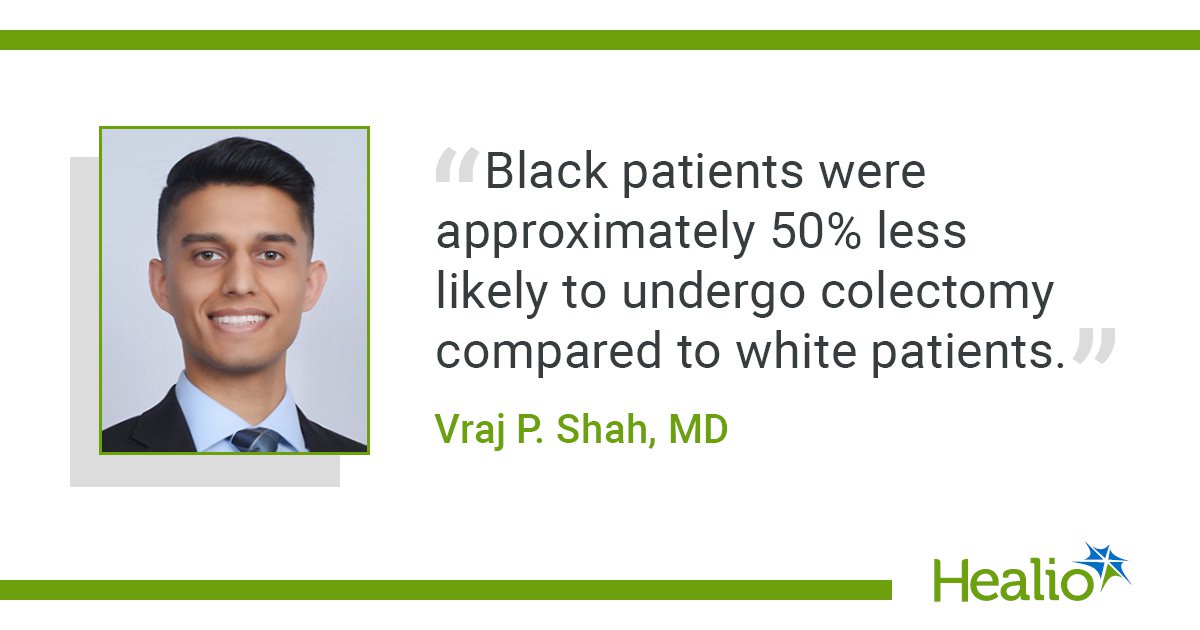
“We observed that Black patients were approximately 50% less likely to undergo colectomy compared to white patients, and female patients were over 20% less likely than male patients, even after adjustment for multiple factors,” Shah told Healio.
Shah and colleagues observed that patients who underwent colectomy were younger on average than those who did not (48.25 years vs. 57.47 years, P < .001). Men were more likely than women to undergo the surgery (7% vs. 5.2%, P < .001), and white patients underwent colectomy at higher rates (6.3%) than either Black (3.3%) or Hispanic (5.7%) patients (P < .001).
In their multivariable analysis, the researchers noted that women were more than 20% less likely to undergo colectomy than men (OR = 0.79, P < .001). Black patients were nearly half as likely to receive colectomy as white patients, and Hispanic patients were 17% less likely than white patients to undergo surgery.
Colectomy rates were higher among patients living in higher-income areas (OR = 1.13, P < .001) and nearly doubled among those with private insurance vs. Medicare (OR = 1.97, P < .001).
“When we stratified by admission type, we found that disparities varied by clinical context,” Shah said. “Racial disparities were more pronounced in emergent settings, whereas gender, income and insurance-related differences were more prominent in elective settings. This suggests that disparities are not uniform but instead may arise at different points along the care pathway.”
Shah noted that “access to care plays a major role” in these disparities, as patients with private insurance or higher income may have improved access to specialty inflammatory bowel disease care and colorectal surgeons, as well as shorter wait times for evaluation and surgery.
“There may also be differences in referral patterns, where clinicians have a lower threshold to refer patients with greater resources for surgical consultation,” he said. “Additionally, socioeconomic barriers, such as time off work, caregiving responsibilities and transportation, may limit access to elective surgery for lower-income patients.”
Shah stressed that these results should not be interpreted as favoring higher or lower colectomy rates for patients, but rather as a call to ensure all patients receive “equitable access to appropriate care” for their clinical needs.
“Disparities in the surgical management of ulcerative colitis persist at a national level and vary depending on the clinical setting,” Shah told Healio. “Gastroenterologists play a central role in shaping these pathways. Ensuring equitable care requires awareness of these disparities, timely and consistent referral for surgical evaluation, and commitment to shared, patient-centered decision-making. Ultimately, the goal is to ensure that all patients have access to the full spectrum of appropriate therapies, including surgery when indicated.”
For more information:
Vraj P. Shah, MD, can be reached at gastroenterology@healio.com.
Sources/Disclosures
Source:
Shah VP, et al. Racial and gender disparities in rates of colectomy in ulcerative colitis patients: A retrospective national cohort study. Presented at: Digestive Disease Week; May 2-5, 2026; Chicago.
Disclosures:
Shah reports no relevant financial disclosures. Please see the study for all other authors’ relevant financial disclosures.

Ask a clinical question and tap into Healio AI’s knowledge base.
- PubMed, enrolling/recruiting trials, guidelines
- Clinical Guidance, Healio CME, FDA news
- Healio’s exclusive daily news coverage of clinical data