

Key takeaways:
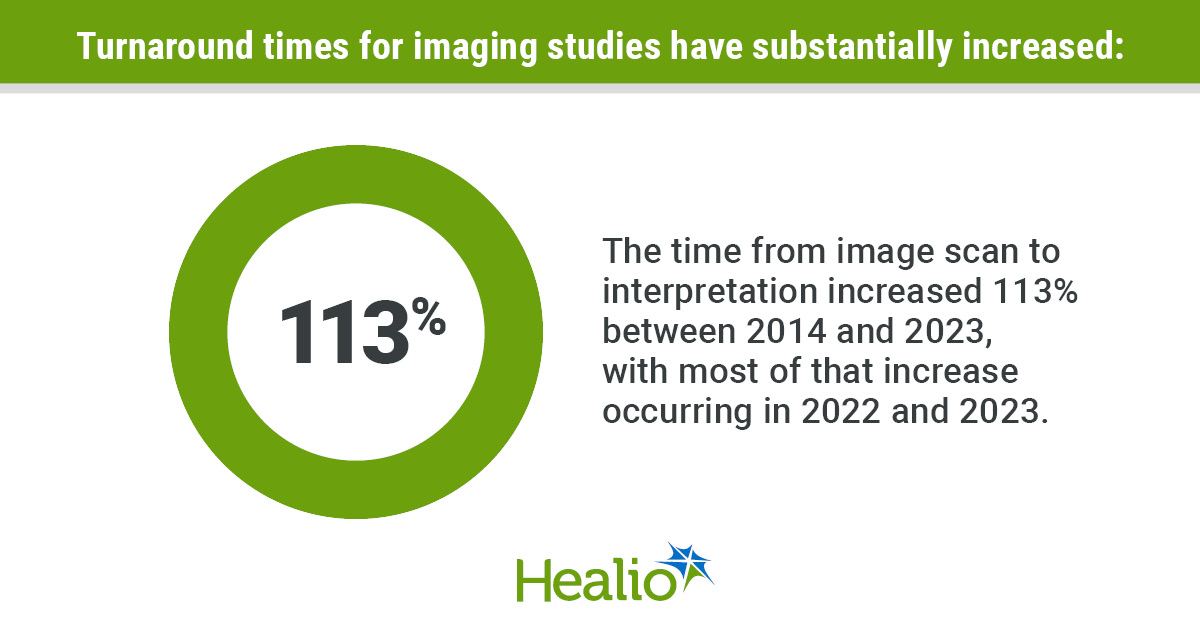
- Turnaround times for imaging interpretation increased 113% between 2014 and 2023.
- The turnaround time-gap between low- and high-income communities more than doubled during that time.
The time from outpatient imaging to interpretation by a radiologist more than doubled over the past decade, and most of that increase occurred in 2022 and 2023, which are the most recent data.
An evaluation of more than 2 million Medicare claims between 2014 and 2023 showed that time from CT to interpretation increased over 300%, MRI more than 250% and ultrasound nearly 150%, with disenfranchised communities experiencing longer delays.

Data derived from Christensen EW, et al. J Am Coll Radiol. 2026;doi:10.1016/j.jacr.2026.02.038.

Eric W. Christensen
“We’ve reached a critical juncture with the workforce,” Eric W. Christensen, PhD, research director at Harvey L. Neiman Health Policy Institute, told Healio. “You’ve reached a point where there’s no more slack in the system. The radiology workforce is increasing in numbers, but how does that increase compare with increases in volume?”
‘Pressure of increasing workloads’
Christensen and colleagues previously published data in American Journal of Roentgenology that showed radiologist attrition rates more than doubled from 2014 to 2022 (1.1% to 2.5%) with much of that increase occurring by 2019 and remaining at higher levels since then.
In a separate paper in Journal of the American College of Radiology, they projected image utilization to increase between 16.9% and 26.9% from 2023 to 2055 in a different study in Journal of the American College of Radiology.
“For several years now, radiologists have felt the pressure of increasing workloads and volumes,” Christensen said. “They’ve likely handle it by working more hours.”
This led researchers to conduct a retrospective analysis of a 5% sample of Medicare fee-for-service beneficiaries to see how the workforce shortage impacted turnaround times for imaging.
They included 2,578,953 office and hospital outpatient imaging studies (59.6% radiography or fluoroscopy; 15.9% CT, 12.9% MRI, 11.5% ultrasound) from 2014 to 2023.
Annual turnaround times served as the primary endpoint.
‘Really shocking’
Overall, 97.1% of imaging studies were interpreted the same day, but the number interpreted on a different day increased from 2% in 2014 to 5.5% in 2023.
Turnaround times increased 113% during the study period (0.091 mean days to 0.193 mean days).
However, most of the change occurred in 2022 (19% of the increase) and 2023 (68% of the increase).
“I fully expected we would start to see some uptick, but the fact that it was flat and then just rapidly increased was really shocking,” Christensen said.
Turnaround times increased the most for CT (318%), followed by MRI (256%), ultrasound (140%) and radiography or fluoroscopy (63%).
Between 68% and 77% of the increase for CT, MRI and radiography or fluoroscopy occurred in 2023.
From 2014 to 2020, the lowest-income communities (less than $25,000) had mean turnaround times 56% longer than the highest-income communities (more than $100,000). That disparity increased to 121% between 2021 and 2023.
The gap improved based on area deprivation index, though. The most deprived communities had 44% longer turnaround times from 2014 to 2020, but that decreased to 26% between 2021 and 2023.
“When we see a disparity, the implicit assumption is that there’s discrimination happening, that people are behaving badly and that’s why we’re getting these results,” Christensen said. “That may be part of it, but economic forces and other factors have side effects. One of those side effects is that certain communities are disproportionately impacted when economic forces drive a result, and we see that in this case.”
Researchers acknowledged study limitations, including lack of time stamps on claims data.
“From a patient perspective, the question is, when does this begin to impact patient care?” Christensen asked. “While our study did not measure the impact of increasing turnaround times on patient care, delays are expected to eventually impact patients. Imaging is conducted to make or rule out a diagnosis, or initiate or change treatment. Imaging is to inform the medical decision-making process. To the degree that process is delayed, then, at some point, you’re going to have an impact on patients.”
‘Solve the workforce problem’
Christensen and colleagues plan to continue their research with an evaluation of 2024 data.
“We want to know if this spike is continuing,” he said. “We would like to evaluate whether this particular trend is associated with growing imaging volumes in the ED, particularly CT volumes. If locations that have more rapid increases in ED CT volumes have relatively worse turnaround time trends, that could potentially point to an area specifically tied to turnaround times. That gives you a target to address.”
Those data are only part of the equation though. Addressing the workforce shortage remains paramount.
“You can solve the workforce problem by having a greater supply, or you can decrease the workforce problem by reducing the demand or the utilization of imaging,” Christensen said.
Christensen noted both problems are “very hard to solve,” but reducing volume likely would achieve quicker results.
“A study in Applied Health Economics and Health Policy journal puts the range of low-value imaging between 20% and 50%. It provides no or low benefit to patient, or it doesn’t impact or improve treatment commensurate with the costs,” he said. “Clinical decision support is an important way for ordering providers to be more thoughtful about the imaging studies they do put in the system, because the volume is not a radiologist-driven problem.”
Healio previously reported CT use in 2023 would cause more than 100,000 future cancer diagnoses.
“There’s a lot of imaging happening that’s truly not necessary,” Christensen said. “There have been great efforts to get people to image less. There has to be a mechanism to help ordering providers consider if the imaging study they’re about to order is the right one, or if it’s even necessary at all. That’s where clinical decision support tools can help.”
Without change, Christensen sees a “vicious cycle” of extra time spent on interpretation, which leads to burnout, which leads to attrition, which leads to longer turnaround times.
“If you have no downtime in your day and something new comes up, everything kind of falls apart in terms of your timeline, for what you can do in a day,” he said. “You can only work so many hours in a day.”
For more information:
Eric W. Christensen, PhD, can be reached at echristensen@neimanhpi.org.

Ask a clinical question and tap into Healio AI’s knowledge base.
- PubMed, enrolling/recruiting trials, guidelines
- Clinical Guidance, Healio CME, FDA news
- Healio’s exclusive daily news coverage of clinical data