
Key takeaways:
- Co-antibody combination therapy showed positive results in patients with IBD with inadequate response to two or more systemic therapies.
- At week 48, high dose co-antibody combination outperformed golimumab.
CHICAGO — Combining golimumab and guselkumab into JNJ-78934804, a fixed-dose co-antibody therapy, helped overcome treatment failure in inflammatory bowel disease and exceeded dose-dependent benefits of either drug alone, according to data.
Two parallel phase 2b trials combining the anti-tumor necrosis factor and anti-interleukin-23 medications in Crohn’s disease and ulcerative colitis, DUET-CD and DUET-UC, were presented by lead authors at Digestive Disease Week.

“Results show that people with Crohn’s disease who have had inadequate response to two or more systemic therapies do strikingly better with combination therapy of two drugs with different mechanisms of action, specifically with golimumab, an anti-TNF antibody, and guselkumab, an anti-IL-23 antibody, rather than with treatment with either one alone,” Bruce E. Sands, MD, MS, chief of the Dr. Henry D. Janowitz Division of Gastroenterology at Mount Sinai Health System and lead author of the CD study, told Healio.
Similar results were observed in the parallel UC trial, according to lead author Maria T. Abreu, MD, executive director at F. Widjaja IBD Institute at Cedars-Sinai Medical Center.
“The study highlights that there is a path forward for UC patients who have been on more than two types of mechanisms of action of medications,” she told Healio. “Combining anti-TNF and anti-IL-23 was safe and showed superiority in the toughest to treat UC patients.”
Crohn’s study results
In the DUET-CD study, 693 adults with Crohn’s disease (57% men) were randomly assigned to receive guselkumab (Tremfya, Janssen), golimumab (Simponi, Janssen), low-, mid- or high-dose JNJ-78934804 (JNJ-4804, Johnson & Johnson) or placebo. Half of the patients had a prior inadequate response to two or more classes of systemic therapy.
The coprimary endpoints were clinical and endoscopic remission at week 48, while other key endpoints included endoscopic remission, deep remission and corticosteroid-free clinical remission at that time point.
High-dose JNJ-4804 achieved higher rates of the co-primary endpoints than golimumab, including clinical remission (difference = 25.7; P < .001) and endoscopic response (difference = 18.5; nominal P < .001), with similar or greater efficacy compared with guselkumab. The researchers also found that differences in treatment were greater among those who were refractory to two or more systemic therapy classes.
At week 48, high-dose JNJ-4804 demonstrated clinically meaningful improvements in both clinical remission and endoscopic response compared with golimumab (27.3 and 21.2, respectively), guselkumab (21.2 and 11.7) and placebo (39.4 and 35).
Exposure-adjusted safety events with JNJ-4804 were similar to or lower than those reported with placebo or golimumab. Most serious adverse events were gastrointestinal-related and serious infections were uncommon. Safety was comparable to that observed with monotherapies.
This “fixed-dose combination of golimumab and guselkumab outperformed either one alone” in refractory Crohn’s disease without increased risk for adverse events compared with monotherapy, Sands told Healio.
UC study results
For the UC study, 572 individuals (57% men) were also randomly assigned to the same medications in the same way as the CD trial. Patients had a mean UC duration of 9 years (standard deviation, 7.5). Most patients had severe endoscopic disease, with 72% scoring 3 on the Mayo Endoscopy Subscore, 70% having modified Mayo scores of 7–9 and 45% reporting an inadequate response to two or more systemic therapy classes.
Abreu and colleagues reported findings consistent with the DUET-CD study: High-dose JNJ-4804 was significantly superior to golimumab (28.4; P < .001) and comparable to guselkumab (6.3) in the study’s primary endpoint.
At week 48, treatment responses were greater in patients who were refractory to two or more systemic therapy classes. In this subgroup, high-dose JNJ-4804 resulted in clinically meaningful improvements in clinical remission, corticosteroid-free clinical remission, endoscopic improvement and histologic remission and endoscopic improvement compared with golimumab (22.9, 20.5, 31.9, and 27.3, respectively), guselkumab (12.5, 12.3, 17.3, 16.9) and placebo (19.7, 17.2, 28.3, 23.6).
Safety events per 100 patient-years in the JNJ-4804 groups were either comparable or lower than those observed in the other treatment groups. As in the DUET-CD study, most serious adverse events were GI-related with low rates of serious infection.
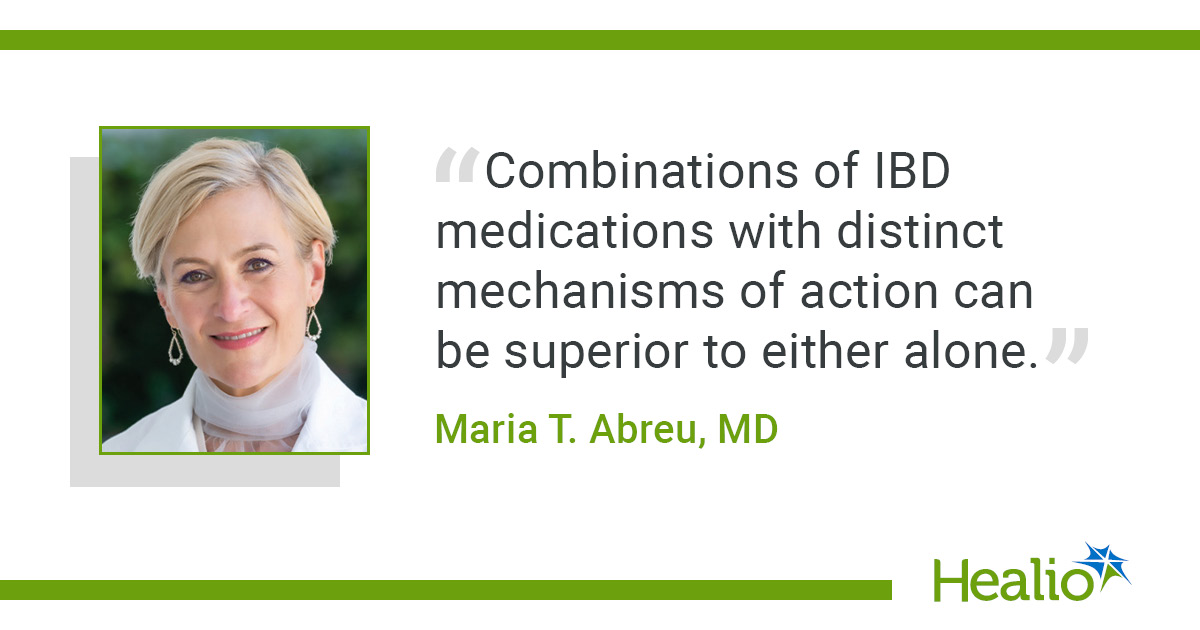
“Combinations of IBD medications with distinct mechanisms of action can be superior to either alone,” Abreu told Healio. “The impact appears to be greatest for those patients who have already been on more than two types of therapy.”
Both parallel trials are set to continue to phase 3 trials based on data, according to a press release on Sands’ and Abreu’s presentations.
“These results suggest the power of combination therapy after attempts at treatment with single agents fail,” said Sands .
For more information:
Maria T. Abreu, MD, can be reached at maria.abreu@cshs.org.
Bruce E. Sands, MD, MS, is Dr. Burrill B. Crohn Professor of Medicine at Icahn School of Medicine at Mount Sinai. He can be reached at bruce.sands@mssm.edu.
Sources/Disclosures
Source:
Sands BE, et al. Efficacy and safety of the first co-antibody therapy, JNJ-78934804, in patients with moderately to severely active Crohn’s disease refractory to systemic therapies. Presented at: Digestive Disease Week; May 2-5, 2026; Chicago.
Reference:
- Abreu MT, et al. Efficacy and safety of the first co-antibody therapy, JNJ-78934804, in patients with moderately to severely active ulcerative colitis refractory to systemic therapies. Presented at: Digestive Disease Week; May 2-5, 2026; Chicago.
Disclosures:
Healio was unable to confirm relevant financial disclosures at time of publication.

Ask a clinical question and tap into Healio AI’s knowledge base.
- PubMed, enrolling/recruiting trials, guidelines
- Clinical Guidance, Healio CME, FDA news
- Healio’s exclusive daily news coverage of clinical data