June 12, 2026
11 min read

As the presence of ambient AI scribes to record clinical encounters in the exam room grows increasingly common, experts continue to debate over whether this new technology will ultimately be a friend or foe to physicians.
“Ambient AI has the potential to bring about significant changes in what has become the elephant in the room for many physicians: the electronic health record,” Leonard H. Calabrese, DO, chief medical editor of Healio Rheumatology, professor of medicine at the Cleveland Clinic Lerner College of Medicine of Case Western Reserve University, and RJ Fasenmyer chair of clinical immunology at the Cleveland Clinic, said in an interview.

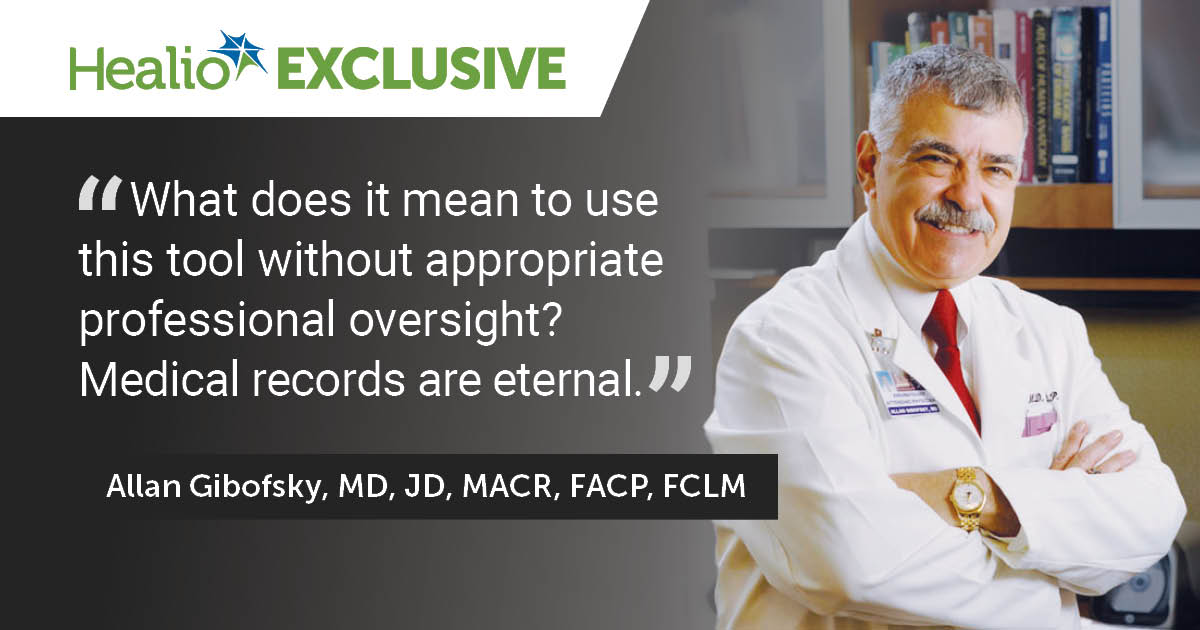
Image: Allan Gibofsky, MD, JD, MACR, FACP, FCLM
For example, ambient AI can listen to clinical encounters and minimize the time physicians spend on electronic health records, which experts have long cited as a source of bureaucracy-related burnout.
However, whether those changes are immediate or universally positive remains to be seen, according to Kenneth G. Saag, MD, MSc, professor of medicine in the division of clinical immunology and rheumatology at the University of Alabama, Birmingham.

Kenneth G. Saag
“Ambient AI has the potential to alleviate a pretty major challenge, which is that most of the clinical encounter is spent typing,” he said. “But we have to consider whether the AI scribe is capturing salient details and weeding out the chatter.”
According to Saag, an ambient AI tool could, in a perfect world, do exactly that and potentially bring back the kinds of doctor-patient encounters he recalls from a generation ago.
“It can allow us to look the patient in the eye and return to the interpersonal nature of a doctor visit,” he said. “The hope is that it is not creating more work by requiring a lot of editing.”
For Allan Gibofsky, MD, JD, MACR, FACP, FCLM, professor of medicine at Weill Cornell Medicine, and attending rheumatologist and co-director of the Clinic for Inflammatory Arthritis and Biologic Therapy at the Hospital for Special Surgery, the risk for introducing errors into the medical record should be top of mind for any physician.
“As with any new technology, we have to temper our enthusiasm for its utilization with caution of how it is going to be utilized,” he said. “For example, what does it mean to use this tool without appropriate professional oversight? Medical records are eternal. If there is an error in a patient’s chart, it gets carried forward and attempts to correct it are, at best, problematic. It is important that the same is not true for the documentation by AI scribes.”
Another potential concern is that employers may see the time-saving nature of these products and adjust employee expectations accordingly, said Grace C. Wright, MD, PhD, of Grace C. Wright MD PC.

Grace C. Wright
“Time is money, and if AI allows you to see patients more efficiently in less time, the patient load may be increased,” she told Healio. “I would prefer to have more issues dealt with in the clinical encounters, such as mental health, life impact and social connectedness, instead of just adding more patients. Undoubtedly, our patients would become healthier if we could spend the extra time managing their overall health.”
Additional concerns over the use of ambient AI in the exam room involve potential threats to patient privacy, and the question of when and how to acquire patient consent to use such technologies.
However, if these impediments can ever be overcome, the technology could fundamentally alter the way medicine is practiced, according to experts.
‘Redesign the choreography’
In a 2025 paper published in JAMA Network Open, Olson and colleagues surveyed 451 physicians who used an AI scribe in the clinic for 30 days to determine whether use of the technology saved them time and reduced burnout. Among the 272 physicians from multiple specialties who completed both the pre- and post-intervention surveys, results at 30 days showed that the proportion of respondents who reported experiencing burnout decreased significantly from 51.9% to 38.8% (OR = 0.26; 95% CI, 0.13-0.54).
Further results showed that use of an ambient AI scribe was associated with significant improvements on a 10-point scale in burnout (mean difference, 0.47 points; standard error, 0.12), note-related cognitive task load (mean difference, 2.64 points; standard error, 0.13), ability to provide undivided attention (mean difference, 2.05 points; standard error, 0.18), patient understandability of their care plans from reading the notes (mean difference, 0.44 points; standard error, 0.17), and time spent documenting after hours (mean difference, 0.90 hours; standard error, 0.19).
“This multicenter quality improvement study found that use of an ambient AI scribe platform was associated with a significant reduction in burnout, cognitive task load, and time spent documenting, as well as the perception that it could improve patient access to care and increase attention on patient concerns in an ambulatory environment,” the researchers wrote.
Although Calabrese said he is encouraged by such findings, he noted that simply having the tool is insufficient to reshape the clinical experience.

Leonard H. Calabrese
“This technology has the potential to redesign the choreography of the practitioner-patient dyad that has been with us for 20 years since we have been using the laptop and the EHR,” he said. “However, I have strong doubts that everyone who starts using ambient AI will be on a trajectory to optimize their practitioner-patient interaction spontaneously just because there is a device recording your voices.”
According to Calabrese, there is a perception that younger physicians will be more adaptable to the new technology. However, he suggested that practitioners of all ages could experience some discomfort in the way ambient AI reshapes the dynamic of the clinic.
“For older physicians who practiced before the introduction of the EMR, we assume that they, as a group, may be more accustomed and perhaps skilled to engage in more enriched dialogue with the patient, or what we nostalgically think of as the classic ‘art of medicine,’” Calabrese said. “As to whether this generation of clinicians will revert back to this form of communication, that remains to be seen.
“As for physicians younger than 40, I wonder if many have ever been free to fully develop their skills to interact with a patient empathically, as they have never been provided the freedom to clinically engage fully without the keyboard and computer between them,” he added.
According to Calabrese, AI scribes may offer a “newfound opportunity to exploit all aspects of nonverbal communication,” including being physically closer to the patients, being more fully observant of patients’ emotions, and being freer to use respectful touch as part of the encounter.
He added that the introduction of ambient AI scribes “provides an opportunity to teach or re-teach these skills in this new environment, but thus far I have seen little organized initiative to provide this.”
Saag, meanwhile, said he remains unconvinced that learning — or, for older physicians, relearning — empathic communication is the biggest challenge. Instead, he noted the challenges in using AI to aid in difficult diagnoses, or in clinical cases that demonstrate few good options.
“I am not certain there is a generation of physicians who never learned that type of communication,” he said. “I wonder what the role of AI will be in diagnostic reasoning, in working with patients to make decisions when not all of the choices are good.”
AI algorithms are improving each day in terms of diagnostic and therapeutic reasoning, according to Saag.
“But physicians will always need to be there to help make the final decision,” he said. “The machines will never take over in that regard.”
That said, such machines may be able to help with the work physicians do after the clinic is closed.
Reducing ‘pajama time’
Ambient AI scribes will not stop patients from emailing their doctors, according to Saag.
“The bigger problem is the back end, when the portal messages start to flood in at the end of your day,” he said, adding that many physicians refer to the hours spent on the computer answering these emails at home as “pajama time.”
“This is the real cause of burnout,” Saag said. “We have protracted email correspondences with our patients in an uncompensated way. This is a component of the technology that needs to be figured out. If we can use AI to reduce pajama time from 3 hours an evening to 45 minutes or an hour, it would be really useful.”
For Wright, this reduction in pajama time would not be just useful, but transformational.
“I cannot describe the elation I felt when I tried the AI tool and was suddenly unshackled from my nighttime computer ritual,” she said. “I was able to just talk with a patient, listen to and see their language, and then document that in my chart note.”
According to Saag, any permanent solution would involve finding a way to compensate physicians for time spent in the portal without discouraging patient use.
“You would rather hear about issues with the patient’s condition or medication than not, but if you charge too much for this, it disincentivizes people with lower economic means to communicate with their provider,” he said. “This will create more disparities in care.”
Still, the potential for ambient AI scribes to alleviate physicians’ clerical workload — and hence improve burnout symptoms — should not be underestimated, according to experts.
‘More than a time saver’
In a 2025 study published in NEJM AI, Lukac and colleagues assigned 238 outpatient physicians to use one of two clinical AI scribe products — Dragon Ambient eXperience (DAX) Copilot or Nabla — or usual care. The aim was to determine any change from baseline in time-in-note, along with parameters of physician task load, fulfillment, work exhaustion and stress.
Results showed that Nabla yielded a decrease in time-in-note of nearly 10% vs. controls, while DAX failed to reduce this time compared with controls. Both AI tools were associated with improvements in burnout, task load and work exhaustion, according to the findings.
“These secondary end point findings need confirmation in larger, multicenter trials,” the researchers concluded, adding that occasional inaccuracies of the scribe require vigilance on the part of the clinician.
According to Wright, such results emphasize that AI scribes may represent “more than a time saver” for physicians.
“Since you can capture a word-for-word or summarized version of the conversation, you find things you missed, forgot to capture or did not realize you dealt with,” she said. “However, you do have to read and edit the note. Not everything should be recorded.”
This raises the question of whether having a complete transcript available from an AI scribe may lead to having too much — or rather, a glut of potentially unnecessary or superfluous — information. This could be especially true in rheumatology, where many patients may offer myriad and combinatory complaints.
Calabrese offered a potential solution.
“At the end of each visit, I write a short note, maybe two or three sentences, that summarize my thoughts on the patient for that day, and place it at the top of my note and label it as ‘My thoughts on this encounter,’” he said. “I then compare it to what the AI scribe captured. Of course, some patients will talk about a hundred issues during the visit, and I have found that AI does a pretty good job of triaging the primary complaints or concerns that I addressed in my note.”
AI transcripts or summaries of visits also require a care eye and close review to catch misspellings, “hallucinations” and other erroneous artifacts, according to the experts who spoke with Healio. Future iterations of ambient AI devices may address these glitches, but even in the here and now, such issues have not slowed uptake in the clinic.
‘None of this is currently regulated’
In a study published in The American Journal of Managed Care in January, Yang and Graetz aimed to estimate the prevalence of ambient AI scribes among U.S. hospitals that use the Epic electronic health record system.
Results showed that among 2,784 health systems that use the Epic record, 62.6% also used ambient AI technology. The tool was used more commonly in systems with higher workloads and in metropolitan vs. non-metropolitan hospitals. In addition, nonprofit hospitals were more likely to use ambient AI scribes than for-profit hospitals.
“These patterns suggest potential for uneven diffusion across hospitals and underscore the need for research on impacts on clinician outcomes, care quality, and equity,” Yang and Graetz wrote.
According to Gibofsky, the elevated use of AI in high-workload environments highlights one potential consequence of uptake, which is that employers may demand more of health care professionals.
“Squeezing more productivity is always a concern in this world of increasing corporatization of medical practices,” he said. “Physicians are becoming employees rather than professionals. This is something we are going to have to look at very carefully: if having an AI scribe in our clinics leads to us being told we should be seeing five patients an hour instead of four.”
Another potential concern about ambient AI, particularly in light of its increasing prevalence, pertains to the security and storage of patient data.
On the one hand, Calabrese noted the proliferation of personal data that already exists across online health platforms and private health care corporations.
“I have minimal concerns about privacy and security in this new setting,” Calabrese said. “Everything is already online. We live in a public world. CVS has your data.”
On the other hand, Gibofsky raised the question of exactly where AI-derived notes will ultimately reside, and who will have access to them.
“This is protected health information,” he said. “Will it be part of the EHR, or will there be new platforms created specifically for this purpose? Also, who will have access to that information, and how? Ultimately, the physician is going to be responsible for this information, and none of this is currently regulated by any governing body like the FDA.”
Saag, who said he largely agrees with Calabrese, suggested that addressing some of the privacy concerns patients may have will ultimately be necessary for the technology to reach its full potential.
“We are going to have to overcome some of those privacy concerns if we are going to get where we need to go with this new technology,” he said.
Gibofsky added that the question of how AI notes are stored and used has consequences that go beyond patient care.
“Remember that medical records exist more for billing purposes than to capture information about a patient,” he said. “What our employers may do is comb through the AI-scriven notes to find the highest level of billing possible.”
This, again, raises the issue of health equity.
“The precursor to the ICD code was the DRG code, or Diagnosis Related Group,” Gibofsky said. “When the term was first used, we joked that it stood for, ‘Da Revenue’s Gone.’”
The issue, according to Gibofsky, is that some patients may be billed for diagnoses that an AI scribe recorded, but that the physician does not necessarily need to treat. If patients are being billed for conditions that are not being addressed, it may discourage them from seeing their doctor, he said.
Another concern — with potentially legal ramifications — pertains to patient consent, according to Gibofsky.
“If I am doing a telehealth visit and using AI capture technology, I have to check the consent laws in the state where the patient is physically located,” he said.
Some states require the consent of just one party to record a conversation, while in others both parties must consent.
“This is not currently appreciated by everyone using ambient AI,” Gibofsky said. “Making sure to have consent of the patient may be overlooked in the zeal to adopt AI transcription tools.”
‘Friend in the exam room’ or ‘sleep with one eye open’
For all the above reasons, Gibofsky said he will step lightly into the ambient AI arena.
“As previously noted, our zeal needs to be tempered with caution,” he said. “I share the enthusiasm for having it available to use, but for the time being I will sleep with one eye open knowing that at the end of the day, I am fully responsible for the accuracy of the note and the decisions made for my patients as a result of the information collected and summarized.”
Despite the concerns, experts like Wright said they remain optimistic that AI will ultimately benefit clinicians.
“Though I am still careful when collecting data using AI as the tool, I have come to regard it as a friend in the exam room, especially when it helps me scribe my notes, or take an accurate deep date data dive,” she said. “Sometimes new is better when we use the tool instead of being used by it.”
For more information:
Leonard H. Calabrese, DO, can be reached at CALABRL@ccf.org.
Allan Gibofsky, MD, JD, MACR, FACP, FCLM, can be reached at GibofskyA@HSS.EDU.
Kenneth G. Saag, MD, MSc, can be reached at ksaag@uabmc.edu or nmledwon@uabmc.edu.
Grace C. Wright, MD, PhD, can be reached at gcwright.md@gmail.com.
Sources/Disclosures
References:
Lukac PJ, et al. NEJM AI. 2025;doi:10.1056/AIoa2501000.
Olson KD, et al. JAMA Netw Open. 2025;doi:10.1001/jamanetworkopen.2025.34976.
Yang F, Graetz I. Am J Managed Care. 2026;doi:10.37765/ajmc.2026.89876.
Disclosures:
Calabrese reports being a medical advisor for OpenEvidence, as well as professional relationships with AbbVie, AstraZeneca, Bristol Myers Squibb, Galvani, Genentech, GlaxoSmithKline, Janssen, Novartis, Regeneron, Sanofi and UCB. Gibofsky reports owning stock in AbbVie, Amgen, Johnson & Johnson, Pfizer and Regeneron; receiving consulting fees from Pfizer and UCB; receiving speaking fees from AbbVie, UCB and Pfizer; and being a special government employee with the FDA. Saag and Wright report no relevant financial disclosures.

Ask a clinical question and tap into Healio AI’s knowledge base.
- PubMed, enrolling/recruiting trials, guidelines
- Clinical Guidance, Healio CME, FDA news
- Healio’s exclusive daily news coverage of clinical data