
Key takeaways:
- A U.S. district judge voided an H-1B visa fee instituted in the fall.
- The fee would negatively affect the U.S. physician workforce, labor groups said.
- A bill before Congress would exempt health care workers.
A federal judge voided a policy instituted by presidential proclamation last fall that raised the application fee for new H-1B visas to $100,000.
As Healio previously reported, the H-1B visa program allows employers to temporarily hire foreign workers in certain occupations that require specialized knowledge, including certain international medical graduates. Nearly 250,000 international medical graduates worked in the United States in 2023, making up 24.7% of the total U.S. physician workforce. The fee increase was predicted to have large and lasting negative effects on the U.S. physician workforce, according to the AMA and medical specialty groups.

In summary judgment in California v. Mullin, the judge ruled the fee increase violated the Administrative Procedure Act by imposing a tax that can be authorized only by Congress. The suit was brought in the U.S. District Court for the District of Massachusetts, but because the ruling was based on federal law, it applies nationwide, according to Linda Gemind, an immigration attorney at Benesch in Cleveland.
“Although it’s likely not the end of the matter, the ruling should take us back to pre-implementation of the $100,000 fee — for now,” Gemind told Healio. “At this point it should be the standard fee, which is generally $3,380 ($780 filing fee, $1,500 [American Competitiveness and Workforce Improvement Act] fee, $500 fraud fee, $600 asylum fee) for most petitions.”
The AMA praised the ruling.
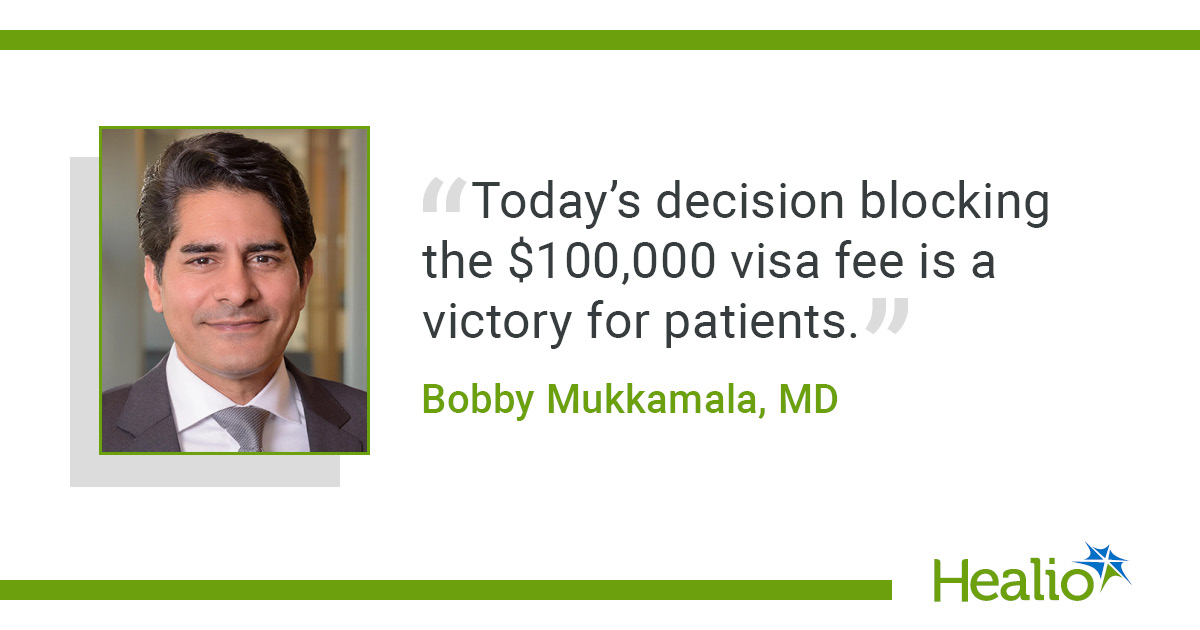
“Today’s decision blocking the $100,000 visa fee is a victory for patients,” AMA President Bobby Mukkamala, MD, said in a press release. “At a time when communities across the country face physician shortages and growing barriers to care, we should be removing obstacles — not creating new ones — to attract talented physicians and other highly skilled professionals. International medical graduates play a vital role in caring for patients, particularly in underserved and rural areas.”
The Trump administration will likely appeal the ruling in the U.S. Court of Appeals for the First Circuit or the U.S. Supreme Court, if it can establish jurisdiction, Gemind said. A judge could stay the decision until after the appeals process, but that has not happened so far.
If the ruling ultimately stands, employers who have already paid the increased fee will likely seek refunds and those who chose not to apply for a visa because of the fee will also likely litigate, according to Gemind.
In addition to legal challenges to the fee increase, a bipartisan group introduced a bill — H.R. 7961 — in the U.S. House of Representatives in March, which would exempt health care workers.
For more information:
Linda Gemind can be reached at lgemind@beneschlaw.com.
Sources/Disclosures
Source:
Healio Interviews
References:
- AAMC U.S. Physician Workforce Data Dashboard. https://www.aamc.org/data-reports/report/us-physician-workforce-data-dashboard. Accessed June 10, 2026.
- AMA applauds court decision blocking $100,000 visa fee for physicians. https://www.ama-assn.org/press-center/ama-press-releases/ama-applauds-court-decision-blocking-100000-visa-fee-physicians. Published June 8, 2026. Accessed June 9, 2026.
- H. R. 7961. https://www.congress.gov/119/bills/hr7961/BILLS-119hr7961ih.pdf. Published March 17, 2026. Accessed June 10, 2026.
- National Center for Health Workforce Analysis. Physician Workforce: Projections, 2023-2038. https://bhw.hrsa.gov/sites/default/files/bureau-health-workforce/data-research/physicians-projections-factsheet.pdf. Published December 2025. Accessed June 10, 2026.
- Memorandum and order on plaintiffs’ motion for summary judgment (doc. no. 86) and defendants’ cross-motion for summary judgment and motion to dismiss (doc. no. 92). https://storage.courtlistener.com/recap/gov.uscourts.mad.293201/gov.uscourts.mad.293201.106.0.pdf. Published June 8, 2026. Accessed June 9, 2026.
Disclosures:
Gemind reports no relevant financial disclosures.

Ask a clinical question and tap into Healio AI’s knowledge base.
- PubMed, enrolling/recruiting trials, guidelines
- Clinical Guidance, Healio CME, FDA news
- Healio’s exclusive daily news coverage of clinical data