
Key takeaways:
- Global Fatty Liver Day, an annual public education and awareness campaign, is observed June 11, 2026.
- A plethora of new and emerging treatments may change the trajectory of care for fatty liver disease.
When Jerry Rosenberg boarded a cruise to Bermuda in April 2017, he was not expecting to return to the U.S. in an air ambulance a few days later.
He spent the rest of the month in an induced coma before receiving a liver transplant.

Unaware he had metabolic dysfunction-associated steatotic liver disease, an acute episode of hepatitis A — brought about by eating contaminated food — left Rosenberg in critical condition.

Jerry Rosenberg
“When I was very young, I’d had the [HAV] vaccine, but it was an old vaccine that should have been redone,” Rosenberg told Healio.
Rosenberg is not alone. An estimated 1.3 billion people worldwide live with MASLD, according to a global health study in The Lancet Gastroenterology & Hepatology.
The road to recovery was not easy. Rosenberg went through transplant rejection twice within 2 years and was prescribed heavy doses of steroids.
During this period, Rosenberg became concerned with his weight gain and increased appetite. He reached out to Andrew P. Keaveny, MD, his transplant hepatologist at Mayo Clinic.
“Weight gain is very common posttransplant,” Keaveny said. “Patients can experience recurrent fatty liver or develop fatty liver in their new liver.”
Initially, Keaveny recommended Rosenberg start taking Mounjaro (tirzepatide, Eli Lilly & Co.), a dual glucose-dependent insulinotropic polypeptide/GLP-1 receptor agonist prescribed off-label for weight loss, but it was not covered by Rosenberg’s insurance. Instead, he began Ozempic (semaglutide, Novo Nordisk), which was.
“When I had my once-a-year major checkup on the 9th anniversary of my liver transplant, I was given the news that after 3 years on Ozempic and trying to eat better, I have 0% fat on my liver,” Rosenberg said.
Keaveny told Healio that while the dangers of fatty liver disease were appreciated from a hepatology perspective, there were not many treatment options available until recently.
“That’s why it’s important to get the message out to [clinicians] to assess patients for fatty liver disease,” Keaveny said. “Previously the pushback was, what can you do about it? Everybody tries to lose weight and they’re not successful. But I think we’ve had a sea change in our approach to identifying and managing MASLD.”
Rosenberg is now an advocate for organ donation and patients with fatty liver disease. Healio spoke with Rosenberg and Keaveny in recognition of Global Fatty Liver Day, an awareness campaign recognized annually on the second Thursday of June.
Future of care
There is an increasing burden of fatty liver disease among younger patients, especially younger males, Keaveny said, citing recent research.
It will be important to determine the predominant factors contributing to the condition in this population and others, according to Keaveny.
“We need to do more studies to better understand what the dominant player is from an epidemiologic point of view,” Keaveny said. “What are the interactions between disordered metabolism and alcohol.”
Emerging therapies, like fibroblast growth factor 21 (FGF-21) analogues, may help alleviate the burden of fatty liver disease by regulating key metabolic pathways to reverse liver fibrosis.
Several FGF-21 analogues are now in phase 3 study, including efimosfermin (GSK).
“These are very promising as antifibrotic medications, even in patients who have very advanced disease,” Keaveny said. “Currently the treatments that are approved, both resmetirom (Rezdiffra, Madrigal Pharmaceuticals) and Wegovy (semaglutide, Novo Nordisk), are approved for patients who have moderate to severe disease, but not established cirrhosis.”
“In the future, there will be multiple medications available, so figuring out sequential therapy and combination therapy is going to be very important, but I think we’re going to have compounds able to address the underlying fibrotic process,” he added.
Keaveny also highlighted the significance of preventative medicine in tackling fatty liver disease, especially in light of Rosenberg’s case.
“I recommend vaccination against HAV and hepatitis B to all my patients with any form of fatty liver disease, but HAV especially, because that’s one you can just pick up from contaminated food,” Keaveny said.
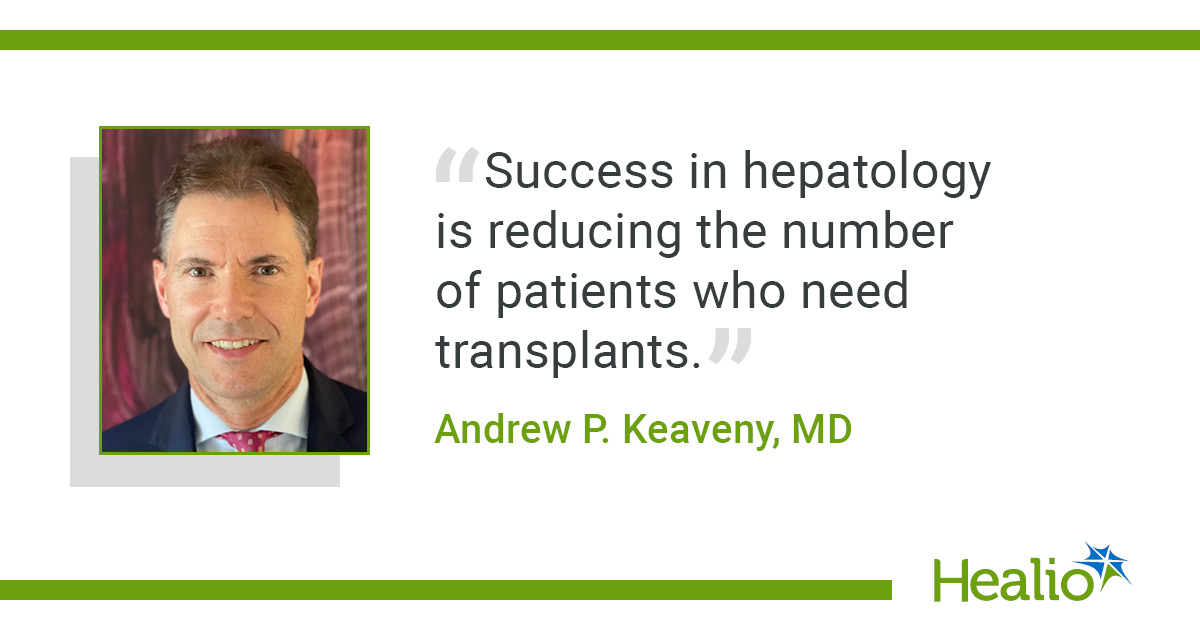
Keaveny is optimistic that these new treatments will reduce the need for liver transplant. “Success in hepatology is reducing the number of patients who need liver transplantations, because if you look at the status of the epidemiology, we’re not going to be able to meet the demand for organs for patients with complications from this condition,” he said.
A message for clinicians
Screening patients for fatty liver disease — particularly those with type 2 diabetes or a family history of liver disease — is crucial, according to Keaveny.
When a patient is diagnosed with fatty liver disease, it is also important to address comorbidities that may be present, he emphasized.
“Mild fatty liver disease is a marker of metabolic stress, so it’s very important that individuals with the condition be counseled about their blood pressure, blood sugar and weight as well, to address cardiovascular risk factors,” Keaveny said.
Clinicians can connect patients with internet resources to learn more about lifestyle interventions to address fatty liver disease. Keaveny recommends online patient education materials from the American Diabetic Association, American Liver Foundation and Mayo Clinic.
He also recommends that clinicians connect patients with dietitians.
“Behaviors change gradually, and ongoing support, encouragement and feedback are critical,” Keaveny said.
Rosenberg highlighted the “beauty” of support groups for patients. After his transplant, Rosenberg became a member of Mayo Clinic’s Second Chance support group for individuals who have had liver, kidney or pancreas transplantation.
“Those of us that have had successful transplants need to be there as a support for people waiting or those that may not have done as great,” Rosenberg said.
“We need to lift each other up,” he added.
For more information:
Andrew P. Keaveny, MD, can be reached at keaveny.andrew@mayo.edu.
Jerry Rosenberg can be reached at funjerry@aol.com.
Sources/Disclosures
Source:
Healio Interviews
References:
Disclosures:
Keaveny and Rosenberg report no relevant financial disclosures.

Ask a clinical question and tap into Healio AI’s knowledge base.
- PubMed, enrolling/recruiting trials, guidelines
- Clinical Guidance, Healio CME, FDA news
- Healio’s exclusive daily news coverage of clinical data