

Key takeaways:
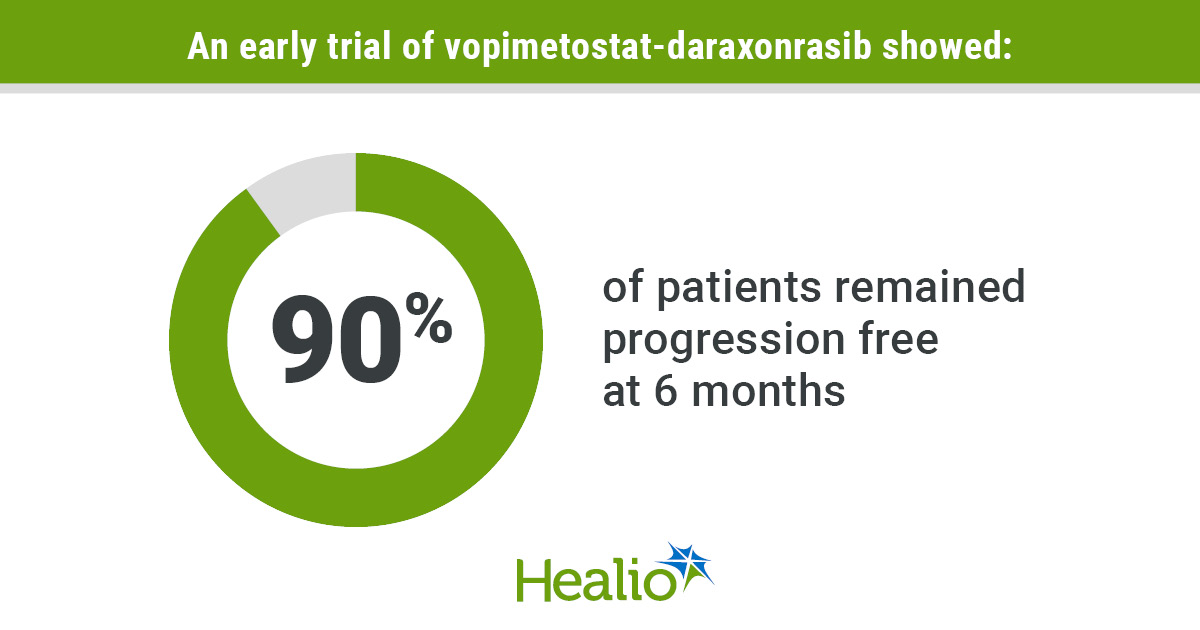
- 92% of patients responded to second- or third-line treatment with vopimetostat and daraxonrasib, and 90% remained progression free at 6 months.
- The combination will be advanced into phase 3 development.
A two-drug combination exhibited durable clinical benefit as second- or third-line treatment for pancreatic cancer, according to a topline data announcement released by one of the agent’s manufacturers.
A vast majority of patients with methylthioadenosine phosphorylase (MTAP)-deleted and RAS-mutant metastatic pancreatic ductal adenocarcinoma (PDAC) responded to treatment with vopimetostat (TNG-462, Tango Therapeutics) and daraxonrasib (RMC-6236, Revolution Medicines), results showed. Most remained progression free at 6 months.

The “extremely encouraging early results” support advancing the combination into late-stage development for this patient population, Malte Peters, MD, CEO of Tango Therapeutics, said in a company-issued press release.
The design of a randomized phase 3 trial to assess the combination as first-line treatment for MTAP-deleted pancreatic cancer is expected to be finalized in the second half of this year, according to the release.
Vopimetostat is an oral PRMT5 inhibitor that targets cancers with MTAP deletions, which occur in up to 15% of cancers and are present in approximately 40% of pancreatic cancers.
Daraxonrasib is an oral pan-RAS inhibitor. RAS mutations — found in more than 90% of pancreatic cancers — have long been known to be a driver of disease development and progression. No RAS-targeting therapies are approved for pancreatic cancer.
Results of the randomized phase 3 RASolute 302 trial — presented at ASCO Annual Meeting — showed daraxonrasib doubled OS and PFS and tripled objective response compared with chemotherapy for patients with previously treated metastatic PDAC, establishing it as a new standard in this setting. Regulatory approval is expected later this year.
A phase 1/phase 2 trial evaluated two combinations for patients with MTAP-deleted and RAS-mutant metastatic PDAC or non-small cell lung cancer, another malignancy in which RAS mutations are common.
As of late May, 20 patients with PDAC — 70% of whom had liver metastases — and five with NSCLC had received 200 mg or 250 mg once-daily vopimetostat in combination with 100 mg daraxonrasib daily.
At data cutoff, 12 patients with PDAC and three with NSCLC had at least 14 weeks of follow-up and could be evaluated for response.
Eleven of 12 (92%) patients with PDAC achieved objective response — with nine responses confirmed — and 90% of patients remained progression free at 6 months. Researchers reported a 100% disease control rate.
All three patients with NSCLC achieved confirmed responses.
The results support preclinical data that showed “synergistic activity” of joint PRMT5/RAS inhibition, Peters said.
Brian M. Wolpin, MD, MPH, who presented the RASolute 302 findings during ASCO’s plenary session, said the phase 1/phase 2 data of the vopimetostat-daraxonrasib combination build on “the monotherapy activity” the investigational agents previously showed.
“Pancreatic cancer remains a largely intractable disease and an area where patients desperately need new therapies,” Wolpin, director of Hale Family Center for Pancreatic Cancer Research at Dana-Farber Cancer Institute, said in the release. “In the front-line setting, chemotherapy has long been the standard of care, yet it presents significant tolerability challenges and overall limited efficacy against this aggressive disease. … These early combination data demonstrated the potential to meaningfully reshape how we treat this disease with a precision-guided, chemotherapy-free approach.”
The Tango Therapeutics press release described the vopimetostat-daraxonrasib combination as “generally well tolerated” across dose levels, with most adverse events being grade 1 or grade 2. The most common treatment-related adverse events included rash, stomatitis/mucositis and diarrhea.
Two patients assigned the higher vopimetostat dose experienced dose-limiting toxicities. One developed grade 3 rash. The other developed grade 3 stomatitis and fatigue.
No patients discontinued the combination due to adverse events, and no treatment-related grade 4 or grade 5 adverse events occurred.

Ask a clinical question and tap into Healio AI’s knowledge base.
- PubMed, enrolling/recruiting trials, guidelines
- Clinical Guidance, Healio CME, FDA news
- Healio’s exclusive daily news coverage of clinical data