
Key takeaways:
- Patients in an automated text messaging cohort returned FIT kits for CRC screening more often than those in a phone call cohort.
- Researchers noted no differences by age, sex, race or ethnicity.
A text message reminder-based strategy significantly improved colorectal cancer screening rates among adults in underserved communities, compared with nurse-led telephone call outreach, according to study results.
Findings from a quality-improvement randomized trial showed that automated messaging may be a more effective and lower cost strategy to increase fecal immunochemical test (FIT) completion.

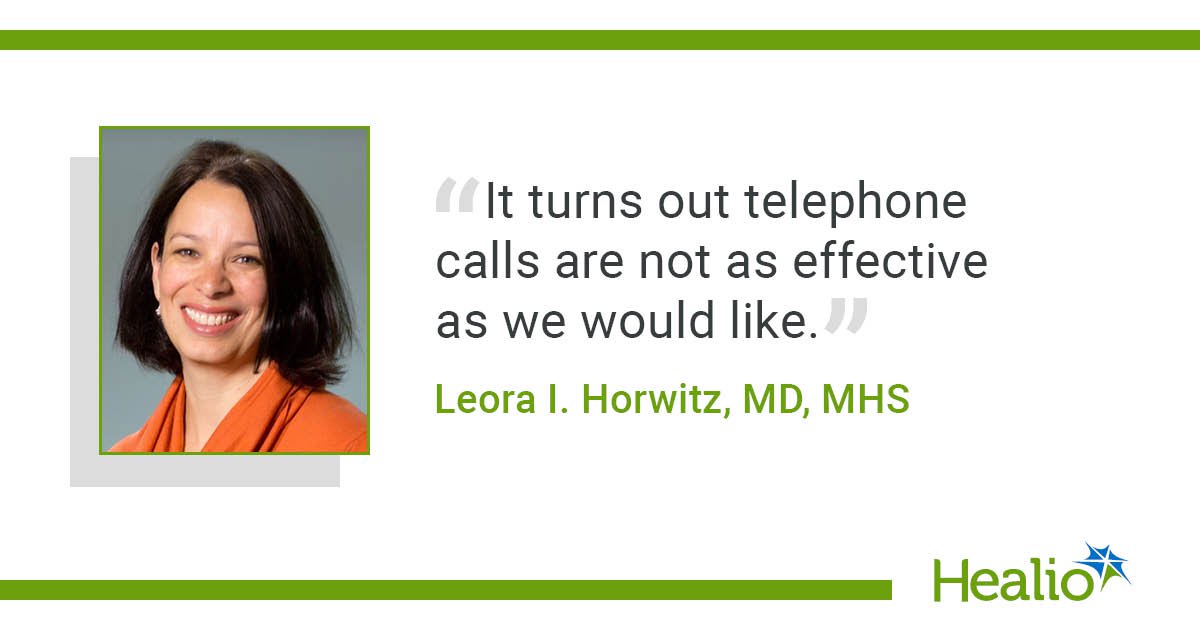
“This is really a universal phenomenon we are seeing with this switch from phone calls to text communication,” Leora I. Horwitz, MD, MHS, director of the division of healthcare delivery science and professor of population health at NYU Grossman School of Medicine, told Healio. “The world is changing and some people avoid picking up the phone from unrecognized numbers, or even recognized numbers sometimes. It turns out telephone calls are not as effective as we would like.”
The study, conducted at eight federally qualified health centers in Brooklyn, New York, assessed FIT completion rates within 21 days of a patient’s test order. Participants were divided into two cohorts: one assigned to receive three automated text message reminders (n = 649; 64.4% women; mean age, 56.4 years) and the other assigned to receive a single nurse-led telephone call reminder (n = 626; 63.6% women; mean age, 56.7 years).
Patients in the text cohort received FIT completion reminders on days 2, 5 and 8, whereas those in the telephone group received a single phone call reminder on day 8.
Participants had designated English, Spanish or Chinese as their preferred language and had not opted out of receiving texts.
Data showed significantly higher FIT completion in the text cohort (58.9% vs. 49.8%), with an absolute difference of 9 percentage points (95% CI, 3.6-14.5).
The researchers observed no differences between groups by age, sex, race/ethnicity, or patient portal use.
Healio spoke with Horwitz about the use of automated text messaging to improve patient outreach, the evolution of health care system communication and other projects.
Healio: Colorectal cancer rates are rising at an alarming rate. How important is it to identify strategies like this that could increase screening for patients in underserved populations?
Horwitz: Colorectal cancer in general is one of the least well-screened for cancers, and yet, the most treatable and preventable. Most screening is meh, frankly. I encourage it, but it is not great. But colorectal cancer screening is actually one of the few that really works, because you can remove polyps entirely when you find them.
Colonoscopies are cancer-reducing and life-improving, but the procedure is not done nearly often enough, particularly for people in underserved populations. CRC screening with colonoscopy is expensive and intrusive. Patients have to take the day off, somebody has to go with them, they have to manage the prep. It can be a hassle.
That’s why FIT is a commonly used alternative — particularly in under-resourced areas — because you can avoid colonoscopy in patients whose results come back negative.
Healio: Nearly 60% of patients in the text group completed FIT screening within 21 days, outperforming the phone call group by 9 percentage points. Did that result surprise you and should it prompt health systems to rethink how much staff time is dedicated to traditional outreach?
Horwitz: We were pretty surprised for all kinds of reasons. For starters, we generally assume that a personalized conversation between two human beings is desirable and effective. That is the gold standard that we measure against. Conversely, texting can feel less personal or less helpful.
It is entirely possible that the phone call was great for the people who answered the phone. What we saw in this study is very typical in that we could only reach about half the people. Some of that is because people are just busy and some people don’t like to answer the phone.
On the other hand, 95% of people got the text message.
We designed the text message with a lot of behavioral science; we had a deadline and there was some social pressure of saying, ‘Your doctor is waiting.’ We had multiple reminders in the text cohort, which was great because we barely had the capacity to call everyone once, let alone two or three times. But we could send out three text messages easily.
I grew up without a cell phone, but my kids grew up only with cell phones and texting. They find it almost intrusive and weird to have someone call them on the phone. It’s just culturally strange for them. Of course, they’re not the population we’re trying to reach with this. We’re trying to reach people like me who didn’t grow up with cell phones, but that will change over time.
Healio: What does this say about how patients want to engage with health systems in 2026?
Horwitz: I think it’s a good signal for us and we should learn from that. This was a project done with a pretty big group and some of our clinical staff were quite worried that our non-English speaking, older or immigrant populations might not respond well. So, we predefined subgroups to look at and found no differences at all.
We want to make sure that things are equally effective in different groups, and, when they’re not, we have to change our behavior accordingly. We did our best to make sure of that. We sent messages in Mandarin to our Chinese-speaking patients and we sent messages in Spanish to our Spanish-speaking patients, which is another reason phone calls are hard — you need someone who can speak all those languages.
It’s easy to translate text messages. We were attentive to that, and having been attentive, we found that method was perfectly effective.
Healio: How scalable can this approach be for other health systems, particularly larger ones, and what potential barriers do you foresee that could make implementation difficult?
Horwitz: This is the most scalable thing there is. This process is so easy. Every health system has texting capabilities now — they send appointment reminders, directions and so on.
This was a quality-improvement project that we designed to be studied. After we discovered it was effective, we turned it on for everybody. We stopped making phone calls, except of course for patients who don’t text or who speak languages other than Chinese or Spanish. Texting follow-up is the standard practice for us now.
In our health system, and I imagine it’s the same for others, you have to opt-in to text messaging. So for patients who don’t want to be texted, we still call them. In our study, about 95% of patients received the texts, so that means for about 5% of patients, maybe we have the wrong number or they ran out of minutes for the month or something else.
There are operational challenges, but they are easier than having correct phone numbers or getting people to answer the phone.
Healio: Is there potential to build off this text-based approach? Or do you think its simplicity is what made it so effective?
Horwitz: Of course we were extremely pleased with results of our study, but still, only about 60% of patients returned the FIT. Right now, we’re about to launch a project for that other 40% who didn’t return a sample after 21 days. Maybe we should preemptively send them another kit or send them a different kind of message.
We did the easiest possible thing with the texts being unidirectional. We sent out the kit, we sent the messages and there was a phone number you could call if you lost the kit.
My colleagues are running several other projects that are far more sophisticated, trying to engage patients in repeated activities like medication adherence, exercise, diet, rehabilitation — things where you want to build a long-term relationship. We have AI bots being tested for those sorts of things.
The way the world is going, it will include much more AI interaction, but for now, this simple approach worked well for us.
For more information:
Leora I. Horwitz, MD, MHS, can be reached at leora.horwitz@nyulangone.org.

Ask a clinical question and tap into Healio AI’s knowledge base.
- PubMed, enrolling/recruiting trials, guidelines
- Clinical Guidance, Healio CME, FDA news
- Healio’s exclusive daily news coverage of clinical data