

Key takeaways:
- GLP-1 use was associated with reduced hepatic complications in MASLD and type 2 diabetes.
- Reductions in hepatic complications were observed across FIB-4 and BMI groups among patients with MASLD.
Use of GLP-1s was associated with significantly reduced risk for hepatic complications among patients with metabolic dysfunction-associated steatotic liver disease and type 2 diabetes, according to data.
The observational study, published in The American Journal of Gastroenterology, showed that the reduction was prompted by fewer cases of incident cirrhosis. Researchers also found that GLP-1s may have a greater disease-modifying potential earlier in the fibrosis trajectory, before advanced fibrosis is established.

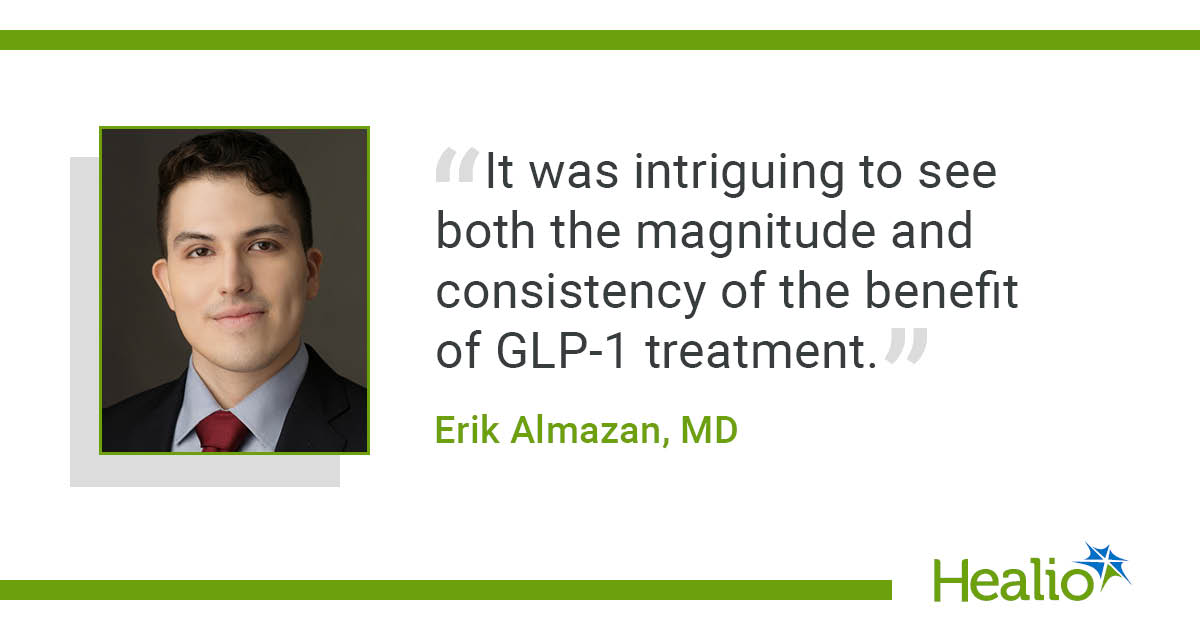
“It was intriguing to see both the magnitude and consistency of the benefit of GLP-1 treatment,” lead author Erik Almazan, MD, resident physician at Brigham and Women’s Hospital, told Healio. “We observed a 38% lower risk of hepatic complications in intention-to-treat analysis and a 42% lower risk in per-protocol analysis.
“These findings suggest an exposure-response pattern consistent with a real biological effect with greater benefit observed during active treatment,” he added.
All of Us: GLP-1s, liver outcomes in MASLD
Almazan and colleagues used NIH’s All of Us dataset — a nationwide, sociodemographically diverse cohort — to examine long-term, real-world outcomes among individuals with MASLD and type 2 diabetes using GLP-1s compared with a propensity score-matched control group.
The retrospective cohort study included 2,110 individuals (mean age, 55.8 years) on semaglutide (Wegovy, Novo Nordisk), liraglutide (Victoza/Saxenda, Novo Nordisk), dulaglutide (Trulicity, Eli Lilly & Co.), exenatide, albiglutide, lixisenatide (Adlyxin, Sanofi) or tirzepatide (Mounjaro; Zepbound, Eli Lilly & Co.).
They were matched with 2,110 nonusers (mean age, 56.9 years). All individuals were 18 years and older, and the majority were women and white.
Data were collected from electronic health records, participant provided information and survey results from 2018 to 2023. Two analyses were conducted: an intention-to-treat analysis and per-protocol analysis. Subgroup analyses also looked at BMI and fibrosis-4 (FIB-4) scores (mean, 1.06 and 1.1).
Median follow-up was 2.7 years.
Individuals who had experienced hepatic complications, including prior cirrhosis, or other chronic liver diseases, were excluded. Other reasons for exclusion included prior exposure to GLP-1s, GLP-1 use less than 30 days, starting GLP-1s before MASLD diagnosis, no follow-up or having high risk FIB-4 scores (> 2.67).
The primary outcome was a composite of hepatic complications, including incident cirrhosis, hepatocellular carcinoma, decompensation events and liver transplantation.
Consistent liver benefit with GLP-1s
Overall, 187 patients experienced hepatic complications in the intention-to-treat analysis. Of those, 74 events happened in GLP-1 users (95% CI, 10.59-16.94) and 113 happened in nonusers (95% CI, 18.02-26.29), corresponding to a 38% lower relative risk for hepatic complications among users (HR = 0.62; 95% CI, 0.46-0.83).
Results were similar in the per-protocol analysis. GLP-1 users experienced 56 events (95% CI, 9.78-16.81) and the nonuser group had 113 (95% CI, 18.02-26.29), representing a 42% lower relative risk for complications among those using a GLP-1 medication (HR = 0.58; 95% CI, 0.42-0.8).
“This complements data from randomized controlled trials that demonstrated histological benefits with GLP-1 receptor agonists but did not follow patients long enough to evaluate for clinical endpoints,” Almazan said. “Our findings extend those results to a more generalizable population.”
Compared with non-users, GLP-1 users reported sustained reductions in BMI and body weight over 5 years. The researchers noted that, on average, BMI declined by about 1 to 2 kg/m² while body weight decreased by approximately 3 to 8 kg. Additionally, GLP-1 use was associated with lower hazard estimates in the low FIB-4 group in both analyses, which has implications for “how aggressively” clinicians can identify and treat metabolic dysfunction in MASLD and type 2 diabetes, Almazan said.
“The consistency of our findings where there was a directional benefit across FIB-4 strata and BMI categories also suggests that the hepatoprotective benefit of GLP-1 receptor agonists is not confined to a subset of patients and is likely applicable across the MASLD population, with the caveat that our study did not account specifically for participants with lean MASLD,” Almazan said.
Limitations noted in the study included limited follow-up, whether benefits continue with time or affect rates of outcomes such as HCC or liver transplant, and if the use of ICD codes instead of imaging or histology to assess fibrosis strata impacted results.
In addition, because the All of Us Research Program includes volunteer participants, it has its “own selection and surveillance bias considerations,” Almazan said. He added that the program itself was worth highlighting:
“All of Us deliberately aims to include racial and ethnic minorities as well as lower-income participants, demographic profiles that closely mirror the patients at highest risk for MASLD-related complications, and that are also often underrepresented in medical research including RCTs,” he said. “We believe that demonstrating a benefit that holds after propensity score matching on socioeconomic variables is a meaningful addition to the existing literature.”
For more information:
Erik Almazan, MD, can be reached at ealmazan@mgh.harvard.edu.

Ask a clinical question and tap into Healio AI’s knowledge base.
- PubMed, enrolling/recruiting trials, guidelines
- Clinical Guidance, Healio CME, FDA news
- Healio’s exclusive daily news coverage of clinical data