
Key takeaways:
- Drug shortages are lasting longer than ever, with the average duration now reaching 5.3 years.
- The number of product discontinuations last year was higher than any year since 2019.
Persistent and prolonged drug shortages across the country are affecting delivery of care across well over 100 therapeutic areas, according to a new report.
Shortages are lasting longer than ever, with the average duration now exceeding 5 years, the analysis from United States Pharmacopeia (USP) showed.

Data derived from 2025 USP Annual Drug Shortages Report.
“That is pretty startling, and it shows that these aren’t one-off, acute shortage events. These are chronic, systemic shortages, indicating there are significant problems with the supply chain,” Matt Christian, director of supply chain insights at USP, told Healio.
The number of drugs in shortage at the end of 2025 declined by 23% from the previous year, the report showed. However, that statistic may be misleading, Christian said.
Product discontinuations are more common today than at any point since 2019, according to the report. This suggests “a lack of resilience” in the supply chain, and many of the drugs once classified as being in shortage may simply have been reclassified in the discontinued category, Christian said.
The report also highlights how geographic concentration could make the supply chain vulnerable to even small disruptions.
Concerning trends
Drug shortages across medical specialties have been common for years. In oncology, a shortage of the generic chemotherapy drugs cisplatin and carboplatin that began in 2023 led to an absolute reduction in use of more than 15%.
Manufacturing complexity, low prices — which result in slim margins for manufacturers — and history of quality concerns are among the key drivers of shortages.
USP — a scientific nonprofit organization that aims to establish quality standards for development of medicines, supplements and food ingredients — released its most recent annual drug shortages report in early June.
The report is based on information from FDA’s drug shortage database as of Dec. 31, 2025, with a focus on drugs regulated by the agency’s Center for Drug Evaluation and Research (CDER).
Among the key findings:
- CDER reported 75 drugs in shortage at the end of 2025, down from 98 a year earlier. This marked the second consecutive year-over-year decline in shortages, down from a high of 125 at the end of 2023.
- Sterile injectable drugs, which are complex to manufacture, accounted for 71% of shortages. Oral solid drugs accounted for 16%.
- Only four of the active shortages began in 2025; the other 71 had carried over from 2024.
- Nearly two-thirds (64%) of drugs in shortage have been unavailable for more than 3 years. More than one-third (39%) have remained in shortage for longer than 5 years.
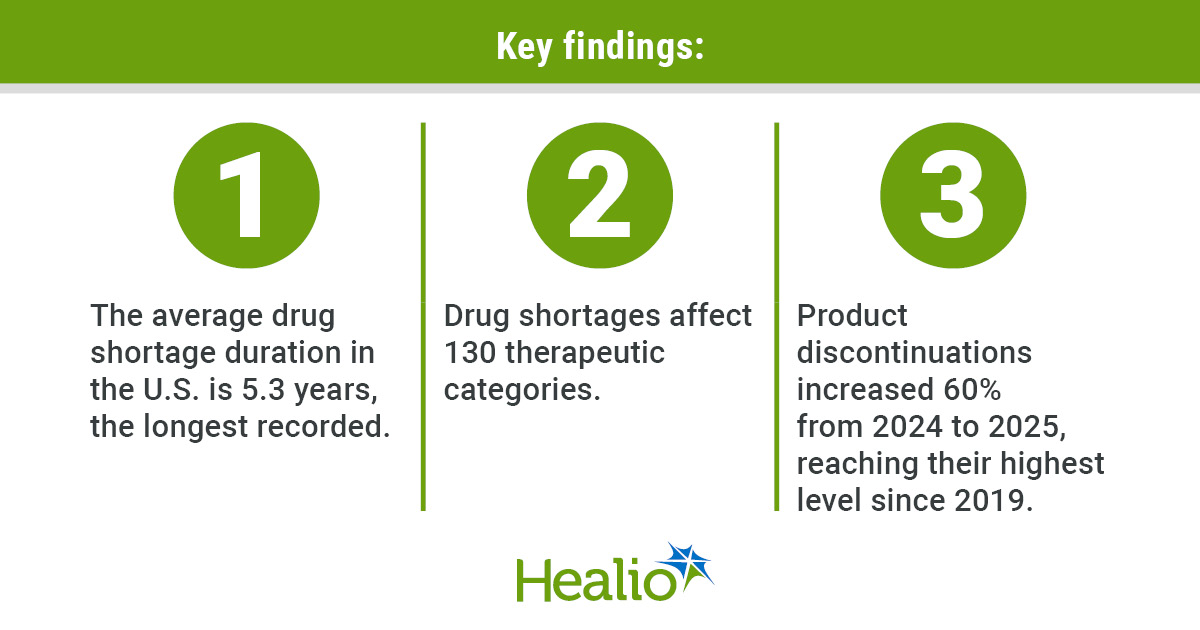
- The average drug shortage duration is now 5.3 years, the longest average duration recorded and more than double the approximately 2-year duration reported in 2019.
- Drug shortages affect 130 therapeutic categories. The most affected categories are pediatrics (n = 16), gastroenterology (n = 11), anesthesia (n = 10), endocrinology/metabolism (n = 10) and oncology (n = 6).
- Product discontinuations increased by 60% from 2024 to 2025 — rising in absolute numbers from 106 to 170 — and are now at their highest level since 2019. Oral solid products (55%) and injectables (29%) accounted for a majority of discontinuations.
Multiple factors may contribute to drug discontinuations or shortages. Low profit margins — which reduce incentive to enter or stay in a market — top the list.
“The biggest driver is low prices, which make production not economically sustainable for manufacturers,” Christian said.
Two-thirds (65%) of discontinued oral solid products had been priced at less than $1 per unit. The median price for those products declined by 78% — from $1.80 to 40 cents — from 2024 to 2025, according to the report. The percentage of discontinued injectables priced less than $15 per unit increased by 19% from 2024 to 2025.
Meanwhile, the average price for generic therapies not in shortage is considerably higher than the average price for those in shortage, according to the report — $8 vs. $3 for oral solid drugs, and $169 vs. $20 for injectable products.
Geographic concentration
Geographic concentration within the supply chain is another important consideration, Christian said.
A natural disaster, one regulatory action or geopolitical turmoil can disrupt the supply chain and cause considerable downstream implications.
This year’s USP report is the first to include data on key starting materials, the core molecular component from which an active pharmaceutical ingredient can be synthesized.
At least one key starting material for 33 drugs currently in shortage — 44% of the total — is manufactured in a single country, most often India or China.
Key starting materials for six drugs — four injectable products and two oral solid products — are manufactured only in one country.
In addition, the European Union is the primary active pharmaceutical ingredient supplier for 15 drugs in shortage, or 20% of the total. India is the primary active pharmaceutical ingredient supplier for seven drugs in shortage.
The USP report cited cefotaxime injection as one example.
The cephalosporin antibiotic, used to treat serious infections, has been in shortage for more than a decade. The active pharmaceutical ingredient for the U.S. supply is manufactured solely in India, and the key starting material is produced mostly in China.
‘Reward resilience’
The consequences of drug shortages — which include delaying essential treatments, or prompting clinicians to choose alternative therapies or change dosing protocols — can persist even after the supply is restored.
“When clinicians go through the pain of having to deal with a shortage, what is their willingness or incentive to switch back once the situation is resolved?” Christian said. “Do they trust that the shortage is, in fact, fully and forever resolved? When durations are lasting longer than 5 years, there is a lot of inertia when you have to make these difficult formulary changes.”
USP’s Medicine Supply Map — which uses data and AI-powered analytics to allow stakeholders to identify emerging disruptions in the global medicine supply chain and strengthen sourcing strategies — is designed to increase the visibility of current or projected shortages.
“You can’t fix what you can’t see,” Christian said.
However, targeted actions — with collaboration from the public and private sectors — are needed to strengthen and address vulnerabilities within the supply chain to ensure patients and clinicians have access to essential medicines, according to the report’s authors.
“The current procurement systems in the U.S. reward the lowest-price manufacturing,” Christian said. “It doesn’t provide any sort of incentive to invest in supply reliability, quality, maturity, redundancy or sustainability. We need to work on procurement reforms and market incentives that reward resilience if we have any hope of eliminating this drug shortage crisis.”
For more information:
Matt Christian, director of supply chain insights at United States Pharmacopeia, can be reached at mediarelations@usp.org.
Sources/Disclosures
Source:
References:
Disclosures:
Christian is employed by United States Pharmacopeia. He reports no relevant financial disclosures.

Ask a clinical question and tap into Healio AI’s knowledge base.
- PubMed, enrolling/recruiting trials, guidelines
- Clinical Guidance, Healio CME, FDA news
- Healio’s exclusive daily news coverage of clinical data