
Key takeaways:
- A study showed alcohol intake raises risks for diseases like cancer and chronic liver disease.
- A separate analysis tied even moderate drinking to a higher death risk.
Two new reports showed that even small amounts of alcohol daily raise the risk for death and a dozen other adverse health outcomes.
And while one analysis suggested that lower alcohol intake potentially reduced the risks for diseases like diabetes, the strength of these associations — which were reversed at higher levels of consumption — were small.

Data derived from Dai X, et al. Nature Health. 2026;doi:10.1038/s44360-026-00139-5.
The findings expand evidence on the health effects of alcohol consumption, which remains divisive as recent reports from the National Academies of Sciences, Engineering and Medicine and an HHS committee clashed on whether low amounts of drinking affect mortality risk.
Alcohol raises risks for 10 cancers
One of the new studies indicates that the impact of alcohol intake varies for 20 different health outcomes, with consumption raising the risk for many cancers and liver diseases.
“The science on alcohol and health is genuinely complex,” Emmanuela Gakidou, MSc, PhD, senior study author and professor in the department of health metrics sciences at the Institute for Health Metrics and Evaluation (IHME), said in a press release. “For cancer, the evidence is consistent and unambiguous: risk rises with any level of alcohol intake. For some cardiometabolic and dementia outcomes, studies suggest small reduced risks at low-to-moderate consumption, but those associations became weaker and reversed at higher levels of drinking. Rather than interpreting these results as an endorsement of drinking, they lay out a complex map of where the evidence is strong, weak or mixed.”
In the Nature Health analysis, Gakidou and colleagues conducted 16 systematic reviews using IHME’s Burden of Proof meta-analytic framework, assessing 843 case-control and cohort studies published through 2023.
This framework “carefully accounts for differences across studies and focuses on the most conservative estimate supported by the data. Each alcohol-outcome relationship is then assigned a 0- to 5-star rating to show how strong and consistent the evidence is,” the release said.
The researchers reported that alcohol intake was adversely tied to all 10 cancers examined, including cancers of the breast, colorectum, esophagus, larynx, lip and oral cavities, pharynx, liver, stomach, pancreas and prostate, with the risks rising as intake grew.
Even one standard drink daily, “or less than 10 grams of pure alcohol,” increased the risks for pharynx, esophagus, breast, colorectum, liver, pancreas and prostate cancers, according to IHME.
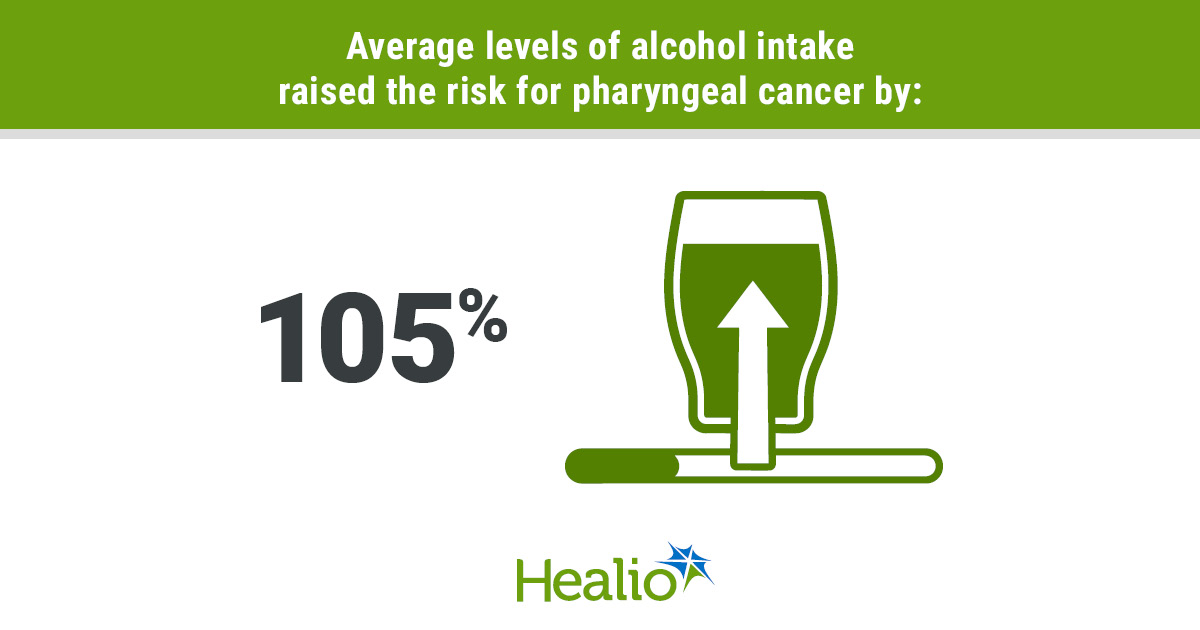
Average levels of alcohol intake were tied to a 105% increased risk for pharyngeal cancer — the only health outcome examined which had an increased risk over 85% — while greater risks for larynx, colorectum, and lip and oral cavity ranged between 22% to 49%.
Alcohol intake also raised the risk for cirrhosis and other chronic liver diseases by at least 40%, pancreatitis by at least 22%, lower respiratory infections by at least 2% and atrial fibrillation and flutter by at least 6%.
Stomach cancer was the single health outcome “needing additional evidence to better understand the strength of the relationship,” according to IHME.
Gakidou and colleagues also found J- or U-shaped relationships between alcohol intake and type 2 diabetes, ischemic heart disease, ischemic stroke, hemorrhagic stroke and Alzheimer’s disease and other dementias.
Specifically, low to moderate alcohol intake lowered the risk for type 2 diabetes and Alzheimer’s and other dementias by 4.5% and 6.4%, respectively, the release said.
The researchers wrote that the lower risk for dementia “may partly reflect shared risk factors with cardiovascular diseases and type 2 diabetes. However, no trial has yet investigated the long-term health impacts of alcohol consumption, and our findings from available observational studies may be biased due to residual confounding.”
Lower risks at lower levels of consumption for ischemic heart disease, ischemic stroke, hemorrhagic stroke were inconsistent, though, with the risks for these outcomes increasing at higher levels.
“Our framework takes a cautious approach by accounting for differences across studies and reporting the smallest plausible effect supported by the data,” Xiaochen Dai, MSc, PhD, lead study author and research collaborator at IHME, said in the release. “For some cardiometabolic and dementia outcomes, the relationship is more complex, and the evidence is weaker, which is exactly what our star ratings are designed to make clear.”
Even moderate drinking raises death risk
The second study found that even moderate amounts of alcohol intake increased the risk for premature death and disability, Katherine M. Keyes, PhD, a professor of epidemiology at Columbia University Mailman School of Public Health, said in a press release. “No protective effect of drinking was observed even at low levels.”
In the analysis, published in Journal of Studies on Alcohol and Drugs, Keyes and colleagues assessed national survey and population data from the U.S. Census Bureau, morbidity data from IHME, mortality data from the CDC and 56 systematic reviews to determine the impact of various levels of alcohol consumption on health.
The researchers reported that men and women consuming over 6.5 and seven drinks weekly, respectively, had a life-time alcohol-attributable mortality risk of over 1 in 1,000.
This risk increased to over 1 in 100 at more than 8.5 drinks consumed weekly for both men and women.
Men and women who consumed 14 drinks weekly had mortality risks of 39.34 and 40.53 per 1,000, respectively.
Even one drink consumed daily raised the risk for death from liver cirrhosis, esophageal and oral cancers, and injuries, with the risks for these outcomes greater among women vs. men at higher intake levels.
“For example, at 14 drinks per week, the relative risk of death due to cirrhosis and other chronic liver diseases was 2.1 (95% CI, 1.68-2.65) for males, compared with 5.38 (95% CI, 3.81-7.73) for females,” Keyes and colleagues wrote.
The researchers acknowledged that their analysis did not assess the impacts of alcohol intake on several diseases like HIV, depression or cervical cancer, and the study was also limited due to “the use of life-time abstainers as the reference group in alcohol risk estimation” in some systematic reviews.
They concluded that many health risks may begin at one drink daily but such risks “are not uniform and vary substantially by drinking patterns, individual characteristics, and context, meaning that some people may experience harm at levels of consumption lower than those reported in this study.”
“Public health guidance should aim to capture this nuance by emphasizing graduated risk and informed choice alongside a potential population-level threshold of one drink per day,” they wrote.

Ask a clinical question and tap into Healio AI’s knowledge base.
- PubMed, enrolling/recruiting trials, guidelines
- Clinical Guidance, Healio CME, FDA news
- Healio’s exclusive daily news coverage of clinical data