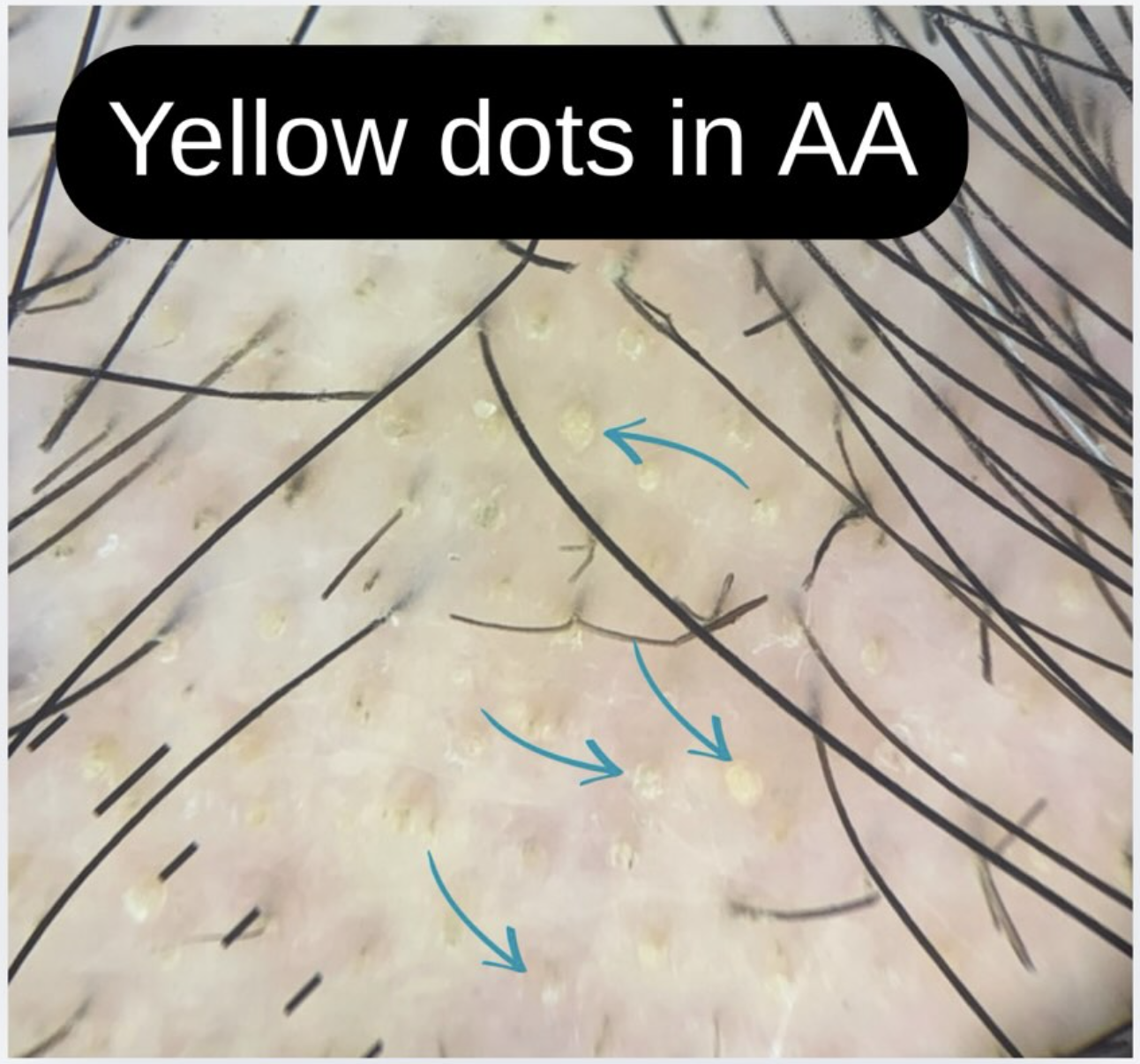
Although they are a classic sign of alopecia areata, it is important to understand both their strengths and limitations.
Yellow dots are generally quite sensitive for diagnosing alopecia areata, meaning they are commonly present and often help point us toward the diagnosis. However, they are not very specific. Yellow dots may also be seen in other disorders including androgenetic alopecia, telogen effluvium, discoid lupus, dissecting cellulitis, and several additional scalp disorders.
One fascinating aspect of yellow dots is their relationship to age. They are seen much more commonly in adults than in children. This likely relates to sebaceous gland development. Before puberty, sebaceous glands are not fully mature and produce far less sebum. Since yellow dots partly reflect accumulation of sebaceous material within follicles, they are less prominent in children.
Yellow dots may also provide clues regarding disease severity. Patients with more extensive alopecia areata often demonstrate larger numbers of yellow dots across affected scalp regions.
For those learning trichoscopy, yellow dots are an important structure to recognize. However, true expertise comes not simply from identifying “yellow dots,” but from understanding why they form, when they appear, and what else belongs in the differential diagnosis.