June 22, 2026
1 min watch

Key takeaways:
- The number of food deserts — areas without grocery stores — in the U.S. stayed almost the same between 2003 and 2023.
- Conversely, the number of food swamps increased during the same time.
Approximately 5 million people in the U.S. lived in communities with no access to grocery stores in 2023.
The number of food deserts in the country remained almost unchanged during the past 2 decades, whereas the number of areas with substantially more restaurants and fast-food locations than supermarkets increased more than 8 percentage points during the same time.

Data derived from Wiese D, et al. Am J Public Health. 2026;doi:10.2105/AJPH.2026.308495.
“Alarming,” Daniel Wiese, PhD, principal scientist in cancer disparity research at American Cancer Society, told Healio. “We might recommend people sustain a certain diet, but is it really possible?”
‘Dealing with this for decades’
Prior research has shown poor diet is associated with numerous negative health outcomes, including cancer, diabetes, heart disease and obesity, according to study background.
In the past year, Healio has reported extensively on the impact nutrition can have on health, including:
However, patients do not always have the option of eating healthy foods.
Many individuals live in food deserts, areas with no grocery stores, or food swamps, areas with dramatically more restaurants and fast-food eateries than supermarkets.
A prior study showed people have between 11% and 61% greater likelihood of eating fast food with increased retailer density in their area. Conversely, another investigation showed that individuals ate more fresh produce for each extra supermarket in the neighborhood.
Food deserts have been linked to elevated BMI, obesity, cardiovascular health risk and more diabetes-related hospitalizations.
“That isn’t new information,” Wiese said. “We’ve been dealing with this for decades, but what is interesting to see is whether anything has changed. It is critically important. We know how COVID-19 interrupted health care services, but did it interrupt anything related to the healthy food environment?”
Wiese and colleagues evaluated the U.S. foodscape between 2003 and 2023.
Researchers defined foodscapes based on census tract. They defined geographic access to food retailers in three ways: a traditional half-mile buffer from the tract; 20-minute drivetime zones from tract centroid (about 6-10 miles in urban areas; 20 miles in rural areas); and 20-minute rides via public transit.
‘It’s not that easy’
The overall number of food retailers increased 62.6% between 2003 and 2020 (756,668 to 1,208,797), but it declined to 1,067,984 in 2023.
The number of unhealthy retailers increased 66% between 2003 and 2020 (623,738 to 1,035,370) and fell 11.2% (919,199) in 2023. The number of healthy retailers rose 30.4% from 2003 to 2020 (132,930 to 173,280) but declined 14.1% by 2023 (148,785).
Growth in unhealthy retailers substantially outnumbered healthy retailers (47.4% vs. 11.9%).
The number of food deserts fell 1.9 percentage points from 2003 to 2020 but rose 1.3 percentage points by 2023.
“It’s certainly [disappointing],” Wiese said. “We’ve known for so long about the existence of food deserts, I would expect that, over time, we might see some progress. There was an increase in supermarkets, so I thought we were going to see a decline in food deserts. That was not the case. The number of food deserts and the proportion of neighborhoods that were categorized as food deserts remained almost unchanged.”
The number of food swamps increased 9.6 percentage points between 2003 and 2020, but dropped 1.3 percentage points by 2023.
“What is concerning is that the number of restaurants and fast-food locations is going so much higher, it’s rapidly increasing, and people are mostly exposed to getting foods from these places instead of going into a supermarket and buying healthy products to cook themselves,” Wiese said.
Rural areas had substantially more food deserts than urban areas (15.8% vs. 2.9%), but far less food swamps (66.8% vs. 93.8%).
The number of tracts with “good food environments” declined 7.7 percentage points — from 13.7% to 6% — between 2003 and 2020 and stayed at that level through 2023.
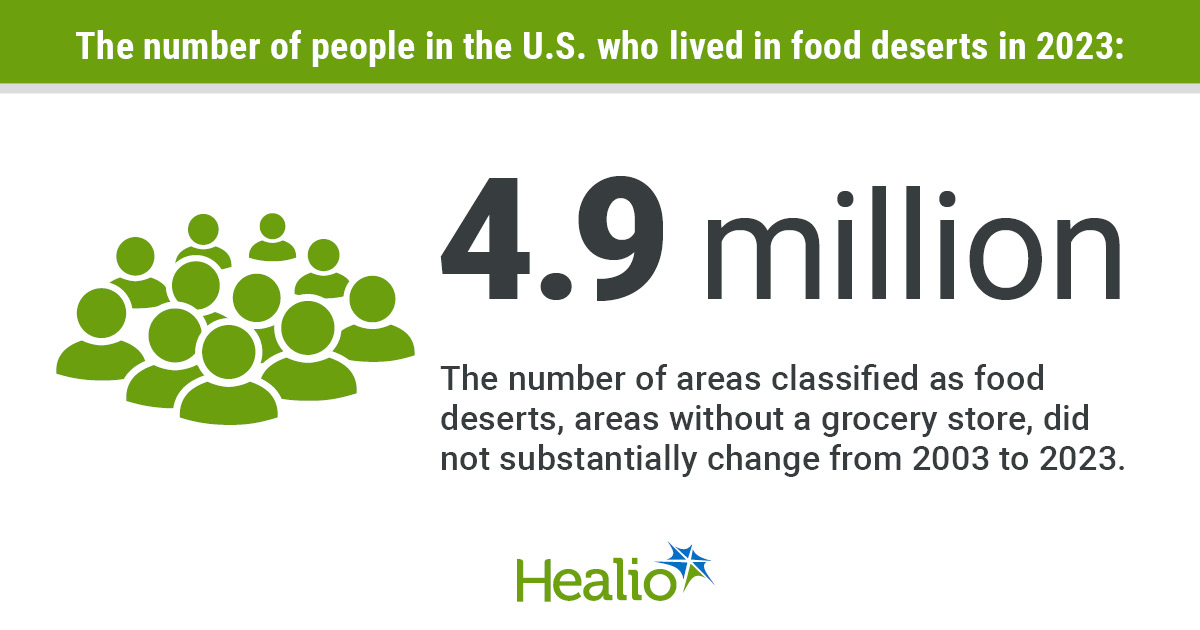
Using the drivetime-based measure, 4.9 million individuals lived in food deserts in 2023. That number increased to 14 million using the distance-based definition, and 178 million with the public transit method.
“We wish everyone would be able to maintain a healthy diet, but the environment where we live, the food environment that we’re exposed to, can be a big limitation of that,” Wiese said. “People should focus on buying fresh produce, but it’s not that easy. Many people have multiple barriers to deal with. People may need to walk for miles to find any grocery store. The attractiveness of fast-food places and restaurants also might change consumption behavior.”
Researchers acknowledged study limitations, including potential misclassification of retailers.
Wiese and colleagues plan to further evaluate foodscapes in different contexts.
“In many areas there will always be more restaurants and fast-food locations, so we’re trying to calculate ratios per thousand people,” he said. “Additionally, we are looking to expand this further to small-scale analyses. We have several sample sites, mostly cities like New York, Philadelphia, Atlanta and a few other places, where we now go into the block group level. We go even more granular and try to see what’s happening on the ground there, and see if we can find any additional information or health outcomes that we can link to. Can we link residency in food swamps and food deserts to any negative health outcomes in the population?”
Wiese expressed some “hope” for improvements in the future, noting some private-public partnerships that have brought supermarkets to underserved areas, as well as examples from other countries, such as Australia, which also increased the number of supermarkets in neighborhoods previously “dominated” by fast food.
“We know there are a few steps we can start with,” Wiese said. “Then, hopefully, they turn out to be a success.”
For more information:
Daniel Wiese, PhD, can be reached at daniel.wiese@cancer.org.

Ask a clinical question and tap into Healio AI’s knowledge base.
- PubMed, enrolling/recruiting trials, guidelines
- Clinical Guidance, Healio CME, FDA news
- Healio’s exclusive daily news coverage of clinical data