
Key takeaways:
- Candidates living in highly segregated neighborhoods were 19% less likely to receive live donor liver transplant.
- Those in neighborhoods predominantly composed of underrepresented groups were 31% less likely.
Liver transplant candidates residing in highly segregated neighborhoods with a predominantly underrepresented population were less likely to receive live donor liver transplant than those in white neighborhoods, study results showed.
Candidates waitlisted at transplant centers in highly segregated areas also were less likely to access live donor liver transplant (LDLT), according to a national cohort study published in JAMA Network Open.


Alexandra “Aly” T. Strauss
Lead author Alexandra “Aly” T. Strauss, MD, PhD, MIE, a transplant hepatologist at Johns Hopkins Medicine, told Healio that she and colleagues were interested in evaluating whether living in a highly segregated neighborhood, or receiving care at a transplant center in one, was associated with lower LDLT access for patients with cirrhosis.
“We also wanted to know whether these associations differed by insurance type and the racial and ethnic composition of neighborhoods,” she said.
Neighborhood segregation is broadly linked to racial and ethnic disparities in health outcomes, which prior research has demonstrated are present across infectious diseases, dementia and liver cancer.
Disparities in care can stem from segregation reinforcing structural inequalities, including lack of opportunity for socioeconomic mobility, social support networks and access to adequate medical facilities, according to study background.
Strauss and colleagues gathered data on 22,223 first-time liver transplant candidates (mean age, 55.3 years; 60.8% men; 70.4% white; 22.9% Hispanic; 6.6% Black) from the national Scientific Registry of Transplant Recipients. Patients were waitlisted between February 2016 and June 2025 at 20 centers in the U.S., all of which performed at least one LDLT annually. More than half (52.5%) of candidates had private insurance.
Results showed patients in high-segregation neighborhoods were less likely to receive LDLT than those in low-segregation neighborhoods (adjusted HR = 0.81; 95% CI, 0.74-0.88), as were candidates waitlisted at transplant centers in high-segregation neighborhoods (HR = 0.64; 95% CI, 0.59-0.7).
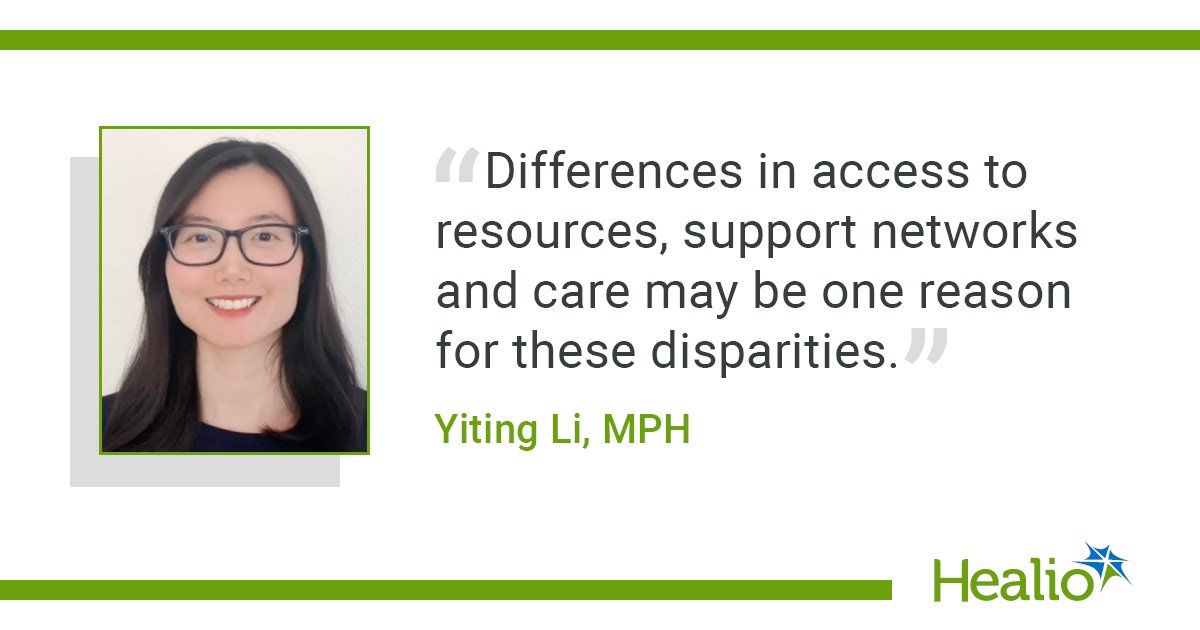
“Differences in access to resources, support networks and care may be one reason for these disparities,” study author Yiting Li, MPH, a doctoral student in health services research and policy at Johns Hopkins Bloomberg School of Public Health, told Healio.
LDLT access did not differ significantly by insurance type between residents of high- and low-segregation neighborhoods. However, being waitlisted at transplant centers in high-segregation neighborhood was a predictor for reduced access to LDLT, both for patients with private insurance (aHR = 0.75; 95% CI, 0.68-0.84) and Medicare or Medicaid (aHR = 0.53; 95% CI, 0.45-0.61).
“The association with residential segregation did not vary significantly by insurance type, which suggests that the problem is not explained by insurance alone and points more strongly to broader structural factors,” Strauss said.
Hispanic or Latino patients in high-segregation neighborhoods also were less likely to access LDLT than their counterparts in low-segregation neighborhoods (aHR = 0.59; 95% CI, 0.49-0.72).
Transplant candidates residing in high-segregation neighborhoods predominantly composed of historically underrepresented populations were less likely to receive LDLT than those in similarly segregated neighborhoods with largely white populations (aHR = 0.68; 95% CI, 0.59-0.78).
“LDLT access is shaped not only by clinical factors, but also by where patients live and receive care,” Strauss said. “For gastroenterologists and other clinicians, this means that structural racism and neighborhood disadvantage can influence transplant access upstream, so improving equity requires attention to social context, referral pathways and patient support, not just medical eligibility.”
The study had several limitations, including unmeasured variables, such as regional health care delivery systems, that might have impacted outcomes. Longitudinal research can confirm whether the link between high-segregation neighborhoods and low LDLT access remains consistent over time, researchers noted.
Future research can also address limitations of this study by including a larger proportion of Black transplant candidates and including data on other social determinants of health, including family support systems and informal caregiving.
Strauss said clinicians can use these findings to proactively identify patients who may face structural barriers to cirrhosis care.
“Health care systems can improve equity by investing in outreach, navigation and referral support in highly segregated communities,” she said. “This could include community-based education about cirrhosis and living donation, stronger partnerships with local clinics and community organizations, transportation and language support, and standardized early referral pathways to transplant evaluation.
“Systems can also track their own outcomes by race, ethnicity, insurance and geography to identify inequities, train staff to recognize structural barriers and invest in the health infrastructure of underserved neighborhoods,” Strauss added.
For more information:
Yiting Li, MPH, and Alexandra T. Strauss, MD, PhD, MIE, codirector of the clinical and translational research unit in the division of gastroenterology and hepatology at Johns Hopkins Medicine, can be reached at gastroenterology@healio.com.

Ask a clinical question and tap into Healio AI’s knowledge base.
- PubMed, enrolling/recruiting trials, guidelines
- Clinical Guidance, Healio CME, FDA news
- Healio’s exclusive daily news coverage of clinical data