
Key takeaways:
- Patients with serious hematologic cancers can oscillate between being ready for prognostic conversations and not wanting them.
- Uncertainty can open the door to talks.
Patients with serious illness may gradually develop a form of “double awareness” — the ability to hold hope for continued living while also preparing for the possibility of dying.
Optimistic prognostic discussions could result in hopeful perspectives, but they may lead to disappointment or depression if treatment does not work. Conversely, clinicians may not provide enough assurance, which may threaten hope and meaningful engagement with life.

An analysis of discussions between clinicians and patients with hematologic malignancies and their caregivers revealed readiness for prognostic dialogue can shift multiple times within a single conversation, and educational training could allow physicians and nurses to provide both hope and realism concurrently.
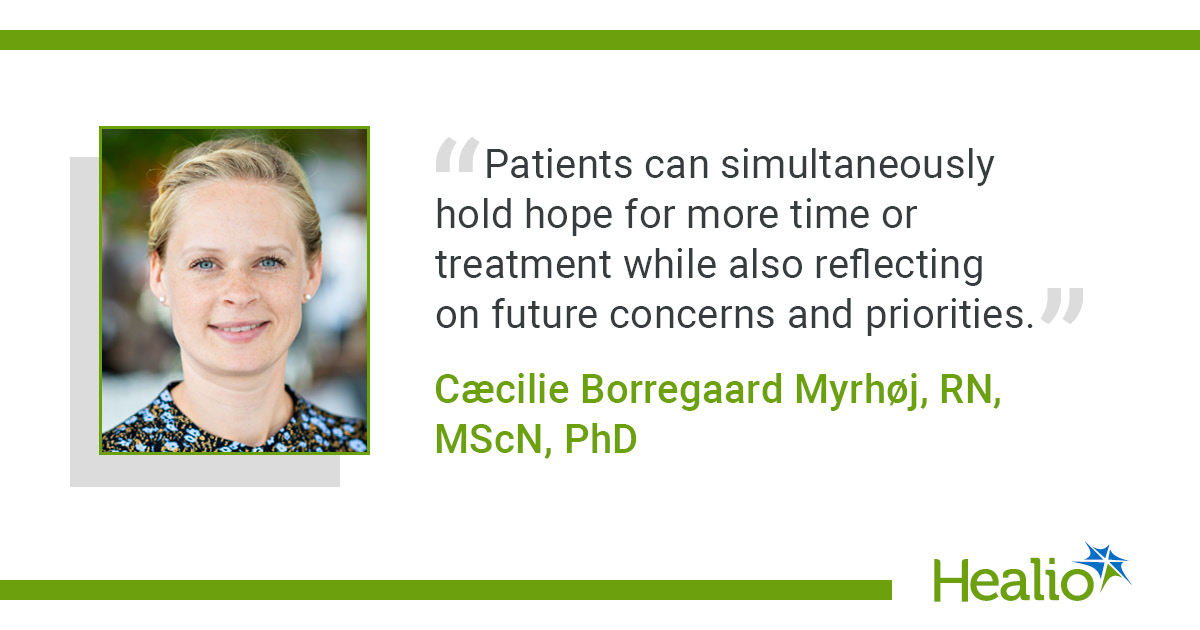
“Serious illness conversations should not be understood as a single disclosure of prognostic information. They are relational and evolving processes that unfold over time,” Cæcilie Borregaard Myrhøj, RN, MScN, PhD, clinical nurse specialist in the department of hematology at Copenhagen University Hospital – Rigshospitalet, told Healio.
“Clinicians do not need to eliminate uncertainty before engaging in these conversations. In fact, acknowledging uncertainty honestly and compassionately may help create space for discussions about both hope and preparation. Our findings suggest that patients can simultaneously hold hope for more time or treatment while also reflecting on future concerns and priorities.”
Optimism vs. taking away hope
Clinicians who treat people with serious illnesses such as hematologic cancers have the difficult task of discussing the potential for improvement or cure with the reality that not all patients will benefit.
“Before this study, some of our patients told us that conversations sometimes focused mainly on optimistic possibilities and hope for further treatment, while more difficult or realistic scenarios were postponed,” Borregaard Myrhøj said. “Patients described that when optimistic expectations later no longer held true, it could create feelings of disappointment and sometimes challenge their trust in the clinicians caring for them.
“At the same time, many clinicians were afraid of taking away hope too early, which is also a well-described barrier in the literature. As a result, they often delayed conversations about uncertainty or more serious scenarios until they felt more certain about the prognosis. But in hematology, certainty may come very late, and by then the patient may be critically ill and opportunities for reflection and preparation may already have been lost.”
Healio previously reported on a survey about prognostic communication in pediatric oncology, which showed direct and individualized communication could substantially improve these conversations.
Borregaard Myrhøj and colleagues investigated how prognostic dialogue “unfolds” and the impact training could have.
They analyzed audio-recorded transcripts of conversations from a randomized clinical trial in Denmark evaluating the Serious Illness Care Program. Clinicians and nurses in the intervention arm received training on subjects such as flexible conversation, communication, trust building and exploration of goals, illness understanding, worries and values.
The analysis involved conversations between 25 patient-caregiver dyads (median patient age, 73 years; interquartile range [IQR], 67-79; 56% men; median caregiver age, 66 years; IQR, 52-72; 80% women) and 16 physician-nurse teams (median physician age, 46 years; IQR, 41-48; 69% women; median nurse age, 38 years; IQR, 32-46; 100% women).
Patients had multiple myeloma (32%), lymphoma (32%), myelodysplastic syndrome (24%) and acute leukemia (12%).
Communication dynamics served as the primary endpoint.
‘Back and forth’
Prior to conversations with physician-nurse teams, the most common patient- and caretaker-identified treatment goals were life prolongation (patients = 48%; caretakers = 44%), cure (patients = 24%; caretakers = 28%) and symptom relief (both = 24%).
Researchers observed two themes from dialogue between clinicians trained in the program and patients and caregivers: Clinicians adapt to the readiness of prognostic discussions, and all parties use prognostic uncertainty to try to balance both hope and reality.
Patients and caregivers frequently expressed discordant cues on readiness, shifting between hesitation, openness and withdrawal.
Borregaard Myrhøj described that as “one of the most surprising findings.”
“Patients did not simply either ‘want to know’ or ‘not want to know,’” she said. “Instead, they often moved back and forth between engaging with difficult realities and stepping away from them. This was a real eye-opener because it highlighted how important it is for clinicians to listen carefully for small emotional or verbal cues and continuously adapt the conversation accordingly — what we describe as clinical attunement.”
Clinicians demonstrated responsiveness to patient and caregiver changes and showed they could adjust within a single conversation.
In one example, a 76-year-old patient with multiple myeloma said he did not want any information because, “I don’t think I could handle knowing about it.” During the same conversation, a caregiver expressed the importance of knowing if something changed. The patient then asked, “Can the illness suddenly change and progress?”
The clinician responded, “It is rare for myeloma to change quickly … Usually you first see small changes in the blood samples, and then a month or two later a bit more. At that point, we might adjust treatment, but we usually have time to talk before making changes.”
Clinicians frequently had to deal with different levels of readiness between caregivers and patients, necessitating both caution and openness in prognostic information.
Patients and caregivers expressed both hope and fear when facing prognostic uncertainty. Clinicians used prognostic uncertainty to set realistic expectations and open the door to possibilities.
A physician told one dyad, “When we talk about the future, there’s always the possibility that treatment may not work. That uncertainty gives us a chance to discuss plan B. I don’t think we are there yet, but it may come, and that possibility makes it worth talking about. It doesn’t have to dominate, we can open the box, talk about it, and then set it aside again.”
“Clinicians often view prognostic uncertainty as a barrier because they worry about saying the wrong thing or taking away hope,” Borregaard Myrhøj said. “But in these conversations, uncertainty sometimes allowed space for both hope and realism to coexist. By acknowledging uncertainty openly, clinicians could talk honestly about concerns and future scenarios while still preserving hope, precisely because the future was not entirely fixed or known.”
Researchers acknowledged study limitations, including the voluntary nature of the trial, which could have resulted in a biased cohort with more readiness for prognostic discussions.
‘Shared understanding’
Future research should investigate how patients develop double awareness and how their prognostic views change over time.
“In this study, we captured single conversations, but prognostic awareness and readiness are not static states — they likely evolve as patients and families experience changes in illness, treatment and everyday life.
“We therefore need longitudinal research exploring how these processes unfold across repeated conversations and how double awareness is expressed differently over time. Another important question is whether supporting this balance between hope and realism may help patients and caregivers make decisions that feel more meaningful and aligned with their values and priorities.”
Borregaard Myrhøj emphasized the importance of “communication training, interdisciplinary collaboration and organization structures” that could help clinicians better support patients over the course of their care.
“Prognostic communication is not simply about delivering information,” she said. “It is fundamentally about supporting patients and families in living with serious illness. Many clinicians worry that conversations about prognosis may remove hope. Our findings suggest the opposite: When conducted with sensitivity and attunement, these conversations may actually help patients and caregivers maintain hope while also creating space for reflection, preparation and shared understanding.”
For more information:
Cæcilie Borregaard Myrhøj, RN, MScN, PhD, can be reached at caecilie.borregaard.myrhoej@regionh.dk.

Ask a clinical question and tap into Healio AI’s knowledge base.
- PubMed, enrolling/recruiting trials, guidelines
- Clinical Guidance, Healio CME, FDA news
- Healio’s exclusive daily news coverage of clinical data