Key takeaways:
- An industry pledge reportedly reduced prior authorizations by 11%, and CMS proposed a rule requiring payers to respond to drug requests in a timely manner.
- But experts are concerned about fragmented processes.
Last year, HHS and dozens of health insurers announced an industry pledge to streamline and reduce prior authorization.
According to America’s Health Insurance Plans (AHIP), that pledge has led to an 11% reduction in prior authorizations “across a range of medical services,” leading to 6.5 million fewer prior authorizations.

AHIP also announced that health insurers participating in the pledge will standardize the process for submitting electronic prior authorization requests for most services, including imaging services like CT scans and MRIs and orthopedic surgeries. These services span Medicare Advantage, commercial coverage and Medicaid managed care, with more to come, according to an AHIP press release.
Despite the AHIP report, many health care professionals remain unconvinced about how effective the prior authorization pledge will end up being. A recent AMA survey of 1,000 physicians showed that only 33% believe the industry pledge will make a meaningful difference.
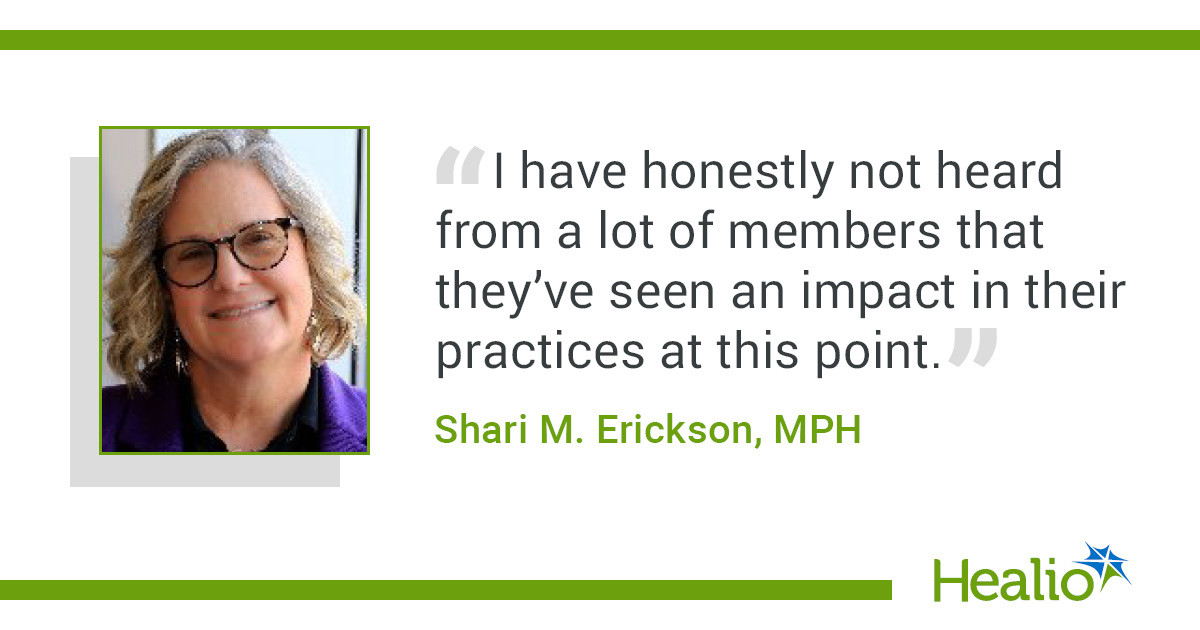
“I have honestly not heard from a lot of members that they’ve seen an impact in their practices at this point,” ACP Chief Advocacy Officer and Senior Vice President of Governmental Affairs and Public Policy Shari M. Erickson, MPH, told Healio. “Now, we haven’t conducted a survey recently to ask them about this, so perhaps in aggregate we might find out from some that they are seeing some improvements, but I certainly have not heard it from any of them voluntarily.”
Patients still struggling with prior authorization
Many patients continue to report disruptions in health care stemming from insurance coverage issues. A 2025 analysis from The Commonwealth Fund showed that 21% of U.S. working-age adults with private health insurance were denied coverage for medical care recommended by a physician in the past year. Among them, 41% said it led to delayed care, 28% said it worsened a health problem and 61% said the denial caused anxiety and worry. Just half of those denied care appealed it, “citing uncertainty over their right to do so and whether it would make a difference if they did, as well as confusion about who to contact,” according to a press release.
Further, a recent Annals of Internal Medicine study found that prior authorization rules remain inconsistent among commercial insurers. For example, “for approval of a prior authorization for medical and surgical services, Aetna only required a site-of-service review, while UnitedHealthcare used this and two other requirements,” Aya Zaari Jabri, MS, a study co-author from Stanford University, and colleagues wrote. “Across all Healthcare Common Procedure Coding System codes, none of the insurers used the same criteria to require prior authorization or the same requirements to obtain prior authorization.” So, despite the industry pledge’s intent to improve prior authorizations, Jabri and colleagues said the pledge does nothing to eliminate fragmented processes across insurers.
New CMS efforts
There has been additional movement in the prior authorization space outside the industry pledge. CMS recently proposed a rule that would extend the CMS Interoperability and Prior Authorization Final Rule to include prescription drugs. Certain federally regulated insurance payers would need to respond to urgent prior authorization requests for all drugs within 24 hours, expedited requests within 72 hours and standard requests within 7 days, as well as publicly report prior authorization metrics for drugs. If finalized, impacted payers would need to comply by Oct. 1, 2027.
CMS’ proposal to expand prior authorization requirements to include drugs “is something we absolutely asked for when they first came out with it, and so we’re really pleased to see that in the proposed rules,” Erickson said. “ACP is still reviewing it, and I’m not sure what feedback we’ll be giving, but we are definitely pleased it’s moving in this direction.”
CMS is also testing the use of AI for processing prior authorization claims and determining approvals through the Wasteful and Inappropriate Service Reduction, or WISeR, Model. The pilot program was launched in six states on Jan. 1. But a report released by Sen. Maria Cantwell, D-Wash., showed that patients’ wait times for procedures under WISeR are two to four times longer due to authorization delays. As a result, providers “are spending more time appealing claims,” Cantwell wrote in a letter. According to Erickson, patients in the pilot states are going “from 1 to 2 days for quick prior authorization turnaround and 3 to 5 days for standard prior authorization to up to 10 to 15 days.”
artificial or augmented intelligence certainly could help in this case, a lot of these are complex types of requests,” Erickson said.
“We feel strongly that you need some level of physician oversight if you are using electronic methods to try to conduct prior authorizations or reduce the need for prior authorization,” she said. “There’s certainly interest in making things more automated and speedier, but at the same time, it needs to be done appropriately from a clinical perspective.”
The ‘good, bad or otherwise’
ACP has previously called on health insurers to “set clear and measurable benchmarks for improvement,” which Erickson said the industry pledge is seemingly “trying to do.”
“We also asked them to work with physicians and patients as they were trying to do this, and we haven’t really seen much outreach on that front at this point,” she said. “We did ask them to ensure transparency, reporting and decision-making, but I’m not sure we’ve seen a lot more transparency in their processes at this point” other than the AHIP report.
She added that ACP “has long advocated that physicians who are performing well on their performance measures, particularly outcome measures and/or typically have their prior authorization requests approved, should be exempted from prior authorizations.”
She pointed out that Sen. Sheldon Whitehouse, D-R.I., “has reintroduced the Prior Authorization Relief Act, which would eliminate prior authorizations from physicians in value-based payment programs. There are also a number of states pursuing prior authorization reform.”
Erickson encouraged physicians to inform ACP of the “good, bad or otherwise in terms of whether they are seeing meaningful changes due to this pledge and some of the new rulemaking … so that we can use that feedback when we’re talking to the payers about these policy changes.”
For more information:
Shari M. Erickson, MPH, can be reached through Jacquelyn Blaser, senior public relations associate at ACP, at jblaser@acponline.org.
Sources/Disclosures
Source:
Healio Interviews
References:
- 2026 CMS interoperability standards and prior authorization for drugs proposed rule. https://www.cms.gov/newsroom/fact-sheets/2026-cms-interoperability-standards-prior-authorization-drugs-proposed-rule. Published April 10, 2026. Accessed April 29, 2026.
- AI-powered prior authorizations for Medicare have greatly delayed care, Washington state hospitals say. https://www.fiercehealthcare.com/regulatory/ai-powered-prior-authorizations-medicare-have-greatly-delayed-care-wash-hospitals-say. Published April 23, 2026. Accessed June 22, 2026.
- AMA prior authorization physician survey. https://www.ama-assn.org/practice-management/prior-authorization/ama-prior-authorization-physician-survey. Published May 13, 2026. Accessed May 14, 2026.
- CMS proposes major reforms to speed up patient access to drugs, increase transparency, and reduce administrative burden. https://www.cms.gov/newsroom/press-releases/cms-proposes-major-reforms-speed-up-patient-access-drugs-increase-transparency-reduce-administrative. Published April 10, 2026. Accessed May 20, 2026.
- Health plans reduce prior authorization, support continuity of care and enhanced consumer communications. https://www.ahip.org/news/articles/health-plans-reduce-prior-authorization-support-continuity-of-care-and-enhanced-consumer-communications. Published April 7, 2026. Accessed April 29, 2026.
- Health plans take next step to streamline and simplify prior authorization for patients and providers. https://www.ahip.org/news/articles/health-plans-take-next-step-to-streamline-and-simplify-prior-authorization-for-patients-and-providers. Published April 24, 2026. Accessed April 29, 2026.
- How health insurance coverage denials affect Americans. https://www.commonwealthfund.org/publications/surveys/2026/jun/how-health-insurance-coverage-denials-affect-americans-2025-affordability-survey. Published June 4, 2026. Accessed June 8, 2026.
- Jabri AZ, et al. Ann Intern Med. 2026;doi:10.7326/ANNALS-25-05289.
- Maria Cantweel: United States Senator for Washington. https://www.cantwell.senate.gov/news/press-releases/in-letter-to-rfk-jr-cantwell-demands-changes-to-new-ai-driven-prior-authorization-program-thats-overruling-wa-doctors-and-delaying-care-for-seniors. Published April 27, 2026. Accessed June 22, 2026.
- Medicare Advantage insurers made nearly 53 million prior authorization determinations in 2024. https://www.kff.org/medicare/medicare-advantage-insurers-made-nearly-53-million-prior-authorization-determinations-in-2024/. Published Jan. 28, 2026. Accessed June 22, 2026.
- New Medicare scheme uses AI and new prior authorization requirement to deny care and impose new costs on Washington’s seniors. https://www.cantwell.senate.gov/imo/media/doc/wiser_snapshot_report1.pdf. Accessed April 29, 2026.
- Snapshot report: New Medicare scheme uses AI and new prior authorization requirement to deny care and impose new costs on Washington’s seniors. https://www.cantwell.senate.gov/imo/media/doc/wiser_snapshot_report1.pdf. Accessed June 22, 2026.
Disclosures:
Erickson reports no relevant financial disclosures.

Ask a clinical question and tap into Healio AI’s knowledge base.
- PubMed, enrolling/recruiting trials, guidelines
- Clinical Guidance, Healio CME, FDA news
- Healio’s exclusive daily news coverage of clinical data