
Key takeaways:
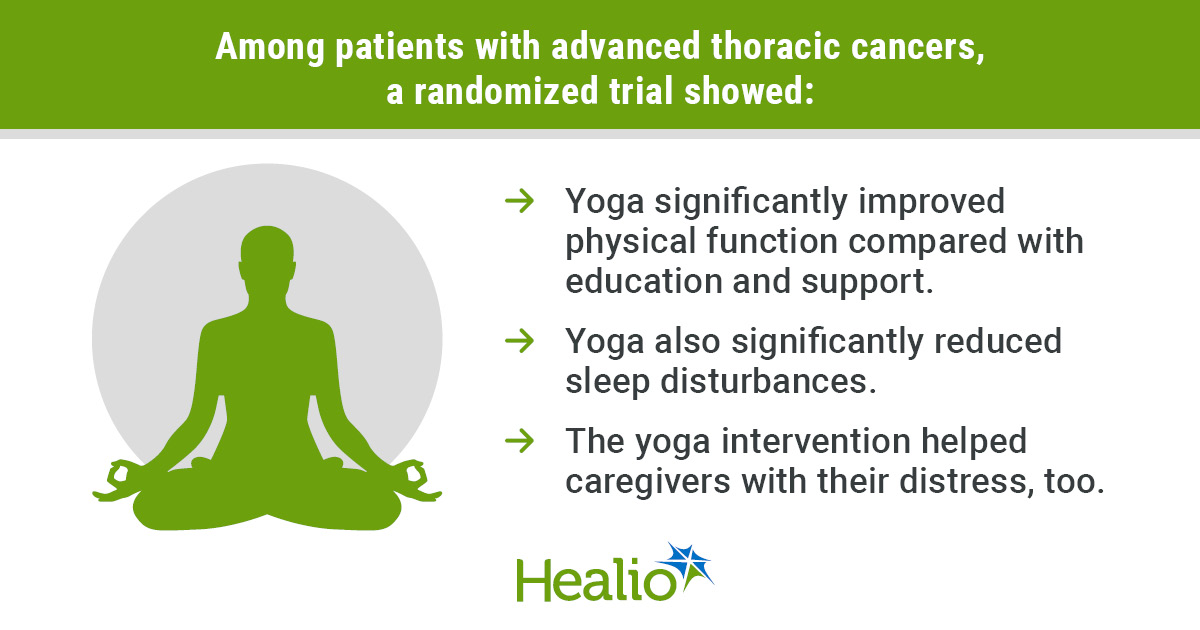
- A randomized trial showed that patients with advanced thoracic cancers physically benefited from a yoga intervention.
- Participants in the yoga arm also had significant improvements in sleep disturbances.
Yoga may help patients with lung cancer and other thoracic malignancies improve their physical function, as well as other quality-of-life metrics.
A randomized trial of more than 100 patient-caregiver dyads showed patients who took part in a yoga intervention performed significantly better in a 6-minute walk test and had improved sleep compared with those who received education and support.

Data derived from Milbury K, et al. JCO Oncol Pract. 2026;doi:10.1200/OP-25-01079.

Kathrin Milbury
“Patients with thoracic cancers are not too sick to exercise,” Kathrin Milbury, PhD, professor in the department of behavioral science at The University of Texas MD Anderson Cancer Center, told Healio.
‘Treatment nihilism’
Patients with advanced thoracic cancers frequently experience a high symptom burden and poor physical and mental health due to treatment toxicities, according to study background.
They often need caregiver assistance, but caregivers can feel ineffective and helpless, which may lead to fatigue, psychological distress and sleep disturbances.
Healio previously reported on the benefits of yoga for cancer survivors, including improved mood disturbances, anxiety and fatigue. Another study showed yoga could lower symptom burden and extend OS.
Milbury’s interest in yoga developed after getting in a bike accident more than a decade ago.
“It was the only exercise I could do,” she recalled.
As Milbury got more involved, she thought yoga could be a “great intervention” for those with lung cancer.
“Yoga is a gentle exercise, so it can be easily modified to various fitness levels, or whatever limitations patients may have at the time of treatment,” Milbury said. “We also know that patients with lung cancer are vulnerable to having shortness of breath, and yoga focuses on breathing exercises to strengthen the diaphragm and other muscles supporting the lungs.
“Yoga also focuses on self-compassion, compassion to others, mindfulness and relaxation techniques. Because of the smoking etiology, patients with lung cancer often blame themselves or experience stigmatization from society. I thought this intervention may also have really nice psychosocial benefits.”
Milbury initially got some “pushback” though.
“There has been a documented treatment nihilism,” she explained. “For a long time, people thought they’re just too symptomatic to be able to participate in exercise, including yoga trials.”
Milbury and colleagues developed an intervention to see whether yoga could aid patients with lung or esophageal cancer receiving 5 or more weeks of standard radiotherapy at MD Anderson. The intervention also was evaluated among caregivers.
They randomly assigned 222 adult participants (111 dyads) to receive either 15 sessions of yoga (n = 110; patients: mean age, 63.6 years; 60% men; 81.8% white; caregivers: mean age, 59.8 years; 70.9% women; 74.5% white) or education and support (n = 112; patients: mean age, 65.1 years; 58.9% men; 82.1% white; caregivers: mean age, 59 years; 76.8% women; 75% white).
“This is a superiority trial,” Milbury said.
Researchers assessed participants at baseline, the final day of radiotherapy, and 1, 2 and 3 months later.
Patient functional capacity measured with a 6-minute walk test served as the primary endpoint. Changes in quality of life for patients and caregivers through survey responses served as the secondary endpoint.
‘Definitely important’
Compared with patients who received education and support, those in the yoga arm performed significantly better in the 6-minute walk from the end of radiotherapy through 3 months of follow-up (P = .03), but the difference narrowed over time.
Additionally, patients in the yoga arm reported significantly improved physical quality of life (P = .03) compared with education and support, but the curves got closer with longer follow-up.
Researchers did not observe significant differences in mental quality of life between arms for patients.
“I was happy, for the most part,” Milbury said. “I wish the effect would have carried on to the longer follow-up period, but what we saw is that once patients no longer visited with the interventionist over the treatment phase, they did very little work on their own, particularly regarding physical exercises. If they continued to practice, it was more around the breathing and the relaxation exercises.
“This is a very strong support education comparison arm,” she added.
Caregivers in both arms had similar physical and mental quality of life scores.
An exploratory analysis revealed patients in the yoga arm had significant improvement in sleep disturbance severity compared with education and support (P = .005), as well as coping efficacy (P = .02), but not with fatigue, distress or sadness. The education and support arm had significantly improved dyspnea (P = .02) compared with patients in the yoga arm.
“Improvement in sleep disturbances is very important,” Milbury said. “If they have improved sleep, they tend to fare better after treatment.”
Caregivers in the yoga arm reported significantly improved distress (P = .01) compared with those who received education and support. Researchers did not observe differences in fatigue, sleep disturbances or sadness.
“I wish we would have seen group differences for the caregivers,” Milbury said. “I was disappointed that we only saw a significant difference for distress. At this point, we cannot tell if both interventions worked equally well, or if both interventions did not work. We can only speculate, since we didn’t see a decrease in quality of life, which we typically see over the course of treatment, that both interventions worked well for our caregivers.”
Researchers acknowledged study limitations, including its single-center design.
Future studies could investigate integrating AI, as well as using mobile health applications.
“What we need to really figure out is who would benefit more from a standard exercise intervention vs. yoga therapy. Coming up with prescriptions,” Milbury said. “That’s where exercise oncology is now: trying to figure out who benefits under what situations, for what disease, for what treatment modality. We still have a long way to go to really know some of those specific prescriptions, but the bottom line is improving well-being via physical exercise, yoga, tai chi, Qigong is definitely important.”
For more information:
Kathrin Milbury, PhD, can be reached at kmilbury@mdanderson.org.

Ask a clinical question and tap into Healio AI’s knowledge base.
- PubMed, enrolling/recruiting trials, guidelines
- Clinical Guidance, Healio CME, FDA news
- Healio’s exclusive daily news coverage of clinical data