
Key takeaways:
- Researchers estimate almost 18 million women aged 45 to 64 years are not up to date with breast, cervical or colorectal cancer screenings.
- More than 3 million women may be overdue for all those screenings.
Nearly 18 million women in the U.S. aged 45 to 64 years are likely overdue for breast, cervical or colorectal cancer screenings, and more than 3 million are estimated to not be up to date on all three.
Survey data from 68,000 women showed that having annual wellness visits and a regular health care provider significantly increased the likelihood of being up to date with at least one, as well as all screenings. Greater educational attainment and being insured also were associated with higher screening uptake.

However, interventions targeting multiple screenings could be beneficial, as only 50% of the cohort reported having all their tests completed.

Jennifer C. Spencer
“We tend to think about these [screenings] in silos,” Jennifer C. Spencer, PhD, assistant professor in the departments of population health and internal medicine at The University of Texas at Austin Dell Medical School, told Healio.
“People tend to research one cancer screening or develop interventions to address colorectal cancer screening, or breast cancer screening, or cervical cancer screening. Those are really important, but we really have a chance to intervene holistically with those folks who are due for screenings, and identify everything that they’re due for.”
‘Are there patterns?’
Cancer is the leading cause of death among women aged 45 to 64 years in the U.S., according to study background.
More than 70,000 women will die from breast, cervical or colorectal cancer alone this year, according to American Cancer Society’s Cancer Statistics 2026 report.
Prior research has shown that patients who screen for these malignancies are diagnosed at earlier stages and have improved cancer-specific mortality.
However, many women are not up to date on screening. NCI estimates 20.2% of eligible patients have not had a mammogram in the past 2 years, and the numbers increase for those who are overdue for cervical (24.1%) and colorectal cancer (26.1%) screenings.
“We see so many similar patterns in who doesn’t get screened for breast cancer, for cervical cancer and for colorectal cancer,” Spencer said. “Insurance, access to care, having a regular care provider are commonly associated with lower screening rates.”
Yet, most investigations and interventions focus solely on screening for a single malignancy, even though there can be broad eligibility overlap, particularly for patients aged 45 to 64 years.
“What if we looked at all of this in one question?” Spencer asked. “What are the patterns within these three cancer screenings for the women who are due? Are there patterns that are very clear about who is due for just one, or all three, or none?”
Spencer and colleagues used data from the 2024 Behavioral Risk Factor Surveillance Survey, a nationally representative survey, to investigate.
Their final sample included 68,111 women (mean age, 54.8 years; standard deviation, 5.8; 69.6% white), which represented a weighted U.S. population of 36.2 million.
Up to date use of breast, cervical and colorectal cancer screenings served as the primary endpoint.
‘Halfway there’
Researchers found 50.3% of women to be up to date with all three screenings, 28.8% with two and 13.2% with one, while 7.7% were not up to date with any screenings.
“We were surprised at the women who were up to date on some, but not all screenings,” Spencer said. “I expected it to be either you’re pro-screening and you get everything, or you’re less likely to screen and you get nothing.”
“Half of women being up to date on all three was lower than I expected, but my clinical colleagues were pleasantly surprised that half of women were up to date,” she added. “They spend so much of their time trying to get people to use these cancer screenings, they were like, ‘We’re halfway there. That’s pretty good.’”
Factors that had a significant association with being up to date for at least one screening compared with none included having a checkup in the previous year (adjusted RR = 1.22; 95% CI, 1.19-1.25), having a regular health care practitioner (aRR = 1.18; 95% CI, 1.13-1.23), being Black (aRR = 1.02; 95% CI, 1.01-1.04) or Hispanic (aRR = 1.06; 95% CI, 1.05-1.08) vs. white, having a high school degree or greater educational attainment, having insurance, being older, and being able to afford care in the previous year.
Most of those factors also had a significant association with being up to date with all screenings vs. any screening, but with greater magnitudes.
Women up to date with all their screenings had a higher likelihood of having a wellness visit in the past year (aRR = 1.71; 95% CI, 1.57-1.86), a regular health care practitioner (aRR = 1.43; 95% CI, 1.24-1.66), private insurance compared with no insurance (aRR = 1.43; 95% CI, 1.24-1.63), a college degree vs. not finishing high school (aRR = 1.28; 95% CI, 1.16-1.41), and older age (age 60-64 years vs. 45-50; aRR = 1.57; 95% CI, 1.49-1.66).
“Getting people in the door is huge, but for people who have some but not all screenings, 80% of that group did have a wellness visit in the past year,” Spencer said. “We see that there’s room for improvement.”
Women living in rural areas had significantly lower odds of having all screenings completed (aRR = 0.94; 95% CI, 0.89-0.98), as did those who were Asian American or Pacific Islander (aRR = 0.86; 95% CI, 0.76-0.98).
“The barriers that get you from zero to any are maybe more fundamental, and the barriers that get you from some to all are maybe a little more, how much do you like your provider? How regularly do you go? What else are you dealing with health-wise that you have to work around? How much do you understand why you would get one screening or another?” Spencer said. “What we have to do to get the absolutely underscreened to screen for all of these things is a different process than what we have to do to identify women who are going into the doctor, getting some screenings, but they’re just missing one.”
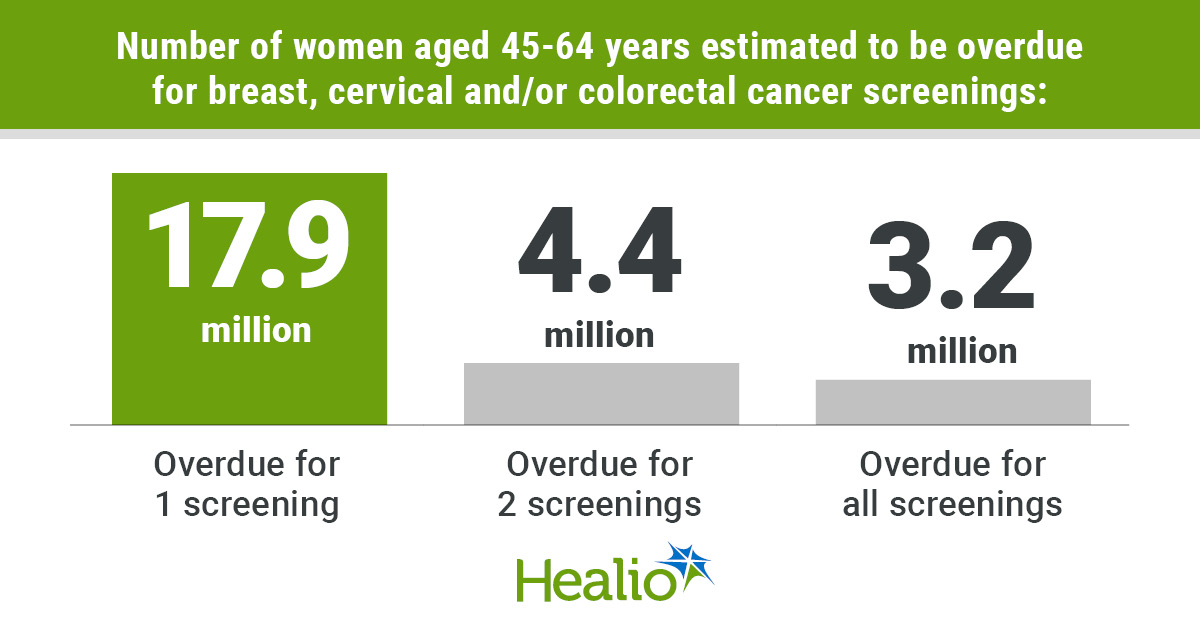
Based on the findings, researchers estimated 17.9 million women aged 45 to 64 years in the U.S. to be overdue for at least one screening.
Of those, Spencer and colleagues projected most (10.3 million) to be overdue for one test, primarily colorectal cancer screening (6 million). They also estimated 4.4 million women were not up to date on two tests, and 3.2 million were overdue for all three screenings.
Among 12.6 million not up to date on colorectal cancer screening, researchers projected 52.4% to be overdue for breast and/or cervical cancer screening. Among 8.5 million women who had not gotten a mammogram, 72.9% also are likely due for cervical and/or colorectal cancer screening. And among 7.2 million estimated to be overdue for cervical cancer screening, 70.8% are projected to be due for mammogram or colorectal cancer screening.
“People need so much in terms of preventive health care,” Spencer said. “Instead of thinking about all of this in silos, we [must realize] a whole person might need multiple things.”
Researchers acknowledged study limitations, including use of self-reported data.
Spencer noted future studies should investigate how to best reach people overdue for one screening or multiple tests.
Challenges exist though, including guidelines recommending screenings at different frequencies.
Mailed interventions, educational materials with details on all tests, as well as patient navigations are “promising” avenues to explore, Spencer said.
“I’m really interested in this population that’s overdue for multiple things,” Spencer said. “I think that’s where you get the most potential impact, understanding what works, and what impact we could potentially have through these interventions. Being able to demonstrate that we’re getting meaningful health benefit from these interventions is also important. Are we really moving the needle on things we care about?”
For more information:
Jennifer C. Spencer, PhD, can be reached at jennifer_spencer@austin.utexas.edu.

Ask a clinical question and tap into Healio AI’s knowledge base.
- PubMed, enrolling/recruiting trials, guidelines
- Clinical Guidance, Healio CME, FDA news
- Healio’s exclusive daily news coverage of clinical data