 Column
Lewiss on Lifestyle Medicine
Lewiss on Lifestyle Medicine
Key takeaways:
- The NOVA classification system categorizes foods based on the nature, extent and purpose of industrial processing.
- NOVA provides a pathway to select nutrient-rich over calorie-rich food and drink.
A pillar of lifestyle medicine is “food as medicine.” This is a health-focused behavioral approach encouraging patients to follow a whole food, minimally processed and predominantly plant-based pattern.
This supports the concept of food serving as a means of preventing, treating and reversing noncommunicable diseases.
A minimally processed diet tends to have higher nutrient content and lower calorie content. In contrast, a diet comprised of mostly industrially processed or ultraprocessed foods tends to have a higher calorie content and lower nutrient content due to emulsifiers, artificial colors, flavorings and other sugar and salt equivalents.
The four-category NOVA classification system is a recognized taxonomy for the extent to which food is industrially processed. First described in 2010 with an update published in 2018, the classification system was developed to categorize foods based on the nature, extent and purpose of their industrial processing, rather than just nutrient content. NOVA is not an acronym. The name is derived from the original Portuguese paper titled “Uma nova classificação de alimentos.”
“Nova” in Portuguese means “new.”
Although more research is needed before incorporating the classification system into evidence-based dietary guidelines, this grouping system truly supports a way to think about selecting food and drink that is more natural in form.
If you are not sure if a food or beverage is ultraprocessed, ask yourself, “Do I have the ingredients and cooking tools in my home kitchen to make this?” If you do not, then it’s probably ultraprocessed.
Lifestyle medicine physicians, public health professionals, epidemiologists and nutritionists use the NOVA classification to help think about nutrient-rich over calorie-rich food and drink. We care about ultraprocessed foods because of the science associating them with higher rates of noncommunicable disease such as diabetes, obesity, CVD and depression. The categories of NOVA move chronologically from more whole food and minimally processed to less whole food and more ultraprocessed:
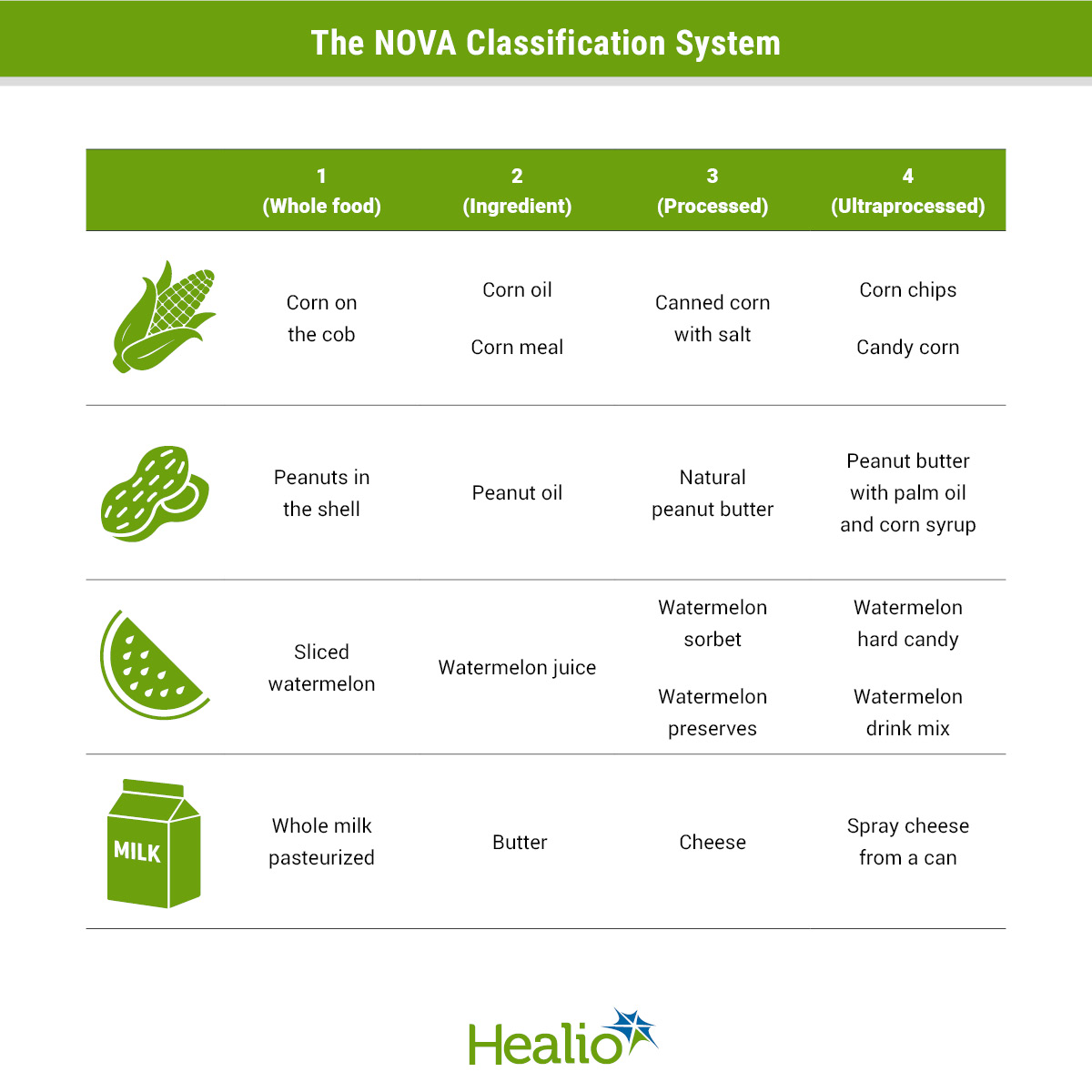
- Group 1 food and drink include unprocessed or minimally processed foods. No other food substances are added. Certain processing and basic techniques such as freezing, boiling or grinding occur. The items retain their natural structure. Examples are fruits, vegetables and milled grains.
- Group 2 consists of ingredients derived from Group 1 foods. They are used to cook or season meals. Examples are oils and spices.
- Group 3 includes processed foods that are made by combining Group 1 and 2 items. They typically contain a few added ingredients; examples include canned vegetables with salt, cheese and natural peanut butter.
- Group 4 consists of ultraprocessed foods — industrial formulations made with little or no whole food. They are generally characterized by convenience, long shelf-life, affordability and hyperpalatability. Examples include soda, packaged cakes and cookies, and margarine.
This chart illustrates examples of food with increasing levels of processing and the associated NOVA category.

Adopt a mindset where you think intentionally about what you consume. The more you do this, the easier it is to identify opportunities to make swaps for less processed versions.
Think about one swap you can make today to move to the more nutrient-rich end of the food you eat and drink you drink.
For more information:
Resa E. Lewiss, MD, DipABLM, is a lifestyle medicine and emergency medicine physician. She is an adjunct professor of emergency medicine at the Warren Alpert Medical School of Brown University. She produces and hosts The Visible Voices Podcast and is the co-author of the leadership book MicroSkills: Small Actions, Big Impact. She can be reached via her website resaelewissmd.com.
Lewiss on Lifestyle Medicine
Sources/Disclosures
Source:
Expert Submission
References:
Disclosures:
Lewiss reports no relevant financial disclosures.

Ask a clinical question and tap into Healio AI’s knowledge base.
- PubMed, enrolling/recruiting trials, guidelines
- Clinical Guidance, Healio CME, FDA news
- Healio’s exclusive daily news coverage of clinical data