June 29, 2026
1 min watch

Key takeaways:
- Time from biopsy to receipt of molecular testing results decreased, but most of the improvement occurred at the laboratory level.
- Clinical sites must streamline processes to ensure even shorter turnaround time.
The time between biopsy and ordering of tissue-based comprehensive genomic profiling varies widely between clinical sites, according to study results.
Delays during this period are the largest contributor to prolonged turnaround time for molecular testing results, which are crucial to inform treatment decisions for people with cancer.

Data derived from Fox AH, et al. JCO Oncol Pract. 2026;doi:10.1200/OP-25-01191.

Adam H. Fox
“I would urge anyone working as part of a multidisciplinary team in oncology care to not assume that this testing is happening as quickly as they would hope,” Adam H. Fox, MD, MS, lung cancer pulmonologist at Medical University of South Carolina’s Hollings Cancer Center, told Healio. “It is very important for them to look at internal data to see how long this process is taking, talk to corresponding specialists — from the ones helping to obtain biopsies to the ones who are using molecular testing results — and identify ways to streamline the process and ensure patients receive optimal care.”
‘How long is it taking?’
Multiple guidelines recommend comprehensive genomic profiling for patients with advanced or metastatic solid tumors to identify individuals who may benefit from precision therapies, such as immunotherapy or targeted agents.
Prior research suggests testing is underutilized in oncology. It also may be performed late. A study presented at last year’s ASCO Annual Meeting showed one-quarter of patients with common cancers who underwent testing received results within 3 months of death.
However, data regarding turnaround time for comprehensive genomic profiling are limited, according to study background. Much of the prior work examining this issue in lung cancer — in which the selection and timing of initial treatment largely depends on biomarker testing — has been conducted at single centers, and data have not been generalizable to broader populations.
“Ideally, we want to have these test results before we make any decisions,” Fox said. “We know selecting the right treatment first can improve outcomes, but there is a pressure to start therapy on the part of both oncologists and patients. There is a limit to how long they are willing to wait, and it varies from person to person. We cannot simply ask, ‘Is testing getting done?’ We also need to ask, ‘How long is it taking?’”
A ‘frustrating’ finding
Fox and colleagues sought to estimate turnaround time — from specimen collection to reporting of comprehensive genomic profiling results — for tissue-based testing across the United States. They also aimed to identify factors that contribute to variation in turnaround time in hopes of identifying interventions to minimize delays.
Researchers analyzed data for all solid tumor samples on which FoundationOne CDx tissue-based comprehensive genomic profiling had been completed successfully from 2018 through 2024.
Their analysis included 271,574 specimen samples that originated from 5,497 clinical sites across the country during that 7-year period.
The most common cancer types included non-small cell lung cancer (23.1%), colorectal cancer (12.5%), pancreatic/biliary cancer (10.1%) and breast cancer (10%).
Most tests had been ordered through manual methods (51.8%) — such as paper forms, fax or email — or an online portal (42.2%). Another 6% of tests had been ordered through electronic health record integration.
Turnaround time for all cancer types declined from a median 43 days (interquartile range [IQR], 31-72) in 2018 to 32 days (IQR, 22-51) in 2024.
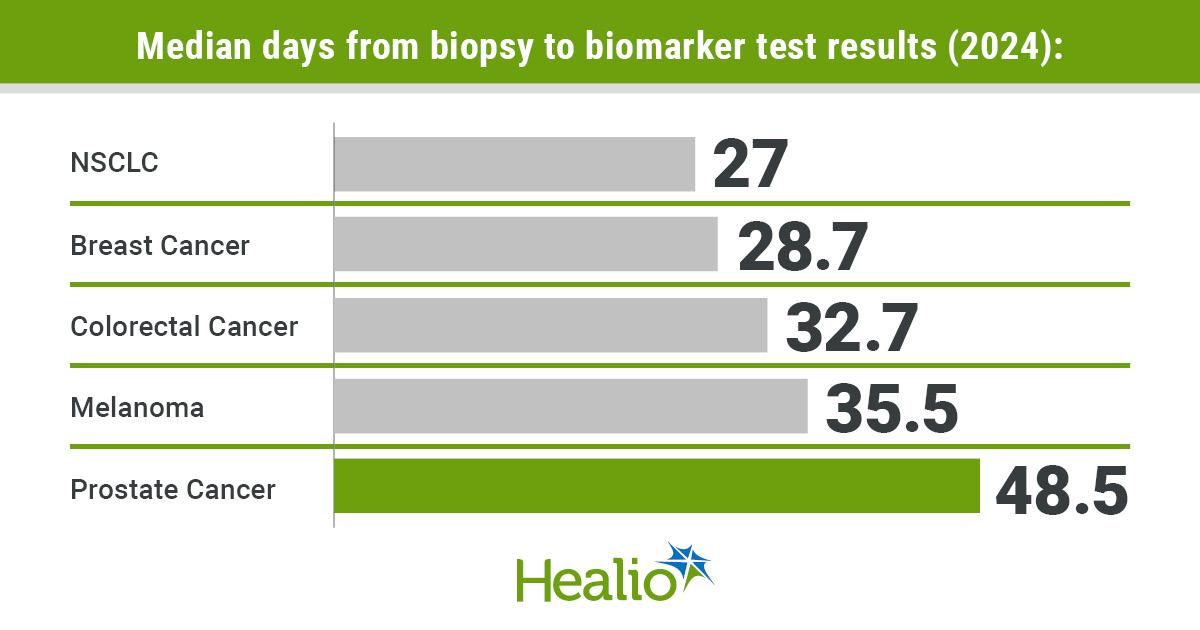
An analysis by cancer type showed the shortest turnaround time for NSCLC samples. It declined from a median 36.6 days (IQR, 27.9-51.6) in 2018 to 27 days (IQR, 19.5-39.9) in 2024.
Fox said he was “pleasantly surprised” to see these decreases but noted much of the improvement has been due to streamlined processes at the molecular laboratory, which shortened the time between sample receipt and availability of results.
For example, molecular laboratory turnaround time for NSCLC samples declined from a median 15.2 days (IQR, 13.5-17.3) in 2018 to 7.1 days (IQR, 6.2-8.1) in 2024 (P = .009 for comparison).
“That is a great win, but the time between biopsy and placing the testing order did not change over the study period,” Fox said. “To see no real improvement over time in that area was really frustrating.”
Turnaround time from biopsy to test result availability varied greatly between clinical sites.
The analysis of all tumor types showed the fastest quintile of sites had a turnaround time of 23.1 days (IQR, 20.6-24.6), compared with 46.5 days (IQR, 42.7-50.8; P < .001 for comparison) in the longest quintile of sites. The analysis limited to NSCLC samples showed the fastest quintile of sites had a turnaround time of 19.5 days (IQR, 16.7-20.6), compared with 38.9 days (IQR, 35.3-41.8; P < .001 for comparison) in the longest quintile of sites.
Meanwhile, median time from biopsy to comprehensive genomic profiling ordering for all samples ranged from 10 days (IQR, 8-12) in the shortest quintile to 30.8 days (IQR, 26.6-35) in the longest quintile. Median time from biopsy to test ordering for NSCLC samples ranged from 8 days (IQR, 6.8-9.1) in the shortest quintile to 23.8 days (IQR, 21-28.3) in the longest quintile (P < .001 for comparison).
“This is the longest component of the process but, the good news is, it also is the most modifiable,” Fox said.
Downstream bottlenecks
Multiple factors — including higher ordering volume at a clinical site, use of electronic methods to order testing and younger patient age — appeared associated with shorter turnaround time.
Turnaround time also varied by cancer type.
It likely is shortest in lung cancer due to “the sheer volume of need across stages,” Fox said, given the number of actionable genetic variants and increasing availability of targeted therapies. Turnaround time appeared longer for other solid tumors for which there are “fewer indications for need,” Fox said.
A table published with the study outlines overall turnaround time — as well as time for each key step in the process — for more than 20 malignancies.
Aside from lung cancer, common malignancies with the shortest overall median turnaround time included breast cancer and pancreatic/biliary cancer (28.7 days each). Malignancies with the longest median turnaround time included prostate cancer (48.5 days), appendix cancer (46.4 days) and nonmelanoma skin cancer (42.7 days).
“It is becoming thematic across solid tumor cancers that this testing is important, but there is still variability about how important testing is across cancer types and stages having different levels of priority,” Fox said.
The layers of care patients receive during diagnosis and staging also may contribute.
For example, a primary care physician may refer a person with a suspected genitourinary malignancy to a urologist. The patient then may see a surgeon who deems a tumor unresectable, prompting referral to a medical oncologist, and only then is molecular testing ordered.
Fortunately, multiple strategies can be implemented to streamline processes for ordering comprehensive genomic profiling, Fox said.
Some sites have instituted reflex testing. This automated, preapproved protocol allows a pathologist to request molecular or biomarker testing as soon as a cancer diagnosis is confirmed, eliminating the need for the oncologist or another member of the care team to order the test manually.
This process works well for some practices, but challenges can arise in certain settings.
“If a pathology group serves patients who receive care from several oncology groups, it would need to have an understanding of the tests that each of those oncology practices wants. Additionally, many patients do not have a designated oncologist until after their diagnosis is confirmed and a referral is made. Ideally, biomarker testing is started prior to a patient establishing with an oncologist to help inform initial treatment decisions,” Fox said. “Our analysis focused on one comprehensive genomic panel. Some oncology practices might want something different. They might say, ‘We like this vendor’s report better than that other vendor’s report,’ or ‘I think one company’s test is more helpful.’ This fragmentation would be much harder for a pathology practice to coordinate.”
Pathologists may be more accustomed to ordering tests that guide diagnostic clarity rather than those that help with treatment decisions, but incorporating those specialists into the genomic profiling process can be “incredibly powerful,” Fox said.
“A primary care physician, a pulmonologist, an interventional radiologist, a surgeon or any number of other people might acquire a biopsy through some means, but they all go through a pathologist,” Fox said. “Anything that can be done to empower them and help them identify patients who need testing, and make sure processes are coordinated with the oncology group, will eliminate some of the downstream bottlenecks that can occur if you have to wait for a surgeon, oncologist or radiation oncologist to order these tests.”
‘This is an issue’
The researchers acknowledged study limitations, including lack of information about cancer stage or the time between tissue availability and pathologist diagnosis.
However, the study’s robust sample size yielded extrapolatable data about the delays that occur between biopsy and biomarker-informed treatment decisions, Fox said.
Because of variations in practice settings — as well as across tumor types — it likely would be unrealistic to identify one industry standard for time to test ordering, Fox said. However, societal guidance supporting reflex testing would be valuable, he said.
“Hopefully this work brings the topic to light and helps people realize this is an issue,” Fox said.
For more information:
Adam H. Fox, MD, MS, lung cancer pulmonologist at Medical University of South Carolina’s Hollings Cancer Center, can be reached at foxah@musc.edu.
Sources/Disclosures
Source:
Fox AH, et al. JCO Oncol Pract. 2026;doi:10.1200/OP-25-01191.
References:
Disclosures:
Fox reports research funding to his institution from Eli Lilly & Co.; a consulting/advisory role with AstraZeneca; stock or other ownership interests in Merck; honoraria from Eli Lilly & Co. and Olympus; and an uncompensated relationship with Foundation Medicine. Please see the study for all other authors’ relevant financial disclosures.

Ask a clinical question and tap into Healio AI’s knowledge base.
- PubMed, enrolling/recruiting trials, guidelines
- Clinical Guidance, Healio CME, FDA news
- Healio’s exclusive daily news coverage of clinical data