
Key takeaways:
- Nutritional delivery improved by 3.2 percentage points in invasively ventilated pediatric patients.
- Survival and time spent on ventilation were similar regardless of whether gastric residual volume was assessed.
When gastric residual volume was not regularly assessed in pediatric patients on ventilation undergoing enteral feeding, nutritional achievement at 72 hours improved, according to study results.
Findings, published in JAMA, also showed that no routine assessment was noninferior to the usual care relative to mortality and days spent ventilated.

Gastric residual volume (GRV) — the quantity of fluid obtained when aspirating a gastric tube — is regularly assessed in many ICUs. The practice is intended to reduce risk for ventilator-associated pneumonia, necrotizing enterocolitis in infants, vomiting and aspiration.
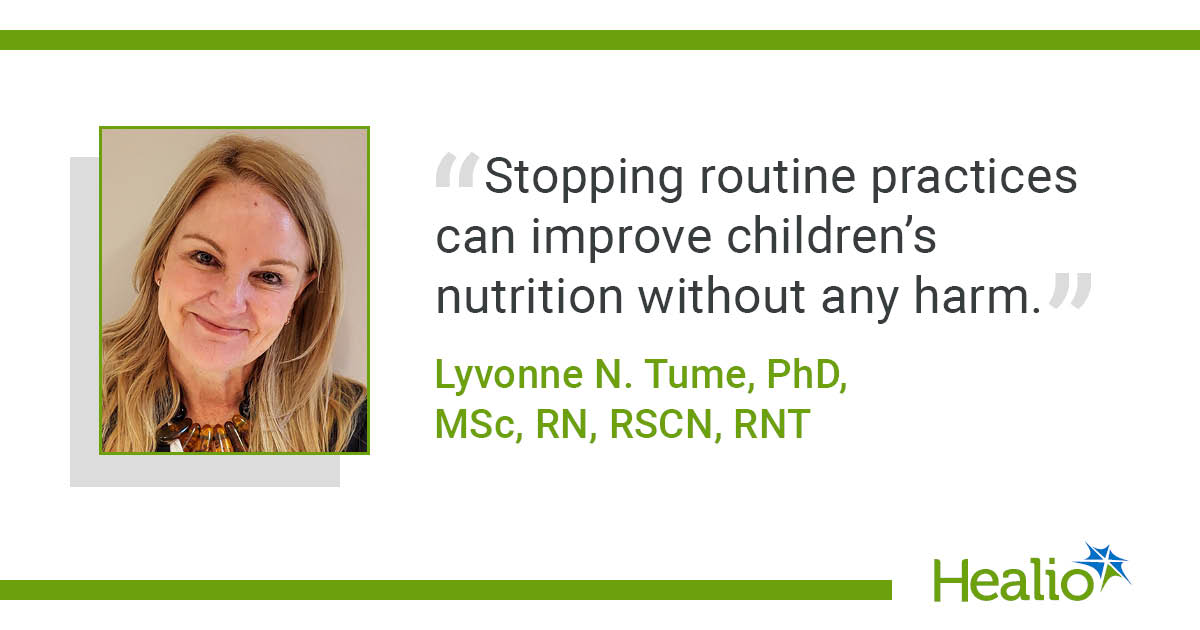
“This routine practice has been embedded in intensive care nursing for many years, but lacks [supporting] research evidence,” lead study author Lyvonne N. Tume, PhD, MSc, RN, RSCN, RNT, a pediatric intensive care unit nurse and professor of critical care nursing at Liverpool John Moores University, told Healio.
Studies of ventilated adult patients found that cutting routine GRV assessment improved nutrition and had no impact on ventilator-associated pneumonia, according to study background.
“Children in intensive care generally receive less than half the calories they are predicted to need,” Tume said. “One of the reasons for this is that feeds are often stopped because of the volume of fluid obtained by this practice.”
Tume and colleagues evaluated the impact of no routine assessment of GRV vs. usual care in a pragmatic, unblinded, multicenter, randomized, noninferiority trial of pediatric patients.
Their final analysis included 4,460 children (median age, 8 months; 57.4% boys) aged 0 to 16 years at 23 pediatric intensive care units in the United Kingdom and one in Switzerland.
Eligible patients were receiving enteral feeding via gastric route while on invasive ventilation between June 2023 and December 2025. They underwent 1:1 randomization to receive no routine GRV assessment or usual care, defined as GRV assessment every 6 hours.
Nurses could assess feeding intolerance via clinical signs in the intervention group, as well as GRV in certain situations, including before procedures, after vomiting and in response to clinical deterioration.
Primary outcomes included composite measure of mortality and days spent off ventilation at day 30, as well as the number of children that met energy requirements at 72 hours.
During the study period, 58.1% of patients received continuous enteral feeding.
Days free of ventilation at 30 days and survival reached a median 25 days (range, 21-27) in both groups, indicating no routine GRV assessment was noninferior to usual care (adjusted OR = 0.95; 95% CI, 0.86-1.05).
After 72 hours of treatment, children without routine GRV assessments achieved 80.3% of their energy requirements. In the usual care group, 76.8% of patients met nutrition requirements (adjusted mean difference, 3.2%; 95% CI, 1.3%-5.2%). This achievement may not seem like much, Tume said. But in certain children, such as cardiac babies, this can make a real difference, which the subgroup analyses showed.
“Our large trial shows that not doing this did not negatively impact patients and, in fact, improved the nutrition that they received,” Tume said. “Our recommendations are that this ‘routine’ practice be stopped, and that this should only be done when it is necessary to do so — not routinely every 4 to 6 hours.”
Patients who did not receive routine GRV assessments also spent less time off enteral feeding during the first 7 days (adjusted mean difference, 1.7 hours; 95% CI, 3.1 to 0.4).
Rates of necrotizing enterocolitis and ventilator-associated pneumonia were not significantly different between groups.
This study only included children on invasive ventilation. Tume and colleagues recommend future studies evaluate GRV assessments’ impact on patients receiving enteral feeding while on noninvasive respiratory support.
“There are other routine practices in children’s ICUs that need to be questioned and tested through clinical trials,” Tume said. “One such practice is the routine and prolonged fasting of children before and after removal of the breathing tube.”
For more information:
Lyvonne N. Tume, PhD, MSc, RN, RSCN, RNT, can be reached atl.n.tume@ljmu.ac.uk.

Ask a clinical question and tap into Healio AI’s knowledge base.
- PubMed, enrolling/recruiting trials, guidelines
- Clinical Guidance, Healio CME, FDA news
- Healio’s exclusive daily news coverage of clinical data