

Key takeaways:
- The parasite, which lives on produce, has caused an outbreak of cyclosporiasis.
- An ID expert said there are “probably multiple sources of contamination.”
Cyclosporiasis — a foodborne illness caused by a parasite that lives on fruits and vegetables — has surged in several parts of the country, according to federal and state health officials.
At least 18 states have reported cases of cyclosporiasis, which, the CDC says, can cause bouts of “watery diarrhea” and “explosive bowel movements.”

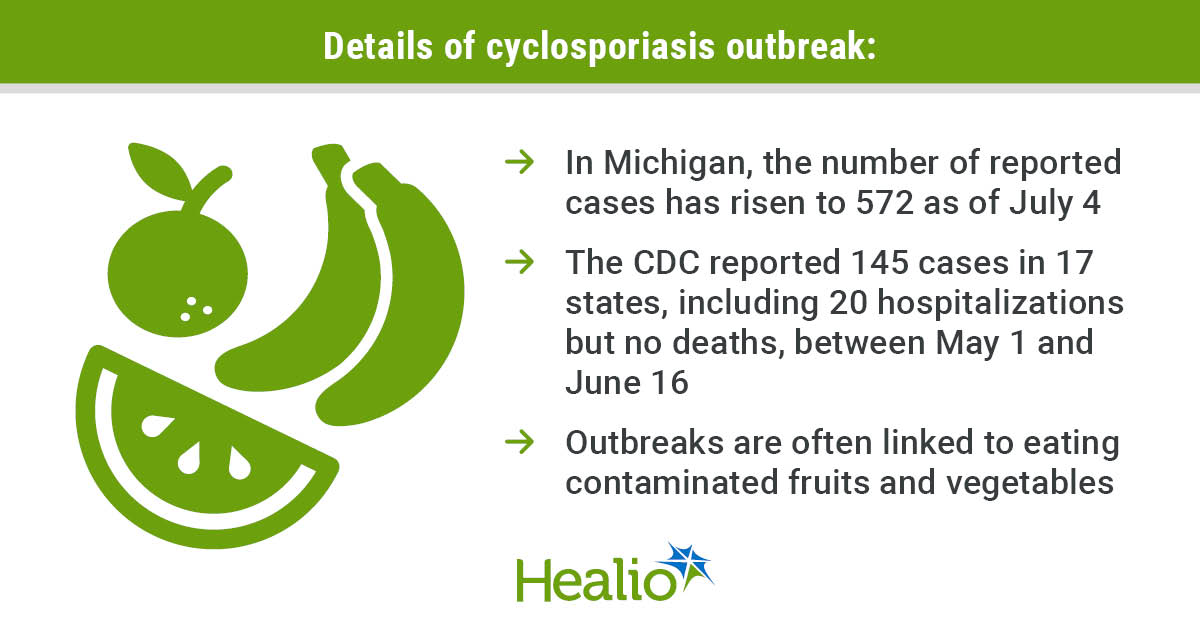
Data derived from the CDC and the Michigan Department of Health & Human Services.
Health officials have not identified an outbreak source, and that is a cause for concern, said David O. Freedman, MD, FIDSA, professor emeritus of infectious diseases at the University of Alabama at Birmingham.
“Usually, by this point, they’ve been able to identify where it came from,” Freeman said. “I think there are probably multiple sources of contamination, and the parasite has gained more of a foothold. It’s just spreading geographically.”
On July 1, the CDC reported a cyclosporiasis outbreak, with 145 cases in 17 states between May 1 and June 16, including 20 hospitalizations but no deaths.
Since then, Michigan, which was not included in the CDC notice, reported a cyclosporiasis cluster in the southeastern corner of the state, with its Department of Health & Human Services counting 572 cases as of Saturday.
Ohio also has been hit hard as its Department of Health reported 268 suspected cases of the illness since June 20.
Freedman said the parasite, known as Cyclospora, is transmitted when fecal-contaminated water gets sprayed onto crops. He said leafy green vegetables and berries are most susceptible to Cyclospora.
“The parasite will stick to the plants, will feed on plants and multiply,” he said, “and then the plants will be ingested by humans.”
That is why, he said, it is important to scrub clean fruits and veggies and added that immuno-compromised individuals should avoid eating uncooked produce amid a cyclosporiasis outbreak.
In addition to diarrhea, the CDC says other cyclosporiasis symptoms include cramps, nausea, loss of appetite, vomiting, fatigue, body aches, low-grade fever and other flulike symptoms. Without treatment, symptoms could last anywhere from a few days to a month or longer.
The CDC recommends trimethoprim-sulfamethoxazole, a combination antibiotic used to treat and prevent bacterial infections, as the preferred medication for cyclosporiasis.
The agency pointed out that most healthy people will recover without medical attention.
“The good news is that it’s relatively easy to treat,” Freedman added, “but it can be a miserable number of days of diarrhea.”
For more information:
David O. Freedman, MD, FIDSA, can be reached at infectiousdisease@healio.com.
Sources/Disclosures
Source:
References:
Disclosures:
Freedman reports no relevant financial disclosures.

Ask a clinical question and tap into Healio AI’s knowledge base.
- PubMed, enrolling/recruiting trials, guidelines
- Clinical Guidance, Healio CME, FDA news
- Healio’s exclusive daily news coverage of clinical data