July 09, 2026
1 min watch

Key takeaways:
- Rates of semiannual HCC surveillance dropped from 30.8% in the pre-COVID-19 era to 22.3% in the post-COVID-19 era.
- Less than 12% of uninsured or indigent care-covered patients underwent surveillance.
Only one out of every five adults with cirrhosis in safety-net health systems receive guideline-concordant hepatocellular carcinoma surveillance.
Rates have dropped significantly since before the COVID pandemic, according to data published in JAMA Network Open, and researchers have not observed a rebound after.

“Even when you look at the period before the pandemic, what we describe as baseline, liver cancer screening was already dismally low,” Robert J. Wong, MD, MS, clinical associate professor of medicine in the division of gastroenterology and hepatology at Stanford University School of Medicine, told Healio.
Wong pointed out that because liver cancer screening must be done in-person, he and his colleagues expected screening disruptions during the pandemic when in-person care declined.
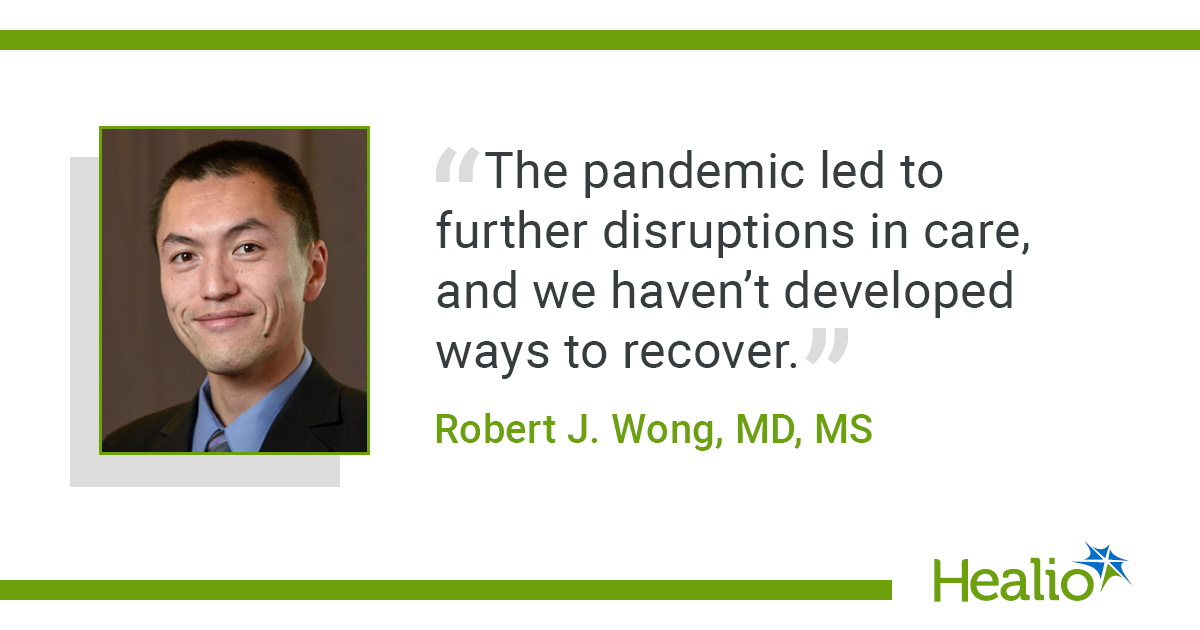
“What was surprising and alarming was that when we looked even beyond the first 2 years [of the pandemic], these numbers still did not recover,” he said. “They declined following the pandemic, and they have remained particularly low [since], which was concerning because it shows this is a population that was already underserved. The pandemic led to further disruptions in care, and we haven’t developed ways to recover.”
The American Association for the Study of Liver Diseases recommends patients with cirrhosis undergo HCC surveillance every 6 months, according to study background.
Researchers conducted a retrospective cohort study across five safety-net health systems in the U.S. to evaluate HCC surveillance use among adults with cirrhosis in three time periods: the pre-COVID-19 era (March 1, 2018, to Feb. 29, 2020), the COVID-19 era (March 1, 2020, to Feb. 28, 2022) and the post-COVID-19 era (March 1, 2022, to Feb. 29, 2024). They included 6,940 patients (57.7% men; median age, 58 years; 44.4% white) in their analysis.
Undergoing HCC surveillance — via ultrasonography, CT or MRI — served as the primary endpoint.
Analysis showed that the proportion of patients who underwent HCC surveillance within 6 months of cirrhosis diagnosis was 30.8% in the pre-COVID-19 era, 21.1% in the COVID-19 era and 22.3% in post-COVID-19 era.
Researchers noted consistent and similar trends in surveillance regardless of gender, age or race, except for Asian individuals, who experienced an increase in the post-COVID-19 era.
In the post-COVID-19 period, only 11.9% of uninsured or indigent care patients underwent HCC surveillance.
“When we stratified by subgroups, we saw that [screening] declined for most of the groups and then sort of plateaued and didn’t really get better, but there were a few groups where we saw the rates continue to decline [in the post-COVID-19 era],” Wong told Healio.
“This was seen in those that had indigent care or were uninsured. It’s a particularly vulnerable group within this safety-net population already and brings to light the need to develop better ways to address these gaps that clearly existed before the pandemic but now have certainly been exacerbated.”
Annual rates of HCC surveillance also have declined, dropping from 40.6% in the pre-COVID-19 era to 31.4% and 30.1% in the COVID-19 and post-COVID-19 eras, respectively.
Given that more than 3 years have passed since WHO officially ended the COVID-19 public health emergency, Wong called it “disappointing” and “disheartening” to see rates decline.
“Despite all that the field has done in terms of education and trying to improve liver disease itself and liver cancer treatment, if we’re not getting people diagnosed, then all of that doesn’t make as big of an impact,” Wong said.
“Now we’re trying to develop targeted interventions unique to these populations, unique to specific centers, while working together with patients and primary care providers, to see what will be effective on the front lines that is practical, easy to use and easy to implement,” he added.
For more information:
Robert J. Wong, MD, MS, can be reached at rwong123@stanford.edu.

Ask a clinical question and tap into Healio AI’s knowledge base.
- PubMed, enrolling/recruiting trials, guidelines
- Clinical Guidance, Healio CME, FDA news
- Healio’s exclusive daily news coverage of clinical data