

Key takeaways:
- The Oakland score should be used alongside clinical judgment to predict safe discharge for patients with lower GI bleeding.
- The score was among the most discriminative and had the highest specificity in analyses.
The Oakland score outperformed several risk assessments and should be used alongside clinical judgment when determining which patients with lower gastrointestinal bleeding can be safely discharged, according to study results.
Findings, published in Clinical Gastroenterology and Hepatology, showed the Oakland score to be the most discriminative and specific among several lower and upper GI bleeding risk scores analyzed.

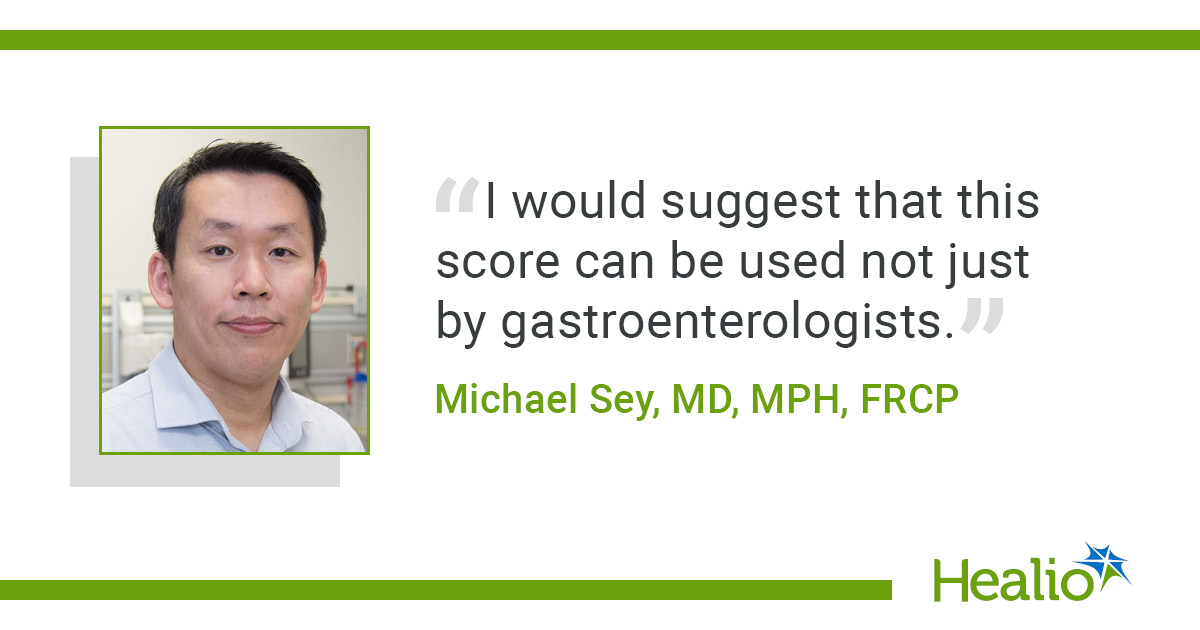
“I would suggest that this score can be used not just by gastroenterologists but also by emergency physicians, internists, hospitalists and general surgeons — basically anyone who sees [lower gastrointestinal bleeding (LGIB)] patients in the ED,” Michael Sey, MD, MPH, FRCP, a gastroenterologist who specializes in advanced therapeutic endoscopy at London Health Sciences Centre in Ontario, told Healio. “It’s a useful tool to help them identify which patients are safe for outpatient management.”
‘Critical limitation’
The Oakland score was developed and validated using data from more than 48,000 cases of lower GI bleeding in the U.S. and U.K., according to study background. Previous analyses have shown the score outperformed other risk scores in predicting safe discharge among patients hospitalized with lower GI bleeding.
“The problem was all the studies done in the past were limited to patients who were admitted for LGIB,” Sey explained. “This is a critical limitation in our field given we are trying to predict who can be safely discharged from the ED. Thus, if we only study those who are hospitalized and exclude those who are discharged — the very people we seek to identify — then this seriously threatens the validity of the work.”
Additionally, prior studies did not compare risk scores with clinical judgment, the current standard of care.
Sey and colleagues conducted a prospective cohort study of patients with lower GI bleeding to compare the Oakland score with other lower and upper GI bleeding risk scores, as well as clinical judgment, in predicting safe discharge. Strate and BLEED scores (lower) and Glasgow-Blatchford and clinical Rockall scores (upper) were used for comparison.
Analysis included 344 patients (mean age, 59.2 years; 47.7% women) presenting to the ED at eight hospitals in Canada between September 2019 and February 2024.
Safe discharge, which researchers defined as the absence of readmission, blood transfusion, endoscopic/radiologic/surgical hemostasis or death by day 28, served as the primary outcome.
High discrimination, specificity
In total, 41.5% of patients were admitted to the hospital. Adverse outcomes by day 28 included blood transfusion (12.2%), endoscopic hemostasis (7.4%), readmission after discharge (4.7%), transanal surgery (2%) and surgical hemostasis via laparotomy (1.5%). Five patients died. About three-quarters (76.7%) of patients had no adverse outcomes and could be safely discharged.
Multivariable analysis showed the Oakland score outperformed Strate and BLEED scores in discrimination for safe discharge (area under the receiver operating characteristics curve = 0.77 [95% CI, 0.68-0.83] vs. 0.68 [95% CI, 0.59-0.75] and 0.62 [95% CI, 0.56-0.69]). The Glasgow-Blatchford score had an AUC of 0.81 (95% CI, 0.74-0.87) and clinical Rockall had an AUC of 0.63 (95% CI, 0.56-0.71).
Clinical judgment had an AUC of 0.76 (95% CI, 0.7-0.8), which was not significantly different than the Oakland score.
Researchers found the Oakland score — with a cutoff threshold of no more than 8 — had the highest specificity (94.8%) for the lower GI scores, followed by 80.3% and 77.5% for Strat and BLEED scores, respectively. The upper GI risk scores had similar specificities (87.9% for Glasgow-Blatchford and 89.9% for clinical Rockall). The specificity for clinical judgment was 81%.
Positive predictive values were similar for the Oakland score (93.7%), Glasgow-Blatchford score (93%) and clinical judgment (92.5%).
“The one piece of data I was really excited to see was how the Oakland score performed against clinical judgment,” Sey said. “This is ultimately the crux of our many years of research and prior to our study, completely unknown. As such, it was entirely possible that despite spending years of work developing this risk score, it could prove to be inferior to what we’re already doing day to day — clinical judgment.”
Researchers acknowledged study limitations, including that many patients did not undergo a digital rectal exam, which is a key element of the Oakland score, as well as likely heterogeneity in clinical judgment among physicians.
Sey noted that although no perfect prediction score exists — including clinical judgment —the Oakland score “performs really well” and appears to be the “ideal” score to use when assessing patients with lower GI bleeding for safe discharge.
“Most patients with LGIB do well, but a minority will experience serious adverse outcomes,” Sey said. “Our score helps predict and differentiate between the two groups. Ultimately, discharge decision-making is a complex cognitive process that has to take into account factors beyond direct LGIB adverse events, such as appropriate outpatient follow-up, social supports and concurrent medical conditions. For this reason, we felt clinical judgment should be used alongside our score.”
For more information:
Michael Sey, MD, MPH, FRCP, a gastroenterologist at London Health Sciences Centre and associate professor of medicine and epidemiology and biostatistics at Western University, can be reached at msey2@uwo.ca.

Ask a clinical question and tap into Healio AI’s knowledge base.
- PubMed, enrolling/recruiting trials, guidelines
- Clinical Guidance, Healio CME, FDA news
- Healio’s exclusive daily news coverage of clinical data