
July 13, 2026
1 min watch

Key takeaways:
- Patients diagnosed with early-stage hepatocellular carcinoma had comparable survival with external beam radiation as other traditional therapies.
- More research is needed for later-stage disease.
Patients with very early or early-stage hepatocellular carcinoma have similar survival with external beam radiation as they do with traditional therapies.
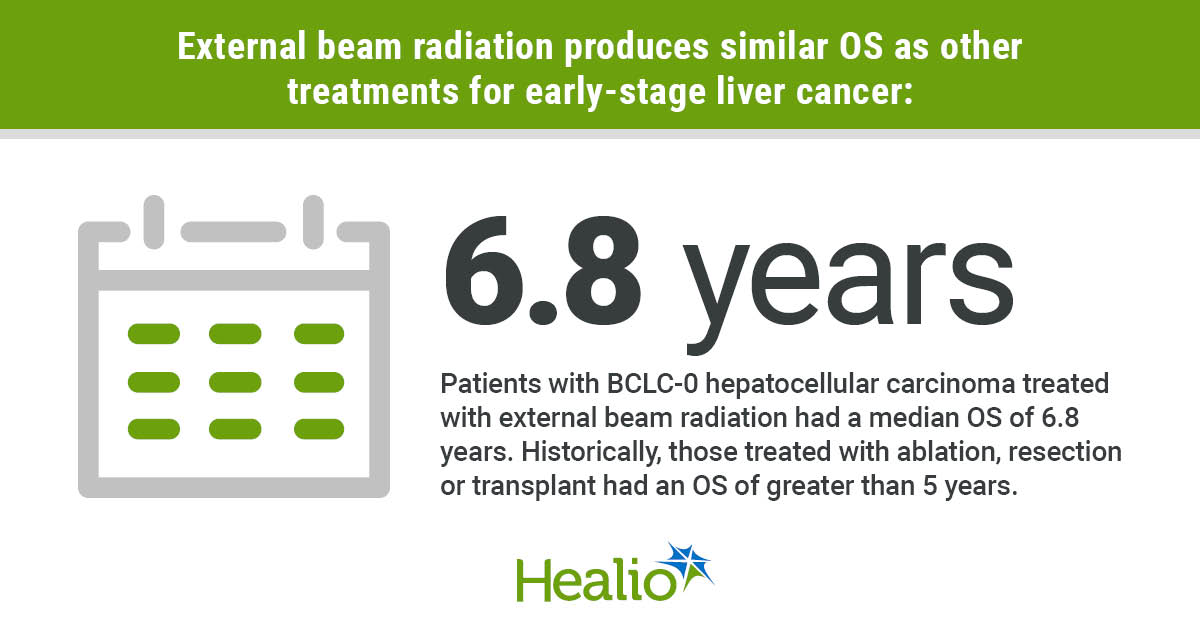
A systemic review of approximately 5,000 patients with HCC showed those with Barcelona Clinic Liver Cancer (BCLC) stage 0 had a median OS of nearly 7 years and those with stage A disease had a median OS of almost 5 years.

Data derived from Moon AM, et al. J Clin Oncol. 2026;doi:10.1200/JCO-25-02399.
The “benchmark” for traditional therapies, such as ablation, resection and transplant, is 5 years or more, Andrew M. Moon, MD, MPH, assistant professor of medicine in the division of gastroenterology and hepatology at The University of North Carolina at Chapel Hill, told Healio.

Andrew M. Moon
“External beam radiation therapy is an excellent treatment for patients with very early-stage and early-stage HCC,” he said.
The study, which included 4,913 patients (mean age, 67 years; standard deviation, 10; 76% men), prompted the BCLC group to recommend external beam radiation as a treatment option for this patient population after omitting it in its 2022 update.
Healio spoke with Moon about how external beam radiation fits in the treatment landscape of HCC, its potential in later-stage disease and more.
Healio: How has hepatocellular carcinoma historically been treated?
Moon: In localized hepatocellular carcinoma, there are three groups of treatments. We have surgical treatments like resection and liver transplant. We have non-surgical therapies like [transarterial chemoembolization (TACE)], transarterial radioembolization and thermal ablation. And then there’s the new kid to the block, external beam radiation, specifically stereotactic body radiation therapy.
Traditionally, surgical resection and thermal ablation have been the first-line options for very early-stage, a single lesion less than 2 centimeters. For early-stage, a single lesion of any size or up to three lesions of 3 centimeters or less, ablation, transplant and radioembolization have been the first-line therapies.
Healio: Why wasn’t external beam radiation used?
Moon: The main reason was, when you treat HCC with external beam radiation, the rest of the uninvolved liver got a high radiation dose, and patients would be at high risk for radiation-induced liver disease. But, techniques have improved in recent years, and now they can precisely target lesions with high doses of radiation with relative sparing of the uninvolved liver.
The nice thing about SBRT is it’s totally noninvasive. The patient sits there, the radiation beams come from outside the body, and the radiation can specifically target the HCC. Over the last couple years, we’ve shown really good outcomes in terms of local control, but we don’t have as much data on how external beam radiation influences overall survival.
The lack of overall survival data, specifically prospective data, led to the BCLC update in 2022 not including external beam radiation. There was a lot of controversy about that omission, particularly among the radiation oncology field. In light of that, Maria Reig, MD, PhD, director of Barcelona Clinic Liver Cancer of Hospital Clinic Barcelona and senior study author, was really interested in looking at the data on the association between external beam radiation therapy and overall survival among patients with HCC.
Healio: Why would some patients benefit from external beam radiation over other therapies?
Moon: Sometimes, decisions are straightforward. For example, if a patient cannot receive sedation or anesthesia because of a non-liver comorbidity or if a needle cannot physically reach a lesion to perform a thermal ablation – these are scenarios where external beam radiation can still be used effectively. Because external beam radiation is noninvasive, the patient just shows up, gets their treatment and walks out that day.
Other cases are more nuanced and will depend on many factors, including expectations around post-treatment symptoms. Radiation-based treatments can cause some fatigue. Sometimes we see nausea and abdominal pain. However, it can be better tolerated than some of the intra-arterial therapies, like radioembolization and TACE. Oftentimes, patients will say, “I didn’t really feel anything after the external beam radiation therapy.” If patients have lots of gastrointestinal symptoms before treatment, this can be better tolerated.
One of the downsides of external beam radiation is inconvenience. It often requires more treatment sessions, usually three to five, compared to ablation, TACE or radioembolization, which are one-and-done. Additionally, any radiation-based treatment can be associated with worsening liver function. We have to carefully select who’s a good candidate for external beam radiation. If we’re worried about their baseline liver function or if nearby sensitive organs will get too much radiation, like the stomach or small bowel, we often avoid it.
Healio: What is OS for other treatment modalities?
Moon: Patients with very early-stage or early-stage HCC who get first-line ablation, resection or transplant have an expected overall survival over 5 years. That was our benchmark.
Healio: What were the key findings?
Moon: The big findings are specifically for BCLC-0, a single lesion less than or equal to 2 centimeters. [Median] overall survival was 6.8 years for that group. The important thing is, if you look at a lot of studies of early-stage disease, they often report median overall survival, but they don’t look at it specifically among patients who are treatment naive.
Patients who have gotten another treatment are a totally separate population, and their overall survival is not expected to be as good because they’re diagnosed a few years earlier when they got their first treatment. We wanted to look not only at BCLC-0, but also treatment naive and then by liver disease stage.
There are a couple ways to look at liver disease severity, but the traditional way is Child-Pugh score. We wanted to look at patients who were Child-Pugh A, meaning good liver disease function, and treatment naive. In those patients with BCLC-0 HCC, median overall survival was not reached. External beam radiation was an excellent treatment for that patient population.
We did the same in patients who are BCLC-A, so a little more tumor burden than BCLC-0, and the overall survival was 4.6 years. When you just looked at patients who were treatment naive, it was 5.4 years, and when you looked at patients who were BCLC-A and had CP-A cirrhosis, it was 4.8 years.
From BCLC’s standpoint, external beam radiation was associated with 5-year survival among patients with BCLC-0 and BCLC-A that met the benchmark. In those specific patient populations, this can be considered a first-line treatment option. The updated BCLC, guidelines, which came out last year, included external beam radiation based on the data in our study.
Healio: What about late-stage disease?
Moon: We found some really interesting things. BCLC-B is at least two lesions, one of which is 3 centimeters or larger, or more than three lesions. It’s a lot of cancer confined to the liver. These patients are usually not eligible for ablative or curative treatment. For that BCLC-B population treated with EBRT, the median overall survival was 3.6 years, and if you look at treatment naive, it was 6.3 years, which is much better than expected.
The tricky thing is there’s probably a lot of selection bias, because patients with BCLC-B getting external beam radiation probably have really good liver function and earlier BCLC-B. If you’ve got a very large burden of cancer in the liver, external beam radiation probably isn’t a good option.
Most patients in the study who had BCLC-C were classified BCLC-C because they had vascular invasion. BCLC guidelines recommend first-line immunotherapy combinations for those patients, but more centers are using radioembolization or external beam radiation, particularly when it’s a small lesion with minor vascular invasion. In those BCLC-C patients, we saw median overall survival was 1.7 years for all comers. That’s similar to what you see with systemic therapy, particularly in clinical trials, where overall survival is getting closer to 2 years.
The reason to take those results with a grain of salt is I suspect that some of those patients may receive systemic therapy after getting external beam radiation, so I start to wonder what’s really driving the overall survival. Is it external beam radiation therapy or the subsequent lines of therapy?
Healio: What’s the big take-home message from this study?
Moon: Up until very recently, there have been a lot of skeptics about how effective this treatment was. Based on our results, which include nearly 5,000 patients from 11 countries with various etiologies and severities of liver disease, this is a treatment I can confidently say is a good option for my patients with very early or early-stage HCC.
Healio: What are the next steps in research?
Moon: Prospective trials comparing these ablative therapies would be welcome. I think prospective clinical trials comparing these treatment modalities will provide us important information. How do we best select patients for different treatments? Can we tailor treatments based on tumor size, number, location, liver disease severity and other baseline patient symptoms?
Future research also is needed on the role of external beam radiation for patients with advanced-stage disease. That’s a newer application of this technology.
Healio: Do you expect those trials to happen?
Moon: I think where we’re going to see a lot of action is combination therapy. I think a lot of drug companies are interested in seeing if there is a benefit of providing locoregional therapy plus one of the systemic therapies. We’ve already seen this in several trials using TACE. We’ve got some single-arm trials looking at radioembolization, and then we have some ongoing [trials] looking at external beam radiation therapy. I think those will provide some important insights.
As far as one locoregional therapy compared to another, those trials are much harder to fund. I’m hopeful that organizations like [Patient-Centered Outcomes Research Institute] understand the importance of those comparative effectiveness trials and fund much more in the HCC space.
Healio: How do you expect external beam radiation to be viewed in the next 5 to 10 years?
Moon: I sense much more acceptance in the field at large. There are still true believers in their specific modality. That’s only natural when you’re a specialist who’s been providing one specific treatment, but what you’ve seen in the guidelines over time is the number of locoregional therapies they recommend have only increased, and external beam radiation is now one. I think we’re going to see outcomes continue to improve for HCC across the board, particularly for patients seen in multidisciplinary settings with multiple treatment options.
For more information:
Andrew M. Moon, MD, MPH, can be reached at andrew.moon@unchealth.unc.edu.
Sources/Disclosures
Source:
Moon AM, et al. J Clin Oncol. 2026;doi:10.1200/JCO-25-02399.
Reference:
Disclosures:
Moon reports consulting or advisory roles with AstraZeneca, Eisai, IDEOlogy Health, Intercept Pharmaceuticals and Sirtex Medical; and research funding from DCN Diagnostics and Madrigal Pharmaceuticals. Please see the study for all other authors’ relevant financial disclosures.

Ask a clinical question and tap into Healio AI’s knowledge base.
- PubMed, enrolling/recruiting trials, guidelines
- Clinical Guidance, Healio CME, FDA news
- Healio’s exclusive daily news coverage of clinical data