

Key takeaways:
- There are now cyclosporiasis cases in more than half of U.S. states.
- The outbreak will eventually “burn” itself out even if a source is not found, an expert said.
Cyclosporiasis, a parasitic illness that causes explosive diarrhea, is still surging throughout the country.
As of July 9, the CDC said it has received reports of 843 cyclosporiasis cases from 31 states since May 1, including 86 hospitalizations and no deaths, although the actual case count is likely larger given that the agency’s count includes only confirmed cases.

Michigan alone had reported 2,640 cases as of Monday. Other hard-hit states include New York and Ohio — both reporting cases in the hundreds.
Federal and state health officials have issued warnings about the illness, which can lead to bouts of watery diarrhea and explosive bowel movements. It is caused by the parasite Cyclospora, which is transmitted to people through contaminated food or water, such as fruits or vegetables that have been sprayed with fecal-contaminated water.
A common source of the infections has not been identified, although past outbreaks have been linked to lettuce, raspberries, basil, cilantro and snow peas, according to the FDA.
For insight into the current surge, Healio checked in with David O. Freedman, MD, FIDSA, professor emeritus of infectious diseases at the University of Alabama at Birmingham.
Healio: Are all the cyclosporiasis warnings warranted or is this outbreak overhyped?
Freedman: On a national basis, for healthy people, the odds of any illness are still relatively low. Hospitalization, if ill, is extremely rare in normal hosts and care is noninvasive, involving mostly intravenous fluids and initiation of the antibiotic course. No deaths have occurred to date.
The word outbreak refers to rates of illness above a normal year. On a national basis the annual average number of cases is about 3,000, which we have not reached yet, although official reports take several weeks to catch up with individual cases submitted. This is partly due to diminished CDC capacity at the national level. A small number of individual states, notably Michigan, are now reporting case numbers at the outbreak level.
Healio: Can you explain why it is so important to find a source for the outbreak?
Freedman: It is likely that only a portion of the total cases are the result of a single source contamination event at a farm, processing plant or distribution center. The rest of the cases will be due to the dozens of small contamination events that occur each summer in the U.S.
Finding one or a few major contamination events will greatly diminish subsequent case numbers. However, it is important to remember that the incubation period from ingestion to illness is 1 to 2 weeks, so even after identification of a source, the process of withdrawing the product from the supply chain, educating the public to avoid products already in homes and waiting for incubating cases to manifest will take several weeks.
Healio: Do you feel the outbreak will only continue to spread until a source for it is identified?
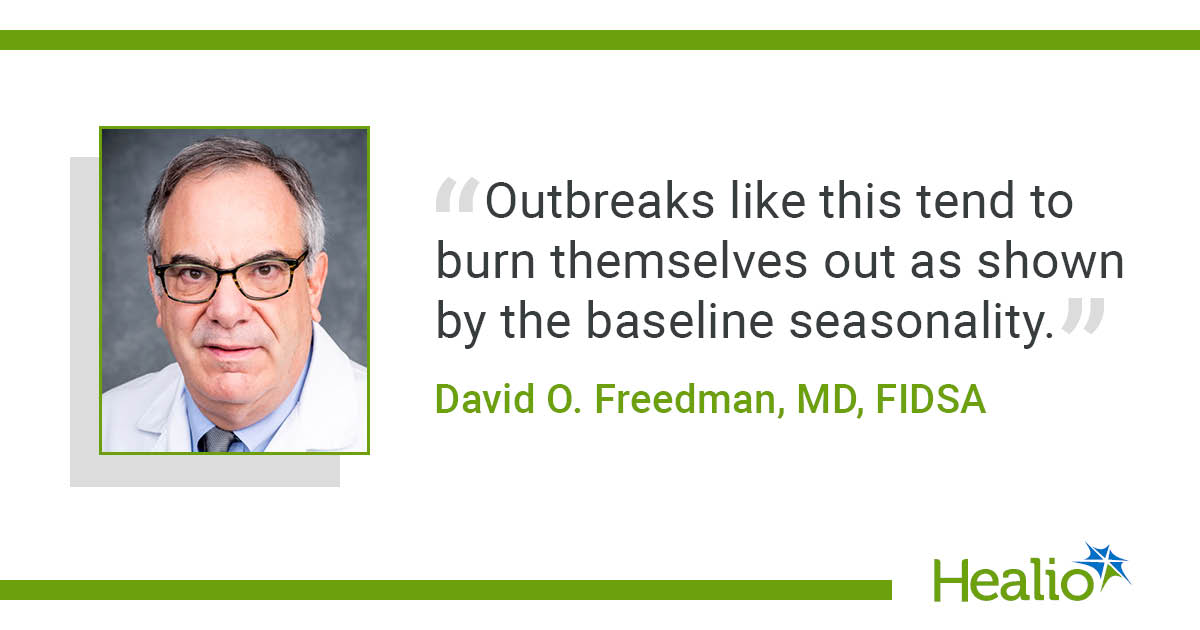
Freedman: Not necessarily. Outbreaks like this tend to burn themselves out as shown by the baseline seasonality that runs from May to August. Contaminated products that entered the processing chain early in the season may have been grown under different circumstances than products entering later in the season.
Healio: What specific tests are needed to confirm someone has cyclosporiasis?
Freedman: If a standard stool test for parasites is ordered, the special stain needed to visualize Cyclospora will not be done. A special stool test asking specifically for Cyclospora must be ordered and needs to be sent to a reference lab, which often will be in another city. Results may take up to 3 days to come back. A PCR test on a stool can also be done but is more specialized and expensive.
Healio: What is the standard medication used to treat this specific parasitic infection and when should it be considered?
Freedman: Treatment is trimethoprim-sulfamethoxazole (TMP-SMX), also known as Bactrim (Sun Pharmaceutical Industries), one double-strength tablet orally twice a day, for 7 to 10 days. Patients with HIV or who are immunocompromised may need longer courses of therapy. This is a very inexpensive generic prescription antibiotic that is easily available. It cannot be used if the patient has a sulfa allergy.
Healio: Is it necessary to re-test after finishing treatment to ensure the parasite is gone?
Freedman: Re-testing of stool, referred to as a test of cure, is unnecessary after resolution of symptoms in normal healthy persons. This applies either after a complete 10-day course of antibiotics or after spontaneous cessation of the diarrhea. Re-test only if symptoms persist. Some highly immunocompromised persons such as transplant patients or cancer chemotherapy patients should discuss re-testing with their treating physicians.
Healio: With all the talk about the illness causing “explosive diarrhea,” is that something that requires immediate medical attention because it really sounds worrisome?
Freedman: Most infections are mild and diarrhea will self-resolve in a few days. Warning signs necessitating medical consultation are high frequency of large volumes of diarrhea with signs of dehydration. This includes extreme thirst, dizziness upon standing and no urine production for more than 8 hours despite good fluid intake. An accompanying documented fever of 100°F is also an indication for medical care.
Healio: Are you advising friends and family to steer clear of any specific fruits or vegetables until the outbreak is over?
Freedman: Extremely vulnerable persons such as transplant patients and cancer chemotherapy patients should avoid berries and green leafy vegetables (including basil, cilantro, mint) especially in settings where the care taken with washing them is unknown.
Healio: If you vigorously scrub leafy greens and berries, are you still at risk?
Freedman: Rinsing with copious amounts of water will physically remove almost all organisms from the surfaces of green leafy vegetable and berries but is not 100% foolproof. The more heavily contaminated the food is, the more parasites will remain. On the other hand, the small number of remaining parasites is much less likely to result in illness.
Healio: So, are you saying this a good reason for me to avoid eating healthy for a while and just have all the potato chips that I want?
Freedman: There is very low but real indirect risk from nonimplicated foods. Potato chips prove to be a great example as the bag or shared bowl where many people are putting their hands in could have been contaminated by a previous person whose hands were contaminated by infectious parasites. The contaminator may have put their hands in a bowl of infectious berries, lettuce, basil, or cilantro in a buffet or other shared food setting. So, the background of general hand hygiene and food sharing in every situation needs to be accounted for.
For more information:
David O. Freedman, MD, FIDSA, can be reached at infectiousdisease@healio.com.
Sources/Disclosures
Source:
Healio Interviews
References:
- About cyclosporiasis. https://www.cdc.gov/cyclosporiasis/about/index.html. Published Sept. 4, 2024. Accessed July 13, 2026.
- FDA. Cyclospora. https://www.fda.gov/food/foodborne-pathogens/cyclospora. Updated July 25, 2022. Accessed July 13, 2026.
- Infectious disease outbreaks. https://www.michigan.gov/mdhhs/keep-mi-healthy/infectious-diseases/infectious-disease-outbreaks. Updated July 13, 2026. Accessed July 13, 2026.
- ODH director Dr. Vanderhoff: Take precautions, as cyclosporiasis can be a serious illness. https://odh.ohio.gov/media-center/odh-news-releases/cyclosporiasis-news-release-070826. Published July 8, 2026. Accessed July 13, 2026.
- Surveillance of cyclosporiasis. https://www.cdc.gov/cyclosporiasis/php/surveillance/index.html. Published July 10, 2026. Accessed July 13, 2026.
Disclosures:
Freedman reports no relevant financial disclosures.

Ask a clinical question and tap into Healio AI’s knowledge base.
- PubMed, enrolling/recruiting trials, guidelines
- Clinical Guidance, Healio CME, FDA news
- Healio’s exclusive daily news coverage of clinical data