
Key takeaways:
- Independent predictors of COMPASS-31 included EoE disease activity and hypermobility.
- The correlation between COMPASS-31 and a quality of life survey was negative.
Among pediatric patients with eosinophilic esophagitis, around a quarter had joint hypermobility, according to results published in The Journal of Allergy and Clinical Immunology.
Researchers went on to find that this group of patients had a significantly higher score on a questionnaire measuring autonomic symptoms vs. those without hypermobility, signaling greater symptom severity.

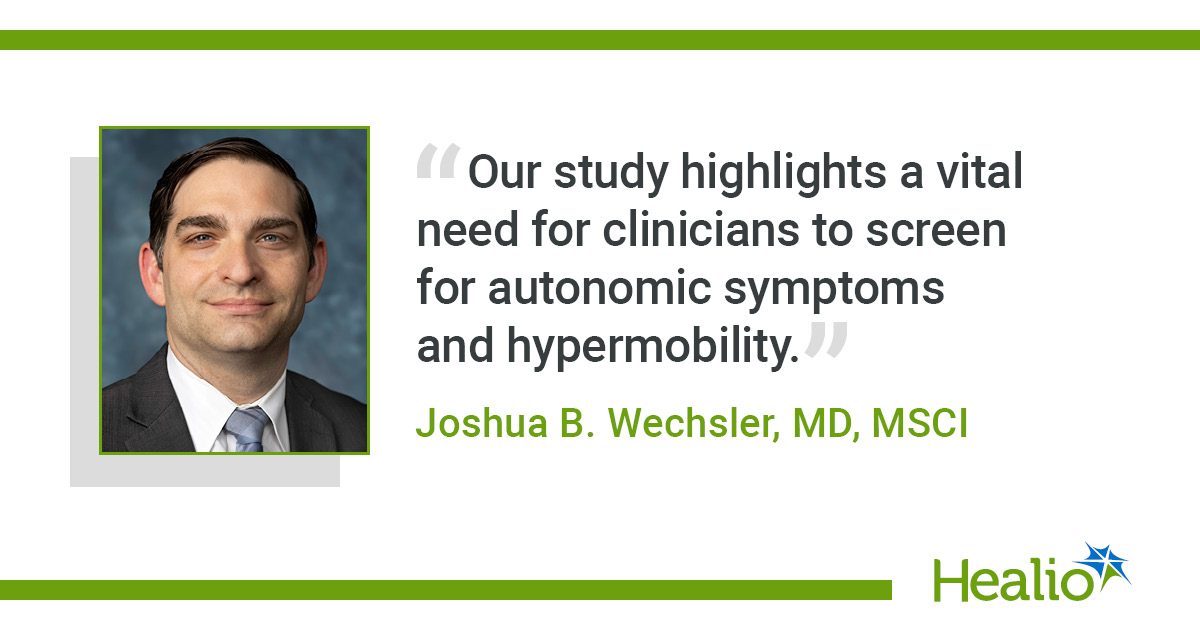
“Our study highlights a vital need for clinicians to screen for autonomic symptoms and hypermobility,” Joshua B. Wechsler, MD, MSCI, medical director of the eosinophilic gastrointestinal diseases program at Lurie Children’s Hospital of Chicago, told Healio. “Both of these ultimately have straightforward treatment options that are effective for many patients.
“For postural lightheadedness, many patients respond to increased fluids, salt, cardio and lower leg muscle strengthening,” Wechsler, who also is assistant professor of pediatrics and medicine at Northwestern University Feinberg School of Medicine, said. “For hypermobile patients, physical therapy and stable physical activity are crucial.”
In a prospective study, Wechsler and colleagues assessed 80 patients aged 2 to 21 years (mean age, 11 years; 21% female; 92% white) with EoE undergoing esophagogastroduodenoscopy to determine how autonomic symptoms are linked to symptoms, quality of life and mast cells (gastric and duodenal). Researchers also evaluated how joint hypermobility is linked to the same outcomes.
According to Wechsler, five factors prompted this study.
“Published literature supports increased connective tissue disorders in EoE, yet no study focused on hypermobility in particular,” he said. “[There is also a] close association between [postural orthostatic tachycardia syndrome (POTS)] and hypermobility.”
Wechsler told Healio the third factor was an anecdotal observation.
“Postural lightheadedness was common when I would meet patients, and often I was the first doctor identifying POTS,” he said.
The last two factors were an “appreciation that POTS may be a cause of GI symptoms and poor quality of life” and “recognition that EoE patients often have ‘unexplained symptoms’ that can’t be directly attributed to the EoE itself,” according to Wechsler.
Data collection
Researchers obtained data on autonomic symptoms from patients/caregivers using the Composite Autonomic Symptom Score 31 (COMPASS-31). For joint hypermobility, a five-question survey from the 2017 international classification of Ehlers-Danlos syndrome and the Beighton score were used.
Additional surveys were completed to measure the studied outcomes: the Pediatric Quality of Life Inventory (PedsQL) for quality of life; the Pediatric Eosinophilic Esophagitis Symptom Score (PEESS) and PedsQL EoE module for EoE symptoms; and the Dyspepsia Symptom Survey for gastric/duodenal symptoms.
For mast cells, the study also collected gastric and duodenal biopsy samples.
Results
COMPASS-31 was significantly greater in the EoE population vs. a published control cohort of asymptomatic pediatric patients (P < .001). When the EoE cohort was broken down by disease activity (active EoE, n = 45; remission, n = 35), researchers found a significantly greater COMPASS-31 among those with active EoE vs. in remission (P = .02).
The correlation between COMPASS-31 and PEESS Parent and Child composite scores was positive, as was the correlation between COMPASS-31 and three of four PEESS domain scores: gastroesophageal reflux, nausea/vomiting and pain.
In contrast, the correlation between COMPASS-31 and PedsQL scores from parents and children was negative, according to the study.
Switching to hypermobility, the EoE population consisted of 26% with hypermobility and 74% without hypermobility.
In the set of patients with EoE, researchers observed a significantly greater COMPASS-31 among those with vs. without hypermobility (P = .003).
“I was surprised at how common hypermobility and postural lightheadedness was among the patients,” Wechsler told Healio.
“As both of these conditions can impact quality of life, identification is a key first step,” he added. “Knowing that the EoE population is a vulnerable population emphasizes the need for screening.”
The study further highlighted that independent predictors of COMPASS-31 included disease activity (P < .01) and hypermobility (P < .01) in linear regression.
In the analysis of COMPASS-31 and the density of gastric and duodenal mast cells, no significant link emerged between the two factors. This outcome was also found between hypermobility and mast cell density.
“I was surprised that we didn’t see associations with mast cells, but the relationship may be much more complex than simple enumeration of mast cell density,” Wechsler told Healio.
“We don’t currently understand if the pathogenesis of hypermobility and dysautonomia ultimately intersect or fuel EoE itself, so future studies should evaluate this more closely,” Wechsler said. “In addition, we don’t know if longitudinal outcomes are different in this subtype.”
For more information:
Joshua B. Wechsler, MD, MSCI, can be reached at j-wechsler@northwestern.edu.
Sources/Disclosures
Source:
Patel RH, et al. J Allergy Clin Immunol. 2026;doi:10.1016/j.jaci.2026.05.027.
Reference:
Disclosures:
Wechsler reports being a consultant and/or speaker for AstraZeneca, Bristol Myers Squibb, Celldex, Ellodi, Sanofi-Regeneron and Takeda; and receiving clinical trial/research funding from Sanofi-Regeneron. All other study authors report no relevant financial disclosures.

Ask a clinical question and tap into Healio AI’s knowledge base.
- PubMed, enrolling/recruiting trials, guidelines
- Clinical Guidance, Healio CME, FDA news
- Healio’s exclusive daily news coverage of clinical data