

Key takeaways:
- The partial dismantling of FoodNet eliminated an “early-warning system” for cyclosporiasis.
- However, a CDC official said tracking of the foodborne illness remains “unchanged.”
Cases of cyclosporiasis — the foodborne illness that can cause prolonged bouts of watery diarrhea — continue to surge nationwide, raising questions about the partial dismantling of a federal surveillance system last year.
There have been 1,645 confirmed cases of cyclosporiasis in 34 states since May 1, including 141 hospitalizations and no deaths, according to the CDC, which said it is investigating an additional 5,100 cases.

The outbreak emerged months after the CDC made major cuts to its Foodborne Diseases Active Surveillance Network — known as FoodNet — a collaboration between federal health agencies and 10 states that actively monitors laboratory-confirmed infections from foodborne pathogens to help officials track and prevent food-related illnesses.
Last year, the Trump administration scaled back FoodNet, removing six pathogens from the program’s core monitoring list, including Cyclospora, the parasite that can live on fruits and vegetables and is responsible for cyclosporiasis.
“Because of cutbacks in funding, essentially FoodNet was gutted,” Healio | Infectious Disease News Editorial Board Member J. Glenn Morris Jr., MD, MPH&TM, who helped establish FoodNet in 1995 during his time with the U.S. Department of Agriculture, said during an interview.
Morris said the CDC now has limited capacity to track long-term illness trends and risks related to cyclosporiasis, although he said there is “not a direct cause and effect” between the cuts and the current outbreak.
“What we have seen … has been a major reduction in foodborne disease surveillance capacity at CDC due to the cutting back of FoodNet. What it means is that you’re losing sort of the early-warning system. You’re losing the system that lets you monitor what’s happening on a regular basis,” Morris said.
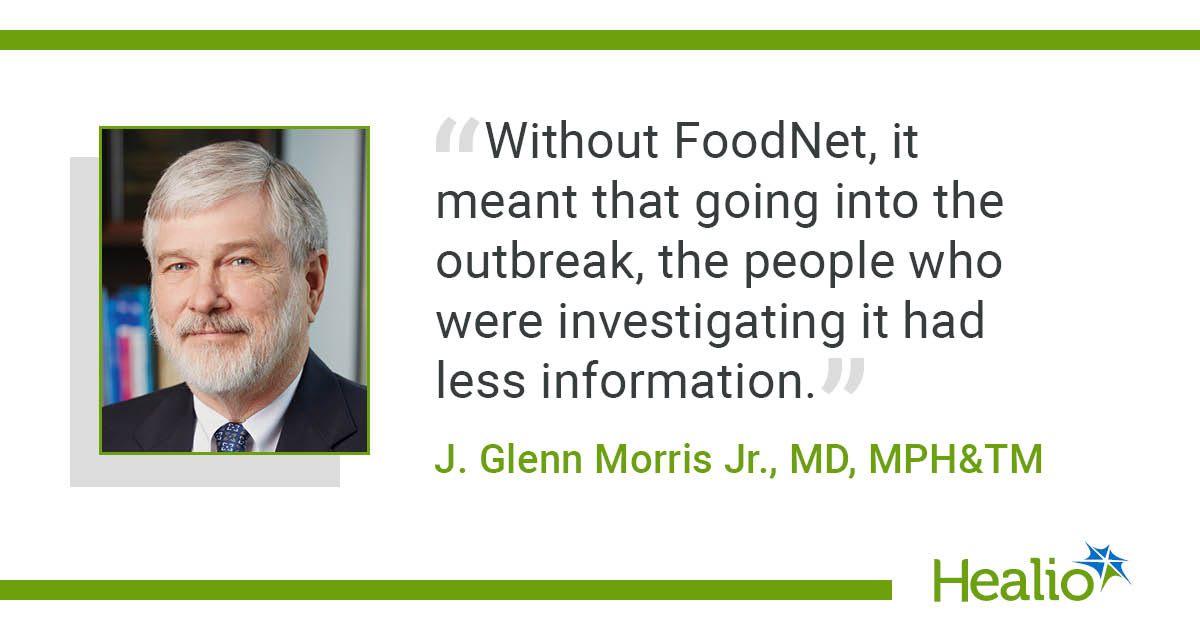
“Without FoodNet, it meant that going into the outbreak, the people who were investigating it had less information,” he said.
Gwen Biggerstaff, MSPH, deputy director of the CDC’s Division of Foodborne, Waterborne, and Environmental Diseases, said during a press conference on Tuesday that, even though states are no longer required to report cyclosporiasis cases to FoodNet, they are still providing relevant data to the agency.
“The data that we have for cyclosporiasis for this outbreak is the same as we’ve had. … We use the same systems and the same processes. So that is unchanged,” Biggerstaff said.
But Morris said the process has changed from active to passive surveillance without FoodNet.
“Passive surveillance is where you just sort of sit there and wait for people to report things to you. It gives you some idea of what’s going on, but it’s not optimal,” he said. “Active surveillance is where you actually go out there and try to find cases and see what’s really happening. FoodNet was an active surveillance program (in which) the CDC was paying specific state health departments to go out and look for cases of Cyclospora.”
He added, “Surveillance is the key to public health. If you don’t know what’s going on, then you’re not in a position to put in place interventions.”
For more information:
J. Glenn Morris Jr., MD, MPH&TM, can be reached at infectiousdisease@healio.com.
Sources/Disclosures
Source:
Healio Interviews
References:
Disclosures:
Morris reports no relevant financial disclosures.

Ask a clinical question and tap into Healio AI’s knowledge base.
- PubMed, enrolling/recruiting trials, guidelines
- Clinical Guidance, Healio CME, FDA news
- Healio’s exclusive daily news coverage of clinical data