

Key takeaways:
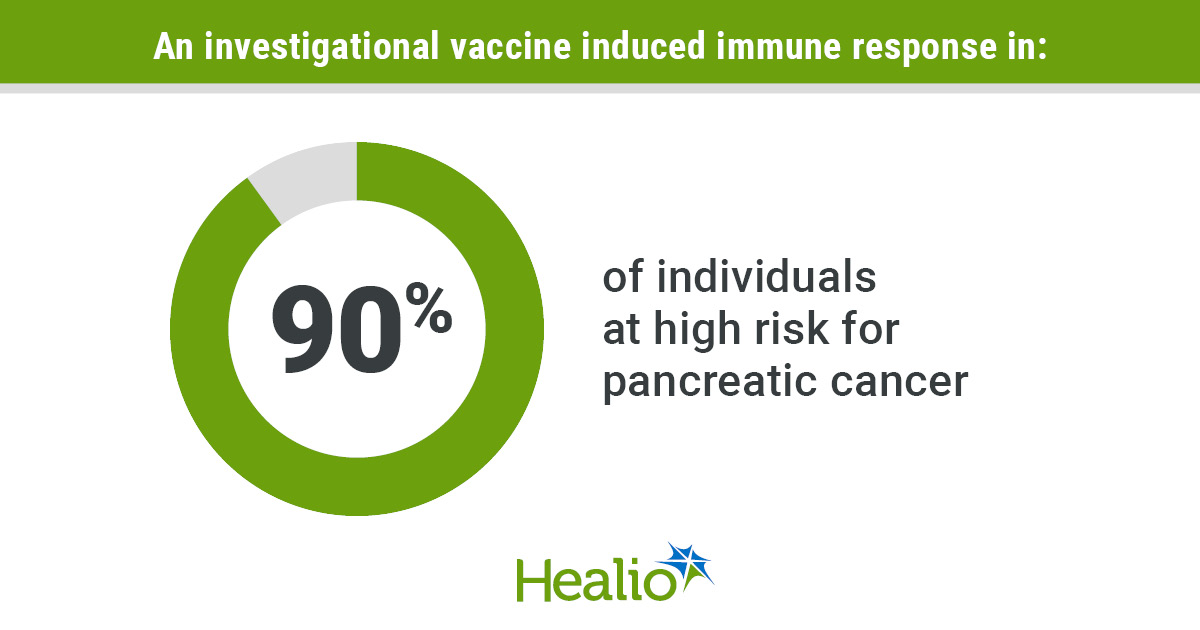
- 18 of 20 individuals at high risk for pancreatic cancer achieved KRAS-specific T-cell responses after vaccination.
- No trial participants developed pancreatic cancer and five had resolution of pancreatic cysts.
An investigational vaccine that targets common KRAS mutations induced durable immune responses among individuals at high risk for pancreatic cancer, results of a phase 1 clinical trial showed.
Eighteen of 20 participants achieved KRAS-specific T-cell responses. Several individuals had either complete radiographic resolution or regression of pancreatic cysts, and none developed pancreatic cancer by data cutoff.

The vaccine also appeared safe, according to researchers, with no grade 3 or higher adverse events reported.

Elizabeth M. Jaffee
“Despite tremendous efforts, we have yet to develop a way to identify pancreatic cancer early enough to prevent most people from dying of it. An important question is: Can we intercept it before it develops?” Elizabeth M. Jaffee, MD, FAACR, deputy director of Sidney Kimmel Cancer Center at Johns Hopkins and codirector of Skip Viragh Center for Pancreas Cancer at Johns Hopkins Medicine, told Healio. “If we can make more progress with screening modalities to better identify who is most at risk, hopefully we can get them a vaccine early and induce an immune response that prevents them from developing pancreatic cancer. I don’t see that happening next year, but I’m hopeful in the next 5 to 10 years that it will be a possibility.”
Seeking a ‘huge advance’
One in 10 people who develop pancreatic ductal adenocarcinoma (PDAC) have hereditary predisposition caused by pathogenic mutations in certain cancer susceptibility genes.
Most PDAC cases are diagnosed at advanced stages due to a lack of early detection strategies and absence of early symptoms.
The disease arises from precursor lesions, such as pancreatic intraepithelial neoplasia or intrapapillary mucinous neoplasms (IPMN). This process — which can take a decade or longer — creates “a window of opportunity” to intercept cancer development among high-risk individuals, according to study background.
No such strategy currently exists. Patients found to have precursor lesions undergo surveillance and — if progression is detected — surgery is standard. However, precursor lesions often are microscopic and many cannot be detected by imaging.
“We also have had instances where, during surveillance, it doesn’t look like the primary lesion is progressing,” Jaffee said. “Then we determine the person has metastasis, even before we have detected a true pancreatic cancer within the pancreas itself.”
As many as 80% of patients with precursor lesions who undergo resection due to concern about transformation to cancer or detection of early malignancy develop recurrence.
“It also is important to remember that this surgery is not harmless,” Jaffee said. “There is significant morbidity. It takes over a year for a person’s gastrointestinal tract to recover and make the enzymes needed to digest food, and patients often develop diabetes. It is not a simple operation so, if we could prevent this particular group of individuals from going to surgery, that would be a huge advance.”
Preventing ‘chaos’
Mutations in the KRAS gene are present in about 90% of pancreatic cancers, and they are a key driver in disease development and progression.
In prior preclinical work, Jaffee and colleagues used a genetically engineered mouse model to evaluate whether a KRAS-targeted vaccine could prevent progression of early precancers.
“We had hypothesized that if we could intercept them at the time of early KRAS activation, the immune system still may have the ability to react to this first change and prevent it from causing chaos that would induce more changes and ultimately lead to development of pancreatic cancer,” Jaffee said. “We were shocked at how well it worked.”
The researchers then tested mKRAS-VAX — an off-the-shelf, synthetic long peptide vaccine that targets six KRAS mutations commonly found in PDAC and precancer lesions — in combination with dual checkpoint blockade for a dozen patients with early pancreatic cancer who had undergone surgical resection. Results published in Nature Communications showed median DFS of 6.3 months and median OS of 29.5 months from the time of first vaccine dose.
Based on the evidence of immune response and vaccine safety, the investigators launched a phase 1 trial to evaluate the vaccine among 20 healthy individuals (median age, 66.5 years; range, 46-81) at high risk for PDAC based on familial and/or germline predisposition.
A majority of trial participants had at least one first-degree relative diagnosed with PDAC (85%) and harbored a germline mutation in a predisposition gene (60%). They all had radiographic evidence of a pancreatic abnormality, most often a small cyst indicative of IPMN.
Participants received the vaccine via subcutaneous injections, with priming doses administered during weeks 1, 3 and 5, and a boost dose administered in week 13.
Investigators collected blood samples at various time points and offered optional annual follow-up visits for long-term immune monitoring.
Inducing ‘memory response’
Median follow-up reached 16.5 months.
Results showed a median 18.2-fold increase (range, 1.8-167.1) in vaccinated individuals’ mutant KRAS-specific T-cell responses, pooled as an average across all six KRAS antigens targeted. Researchers classified the 18 participants (90%) who achieved more than a 2.5-fold increase as immune responders.
Longitudinal T-cell receptor sequencing showed responses remained detectable in the blood for as long as 2 years after vaccination.
No vaccinated individuals developed pancreatic cancer and none had radiographically detected high-risk pancreatic lesions that warranted surgery.
“What makes the immune response so powerful is that it can react when the cancer is there — or even when a precancer is there — but also develops a memory response that acts quickly if that same precancer tries to come back again,” Jaffee said. “We see this with the HPV vaccine and hepatitis B vaccine, both of which prevent virally-associated cancers. The mutated KRAS protein looks like a viral protein before the precancer starts to get very aggressive, so that is why we believe the immune system is seeing it, activating and developing this memory response.”
Changes in cyst size since baseline served as an exploratory endpoint. An analysis of 16 participants with available imaging showed five had cyst resolution and three others had partial regressions. All other cysts remained stable.
Radiologist review of surveillance MRI imaging from a cohort of unvaccinated individuals with similar clinical characteristics showed a higher rate of cyst reduction or resolution in the vaccinated cohort than the unvaccinated comparator group (37.5% vs. 6.8%; P = .01).
No grade 3 or higher adverse events occurred. A majority (85%) of trial participants developed mild injection site reactions. The other most frequent vaccine-related adverse events included fatigue (70%), chills (40%) and flu-like symptoms (40%).
“The vaccine has been safe for all individuals — both those who had cancer and those determined to be at high risk for it,” Jaffee said. “These are not cancer-inducing agents. They are pieces of the protein only, so they get degraded pretty quickly once they complete the immunization process. These proteins do not integrate with DNA. We have not seen any safety issues and we don’t expect to.”
Pursuing the dream
The researchers acknowledged study limitations, including the small cohort. Also, although findings suggest a potential correlation between immune response and outcomes, the trial had not been designed to assess the vaccine’s clinical efficacy.
Additional studies are necessary to validate that the induction and durability of KRAS-specific T-cell responses observed, as well as the evidence of regression or stability of pancreatic cysts among vaccinated individuals, are due to the vaccine, Jaffee said.
“We don’t have enough trial slots for all of the people who would like to be enrolled, so the goal for the next study is to look at how we can do this on a larger, multicenter scale to bring it to more individuals at risk,” Jaffee said.
A trial already underway will evaluate the vaccine among individuals who will need surgery due to transforming pancreatic cysts. Biopsies of resected cysts will allow investigators to measure whether KRAS-specific immune cells observed in peripheral blood are capable of infiltrating precancer lesions.
More research is also needed to clarify optimal vaccine approaches, targets used for immunization and timing of vaccine administration, Jaffee said.
However, the findings so far represent proof of concept that a vaccine may be able to intercept pancreatic cancer in humans and potentially improve outcomes among individuals at high risk, researchers concluded.
“We need to evaluate this in a much larger group of individuals and long-term surveillance is required, but this is a good start,” Jaffee said. “Pancreatic cancer cases are rising. We are seeing more early-onset cases and we don’t understand why. My dream has been to vaccinate 18- to 20-year-olds and prevent them from developing pancreatic cancer. Hopefully one day we think about this like we think about hepatitis B virus and liver cancer, or HPV and cervical or head and neck cancers, allowing us to vaccinate individuals who do not have cancer yet, when their immune system is rigorous, and induce a long-term memory response.”
For more information:
Elizabeth M. Jaffee, MD, FAACR, can be reached at ejaffee@jhmi.edu.
Sources/Disclosures
Source:
Haldar SD, et al. Cancer Discov. 2026;doi:10.1158/2159-8290.CD-25-2245.
References:
Disclosures:
Jaffee is a founder of, holds equity in and serves as a consultant to Adventris Pharmaceuticals, which licensed a technology described in this study from Johns Hopkins University. As a result of that agreement, Jaffee and the university are entitled to royalty distributions related to technology described in this study. Jaffee also reports other relationships with Abmeta Therapeutics, Bristol Myers Squibb, Genentech, Sanofi, The Lustgarten Foundation and other companies or entities. Please see the study for all other authors’ relevant financial disclosures. NCI, Stand Up To Cancer and The Lustgarten Foundation supported this study.

Ask a clinical question and tap into Healio AI’s knowledge base.
- PubMed, enrolling/recruiting trials, guidelines
- Clinical Guidance, Healio CME, FDA news
- Healio’s exclusive daily news coverage of clinical data