
Here is an interesting study of new gene variants in Congenital Hypotrichosis
The two key points I’d like you to take from this study are:
1. Two previously unknown (novel) mutations in the LSS gene were identified in children with congenital hypotrichosis, expanding the known genetic causes of this rare hair disorder.
2. This study reminds us that congenital hypotrichosis may not be limited to the hair. Some patients may also have abnormalities involving the teeth, highlighting the importance of looking beyond the scalp during clinical assessment.
BACKGROUND AND PURPOSE OF THE STUDY
Hypotrichosis simplex is a rare inherited form of hair loss that typically begins in infancy or early childhood. Children usually have sparse, fine, slowly growing hair but otherwise develop normally. Over the past several years, mutations in the LSS (lanosterol synthase) gene have emerged as one of the important genetic causes of this condition. Because relatively few patients have been described worldwide, physicians are still learning how different LSS mutations affect clinical presentation.
The purpose of this study was to identify the genetic cause of congenital hypotrichosis in two unrelated Chinese children and determine whether they carried previously unrecognized mutations in the LSS gene.
METHODS
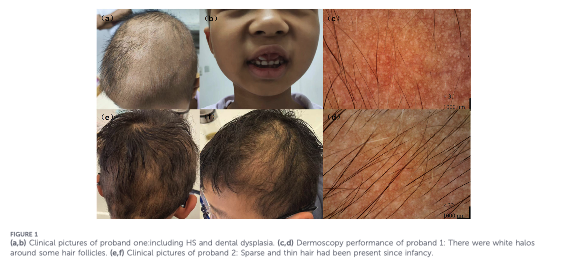
This was a genetic case report involving two unrelated Chinese pediatric patients with congenital hypotrichosis. The study included one 6-year-old girl and one 6-year-old boy. Both had sparse scalp hair beginning shortly after birth or in infancy. The girl also had delayed shedding of her baby teeth with abnormal eruption of permanent teeth, whereas the boy had isolated hair abnormalities. Neither child had neurological impairment, visual abnormalities, nail abnormalities, or intellectual disability. One patient’s older brother was also affected, while both sets of parents were unaffected, consistent with an autosomal recessive inheritance pattern. Race/ethnicity was Chinese. Because these were newly diagnosed children, no prior hair-loss treatments were reported.
The investigators performed whole-exome sequencing on both children and their parents, confirmed the findings with Sanger sequencing, and used computer-based structural protein modeling (AlphaFold2 and PROVEAN) to predict how the newly discovered mutations would affect the function of the LSS protein.
RESULTS
The investigators identified four disease-causing LSS variants, including two completely novel mutations that had never previously been reported: p.(Glu532Gln) and p.(Pro337Leu). Structural modeling predicted that both mutations significantly destabilize the lanosterol synthase protein and impair its function.
The clinical findings supported these genetic discoveries. Both children had congenital hypotrichosis beginning early in life. One child also had dental dysplasia, strengthening the growing evidence that certain LSS mutations can affect structures beyond the hair follicle. Trichoscopy in one patient demonstrated predominantly anagen hairs, occasional twisted hairs, and perifollicular white halos, features that may become useful clues when evaluating patients before genetic testing is performed.
Overall, the study expands the known spectrum of LSS mutations and provides additional evidence that genotype may influence whether patients develop isolated hair disease or additional ectodermal abnormalities such as dental involvement.