
Key takeaways:
- The 21st Century Cures Act requires health care systems to immediately release test results to patients.
- Those with cancer report they want to learn about new malignancies or recurrences from clinical teams.
What if you found out you had cancer while attending a wedding? Or before a job interview? Or while reading a bedtime story to your child?
How about when you are home and alone with no semblance of what the test results mean?

Data derived from Bhalla S, et al. JAMA Netw Open. 2026;doi:10.1001/jamanetworkopen.2026.19977.
David E. Gerber, MD, medical oncologist and professor at Simmons Comprehensive Cancer Center at UT Southwestern Medical Center, has heard all these stories.
In 2021, the information-blocking provision of the 21st Century Cures Act went into effect, requiring hospitals and medical institutions to immediately release nearly all patient test results.

David E. Gerber
“The Cures Act’s information-blocking rule came about because patients were not able to get access to their medical records when they wanted them,” Gerber said. “[Now], very often patients get their test results before they are seen by the physicians who ordered the tests.”
A survey of nearly 2,500 with cancer showed most prefer to learn about a new or recurrent malignancy from clinicians themselves.
“There have been a lot of studies asking patients about their preference for getting medical results, and the vast majority conclude that most patients want to get their test results immediately,” Gerber said. “I want to make sure that we as oncologists are representing our patients and profession in the discussions that go into making major [policy] decisions. We need to take ownership and responsibility for this process.”
$1 million fine
Hospitals and medical institutions could face up to a $1 million fine if they violate the information-blocking provision of the Cures Act, according to study background.
Healio previously reported on data from Gerber and colleagues showing that the median time from a test result being posted in the electronic health record to a patient viewing it in the portal decreased from 77 hours to 6.4 hours since the act’s implementation.
Additionally, the number of patients who saw their results before the clinician who ordered them doubled from 37% in 2017 to 75% in 2022.
“With these test results now going so quickly, there is the possibility that patients find out that they have cancer initially from the portal, before they ever hear from a clinical team,” Gerber said. “We were interested in what that experience was like.”
Researchers surveyed 2,412 patients (63% aged 65 years and older; 50% men; 80% white) diagnosed with cancer at UT Southwestern to investigate.
Communication results and preferences served as the primary endpoint.
‘They don’t know’
Most patients (84%) reported receiving their cancer diagnosis from a clinical team member, either during an in-person/telehealth visit (59%) or a phone call (25%).
Only 7% of respondents said they found out through the portal.
“That rate was lower than we anticipated,” Gerber said.
Among respondents who had a recurrence, 67% got the information from a clinician and 27% learned through the portal.
Just 14% of patients who learned of their recurrence through the portal talked with their clinical team within 1 day. The rate increased to 45% at 3 days and 78% at 1 week.
“The likelihood of patients learning about a cancer recurrence first from the portal was four times the rate of learning about an initial cancer diagnosis that way,” Gerber said.
“Is that because they were already using the portal more frequently to track details of their cancer care? Is it because it was later in time, and as a society we were using electronic communication more? Does it reflect differences in portal policies between the health care system in which the cancer was diagnosed and the system in which it was treated? Or is it possible that some patients who received an initial cancer diagnosis via the portal did not understand what those results meant? By the time of recurrence, though, patients are more familiar with the context and meaning of complex test results like pathology reports.”
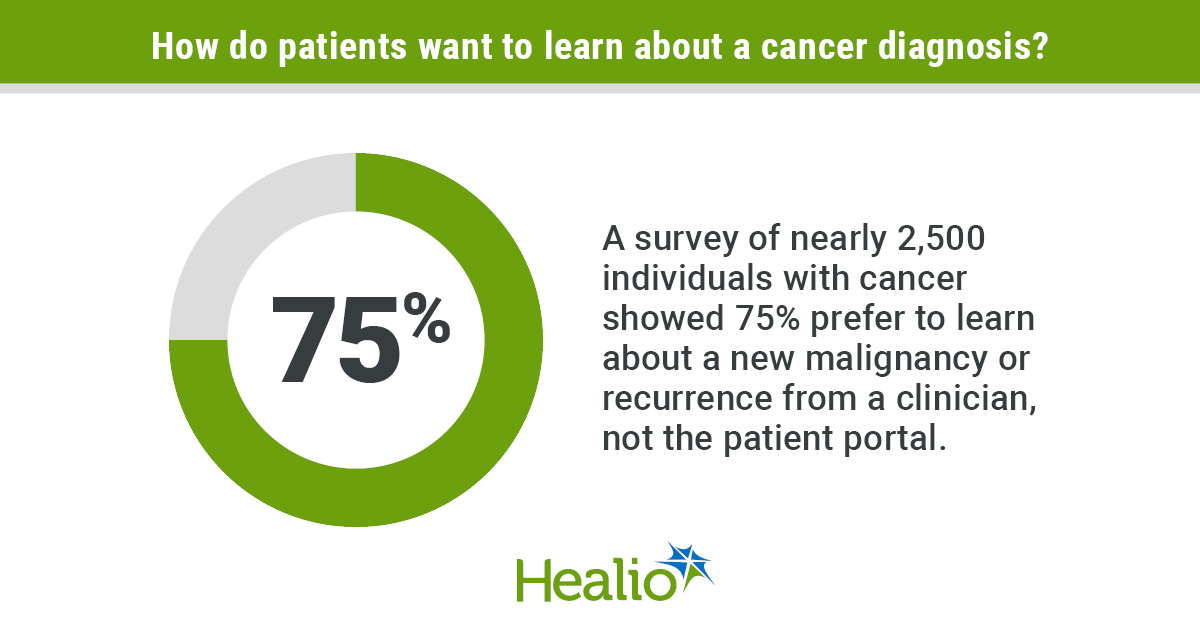
Most respondents (75%) reported they would prefer to get information on a new or recurrent cancer diagnosis from a clinical team member (48% in-person/telehealth; 27% telephone), and 25% said they would want to get that communication from the portal.
Among patients who got their initial diagnosis from a clinician, 79% reported they wanted to communicate the same way in the future.
Among respondents who received their diagnosis from the portal, 54% preferred that communication method for a future cancer diagnosis or recurrence.
For patients who got their cancer diagnosis through the portal, 71% received the information at home and 59% reported being alone. Nearly half of those respondents (48%) conducted more research on the internet.
“More than one-third of these patients spent at least 5 hours online looking for information before they reached out to their clinicians,” Gerber said. “These people are not already in the cancer care system. There’s a very good chance they have never met an oncologist because this is their initial cancer diagnosis.
“In 2026, most patients getting a portal message notification are not sitting down at a desktop computer or laptop and opening an email. It’s probably in real time, hearing a smartphone ding, and once they see it ding, they press to get the test result. They don’t know before they press that link what the test is or what the result may look like.”
Researchers acknowledged study limitations, including response and recall bias, and its single-center design.
What is the ‘best way’?
In a perfect world, Gerber would inform each of his patients about their cancer diagnosis himself.
“I want to be able to provide them not just the yes or no, but empower them with information,” he said. “I want them to know that we have a plan, to have the comfort that there is a medical team ready to navigate them through their care.”
That is an “impossibility,” though.
For one, cancer care is a team sport, Gerber explained. A radiologist, radiation oncologist or surgeon might be needed to go over certain details, and one may not be available.
Results may get posted to the portal at 4:59 p.m. on a Friday, leaving patients an entire weekend to sort out the information themselves.
“Do I want to delay patient care? I don’t, but we need to think about the best way to do this,” Gerber said. “It’s not one size fits all.”
Gerber noted this type of study should be conducted in community settings to see if patients have the same experiences and feelings.
“We should probably start thinking about and studying other ways this can be done,” he said.
Others feel the same way, too.
California, Kentucky and Texas have all signed laws that allow health care systems to delay posting cancer-related and other sensitive test results to the portal.
“California is one of the most liberal states in the country. Texas is one of the most conservative. Yet there seems to be clear agreement across that aisle that maybe this is something we need to revisit,” Gerber said.
This is not an oncology-specific problem, either.
Gerber has heard stories from ED physicians recalling patients who left the waiting room without being seen by a clinician once they viewed results of tests ordered by a triage nurse on their phones. One had foot pain but a negative X-ray. They came back later in the week with a torn Achilles tendon.
Another had a sore throat but had a negative rapid streptococcal pharyngitis test.
“The patient left without being seen, but came back later the same week with a life-threatening tonsillar abscess encroaching on their airway,” Gerber said.
“I don’t know the best scenario for every person. I’m not sure that what we were doing before the 21st Century Cures Act was always the best scenario, and I’m not sure what we’re doing since is always the best scenario.”
For more information:
David E. Gerber, MD, medical oncologist, professor and codirector of the office of education and training at Simmons Comprehensive Cancer Center at UT Southwestern Medical Center can be reached at david.gerber@utsouthwestern.edu.

Ask a clinical question and tap into Healio AI’s knowledge base.
- PubMed, enrolling/recruiting trials, guidelines
- Clinical Guidance, Healio CME, FDA news
- Healio’s exclusive daily news coverage of clinical data