Key takeaways:
- This study looked at patients with EoE that did not meet the approval thresholds for dupilumab but were prescribed it.
- Distal and peak esophageal eosinophilia dropped after starting dupilumab.
Among infants with eosinophilic esophagitis aged younger than 1 year or weighing less than 15 kg, esophageal eosinophilia and growth improved after starting dupilumab, according to study results.
In children with EoE, dupilumab (Dupixent; Regeneron, Sanofi) is FDA approved for use in those aged 1 to 11 years who weigh at least 15 kg.

Data derived from Abi Aad SJ, et al. J Allergy Clin Immunol Pract. 2026;doi:10.1016/j.jaip.2026.06.006.

Sasha-Jane Abi Aad
“Our findings suggest that dupilumab may be a promising treatment option for infants with eosinophilic esophagitis who have limited therapeutic choices,” Sasha-Jane Abi Aad, MD, MSc, postdoctoral research fellow at University of South Florida, told Healio.
“While larger prospective studies are needed, these results provide early real-world evidence that may help clinicians when considering individualized, off-label treatment in carefully selected patients,” she continued.”
In a single-center retrospective chart review published in The Journal of Allergy and Clinical Immunology: In Practice, Abi Aad and colleagues assessed 10 infants with EoE aged younger than 1 year or weighing less than 15 kg (median weight, 11.8 kg) to determine the impact of dupilumab — prescribed for concurrent atopic dermatitis or off-label use between 2021 and 2025 — on clinical and growth outcomes.
“Eosinophilic esophagitis in infants often presents with nonspecific symptoms such as poor growth, vomiting and feeding difficulties, which can delay diagnosis, and treatment options remain limited because there is no FDA-approved therapy for infants under 1 year of age or weighing less than 15 kg,” Abi Aad said.
“In our practice, we observed encouraging responses in infants receiving dupilumab for concurrent atopic dermatitis who were below the approved treatment threshold, which prompted us to evaluate its potential role in treating eosinophilic esophagitis in this population,” she continued.
Included patients had esophagogastroduodenoscopy data before and 3 to 6 months after starting the biologic (median follow-up, 3 months), according to the study.
Researchers found that eight infants received dupilumab every 28 days (200 mg, n = 5; 300 mg, n = 3), whereas the remaining two infants received dupilumab every 2 weeks (100 mg as part of a clinical trial, n = 1; 200 mg off label, n = 1).
The study also outlined that all but three received proton pump inhibitors and swallowed corticosteroids prior to starting dupilumab.
Before dupilumab, 40 was the median number of eosinophils in the distal esophagus, and this significantly fell to 0.5 after starting dupilumab (P = .002).
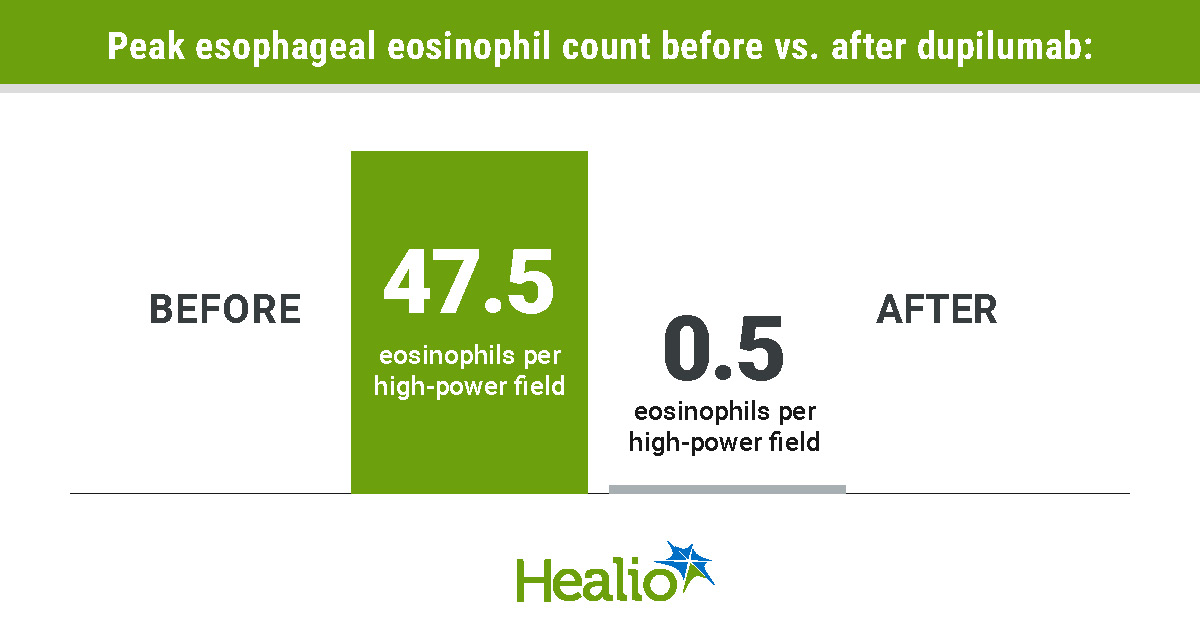
Another measure that was significantly reduced following dupilumab treatment was peak eosinophils across the mucosa (47.5 to 0.5 eosinophils per high-power field; P = .006), according to the study.
On the esophagogastroduodenoscopy taken after starting dupilumab, the majority of patients (80%) had less than 15 eosinophils per high-power field. An even smaller outcome of less than six eosinophils per high-power field was found in 70% of patients.
“The most surprising finding was how quickly many patients achieved histologic remission,” Abi Aad told Healio.
Further, researchers observed a nonsignificant reduction in Eosinophilic Esophagitis Endoscopic Reference Scores after vs. before treatment.
Of the seven patients receiving proton pump inhibitors and swallowed corticosteroids prior to biologic treatment, four still received proton pump inhibitors and five still received swallowed corticosteroids on dupilumab. Additionally, the study noted that two patients started proton pump inhibitors.
In terms of growth outcomes, researchers reported significant increases after vs. before dupilumab in weight (median, 13.8 kg vs. 11.8 kg; P = .006) and length (median, 90.4 cm vs. 83.8 cm; P = .006). Achievement of a higher weight percentile and z score was obtained by 80% of patients, and achievement of a higher length percentile and z score was obtained by 70% of patients.
Seven out of the 10 patients had one to eight restricted foods before starting dupilumab, and after treatment, three no longer had restricted foods and liberalized their diet. An additional patient lowered their number of restricted foods and partially liberalized their diet after dupilumab.
Lastly, researchers highlighted significant improvement after vs. before dupilumab in eczematous body surface area (0% vs. 11%; P = .022) and nonsignificant improvements in the proportion of patients with atopic dermatitis lesions (20% vs. 70%) and pruritus (0 vs. 100%).
“Beyond histologic remission, we also observed concurrent improvements in oral intake, diet liberalization and growth with dupilumab, suggesting benefits beyond reducing esophageal inflammation, particularly in infants where restrictive elimination diets can adversely affect nutrition, feeding development and long-term growth,” Abi Aad told Healio.
“Future studies will be prospective, multicenter studies with larger patient populations and longer follow-up,” Abi Aad added. “These studies will allow us to better evaluate the long-term safety, efficacy and optimal dosing of dupilumab in infants with eosinophilic esophagitis while further investigating potential rare adverse events.”
For more information:
Sasha-Jane Abi Aad, MD, MSc, can be reached at sashajabiaad@gmail.com.

Ask a clinical question and tap into Healio AI’s knowledge base.
- PubMed, enrolling/recruiting trials, guidelines
- Clinical Guidance, Healio CME, FDA news
- Healio’s exclusive daily news coverage of clinical data