Key takeaways:
- Worldwide life expectancy increased by 64.6 years in 1990 to 73.8 years in 2023.
- But the global morbidity gap rose from 8.8 years to 10.7 years during that period.
More people globally are living longer, but many of those extra years are spent experiencing disability and diseases, according to a new report in Lancet Public Health.
“The central finding is that we are adding years to life faster than we are adding health to those years,” Simon I. Hays, DPhil, DSc, FMedSci, director of research strategy at the Institute for Health Metrics and Evaluation (IHME), told Healio.

Data derived from Hay SI, et al. Lancet Public Health. 2026;doi:10.1016/S2468-2667(26)00098-8.
Several recent IHME reports have indicated encouraging jumps in life expectancy over the last couple years, with a 2025 study showing that life expectancy returned to prepandemic rates in 2023, although the U.S. remains behind other developed countries in this area.
In the current analysis, Hays and colleagues looked at the trajectories of multiple measurements of healthy aging — including life expectancy, the morbidity gap and healthy life expectancy (the average years lived in good health) — from 1990 to 2023 using Global Burden of Disease 2023 estimates.
They reported that worldwide life expectancy at birth rose from 64.6 years to 73.8 years from 1990 and 2023, while healthy life expectancy rose from 55.9 years to 63.1 years during that time.
But such gains did not equal healthier lives, as the global morbidity gap increased from 8.8 years to 10.7 years during the study period.
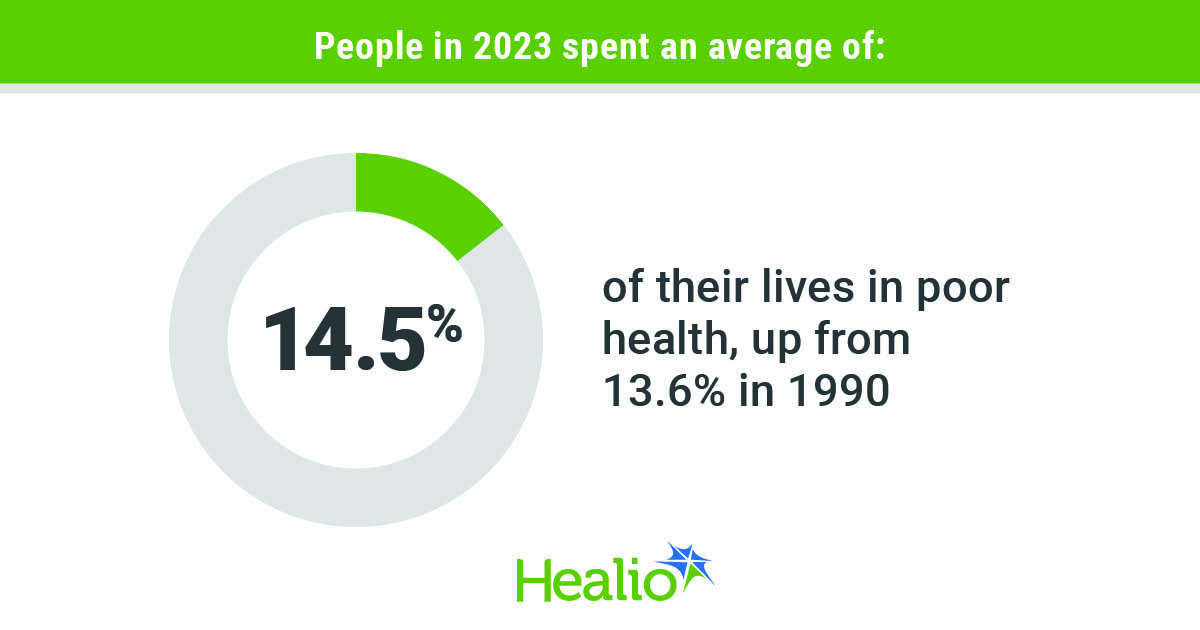
People in 2023 spent an average of 14.5% of their lives in poor health, the release said, vs. 13.6% in 1990.
The largest morbidity gap in 2023 across all countries and regions was 14 years in the U.S., followed by Australia at 13.9 years and Canada at 13.7 years.
The researchers noted that women across all regions consistently lived longer than men but also experienced more years in poorer health.
Specifically, women possessed an average morbidity gap of 12.1 years in 2023 compared with 9.3 years among men.
Hays and colleagues reported that several mostly nonfatal morbidities, including musculoskeletal disorders, depressive and anxiety disorders, age-related hearing loss, falls and other noncommunicable diseases, contributed to 57.4% of unhealthy years globally in 2023, “with nutritional disorders also contributing substantially in some lower socio-demographic index contexts.”
The researchers acknowledged that the availability and quantity of data varied across countries and regions — “with particularly limited data in low-income settings” — while their findings “reflect population-level trends, not individual experiences, with some individuals experiencing far more or fewer years of poor health than the mean.”
Hays told Healio that one encouraging finding for clinicians “is that the conditions filling the gap are largely preventable or manageable: they are rarely the ones that kill people, so they can be acted on.”
He provided some clinical guidance based on the report, which includes:
- managing upstream risks “aggressively and early: high blood sugar, obesity, high BP and tobacco are the dominant modifiable drivers, so glycemic control, weight management, BP control and smoking cessation are high yield for future healthy years, not just for mortality”;
- screening and treatment of mental health disorders, hearing loss and falls risk among older adults;
- treating low back pain with “early activity, physiotherapy and self-management over escalation to imaging or opioids”;
- asking patients about hearing, independence, mood, mobility and pain while tracking those areas over time “rather than focusing only on disease labels and biomarkers”; and
- preparing for patients to live longer with several conditions.
Perspective
This study exposes the troubling reality that we’re extending lifespan faster than we’re extending healthspan. The goal isn’t simply to help people reach 85 or 90 years. The goal is to help them arrive there strong enough to travel, play with grandchildren, maintain independence and fully engage in life. Health works like compound interest — small investments in movement, nutrition, sleep, stress management, connectedness and avoidance of harmful substances accumulate over decades. The encouraging news is that many of the conditions driving disability are modifiable.
When most people think about aging, they think about heart disease, cancer or dementia. Yet some of the greatest thieves of quality of life are less dramatic — chronic pain, loss of strength, impaired mobility, depression and anxiety. In fact, this study adds to a substantial body of evidence showing that therapeutic lifestyle change can prevent, improve and, in some cases, even reverse many of the chronic conditions responsible for declining quality of life.
Clinicians should expand the conversation beyond disease prevention and help patients understand how to actively build health and resilience throughout the lifespan.
While nutrition is critically important, health is not built through any single behavior. Lifestyle medicine emphasizes the six pillars of lifestyle medicine — optimal nutrition, regular physical activity, restorative sleep, stress management, connectedness and avoidance of risky substances. These behaviors work synergistically, and the sum is far greater than their individual effects.
If this study has a single takeaway, it’s that the human body was designed to move. Movement may be the closest thing we have to an anti-aging therapy. Strength training preserves muscle mass and supports healthy joints. Mobility training maintains functional independence. Aerobic exercise helps protect cognitive function, improves mood, reduces anxiety and depression, and increases production of brain-derived neurotrophic factor, which is often called “Miracle-Gro for the brain.”
Clinicians should not only discuss the risks for disease, but also help patients envision the rewards of health, such as maintaining independence, traveling, playing with grandchildren, continuing hobbies and remaining fully engaged in life as they age.
John Findley, MD, CPE
American College of Lifestyle Medicine
Disclosures: Findley reports no relevant financial disclosures.

Ask a clinical question and tap into Healio AI’s knowledge base.
- PubMed, enrolling/recruiting trials, guidelines
- Clinical Guidance, Healio CME, FDA news
- Healio’s exclusive daily news coverage of clinical data