

Key takeaways:
- The U.S. Department of Justice charged 455 defendants for $6.5 billion in alleged false CMS claims.
- However, experts urged for distinction between fraud and mistakes driven by regulatory complexity.
On June 23, the U.S. Department of Justice announced it had charged 455 defendants, including 90 physicians and other licensed health care professionals, with more than $6.5 billion in health care fraud and prescription opioid diversion.
The 2026 National Health Care Fraud Takedown included all 50 state Medicaid Fraud Control Units, international law enforcement partners and seizures totaling more than $182 million in assets, according to the DOJ.

Attorney Mark J. Silberman, JD, vice chair of the health care practice group at Benesch law firm, compared the fraud enforcement action to photos of seized contraband taken by law enforcement after drug busts.

Mark J. Silberman, JD
“This is the health care fraud equivalent, with the exception that it’s like they took a year and a half’s worth of cases and piled them up on one table,” Silberman told Healio.
“As someone who represents lots of providers, institutions, businesses and systems in these types of cases, the government has every right to audit and make sure that they’re getting the benefit of their bargain,” he added. “But missing in these efforts is an independent assessment distinguishing between an effort to defraud the government and an honest mistake that results from an unnecessary, complex regulatory structure.”
Federal investigations into potential CMS fraud continue. In July, CMS and HHS deferred over $1 billion in Medicaid payments to California and Minnesota pending receipt of further documentation.
Compared with last year’s Medicare and Medicaid fraud investigation — which involved 324 defendants and $14.6 billion in losses — the 2026 operation was larger in scale but smaller in dollar value.
Although only 90 defendants were doctors or other medical professionals, CMS took action to suspend or revoke billing privileges for nearly 2,500 clinicians.
“They’re not going to be allowed to see patients with government insurance, and in many respects, they’re basically put out of business,” Allan Gibofsky, MD, JD, MACR, FACP, FCLM, professor of medicine at Weill Cornell Medicine, told Healio.
Fraud or ‘honest mistake’?
Silberman noted that while large-scale Medicare and Medicaid fraud enforcement actions are not unique to the Trump administration, this year’s results are “not unexpected, if you consider the pressure the current administration has been giving on increasing health care fraud enforcement.”
Among the fraudulent actions alleged: $38 million in adult day-care overbilling for services that were never provided in New York, a $49 million crisis stabilization services scam targeting the homeless in Virginia and $44 million in fraudulent behavioral-health claims in Arizona.
These cases make up a fraction of the alleged $6.5 billion in fraud identified in the investigation.
“While the $6.5 billion figure certainly includes allegations of actual fraud — people making up services or services that weren’t provided — a portion of this is framed as fraud that are actually cases that involve some hyper-technical regulatory violation or documentation errors,” Silberman said.
Investigative methodology is evolving, too, as AI and data analytic tools are increasingly being used to identify suspicious billing activity.
“The government is not concerned about an honest mistake, but a pattern of honest mistakes will be looked at as the possibility of a non-honest mistake,” Gibofsky said. “That’s where the average practitioner begins to get into murky and deeper waters.”
Small errors can snowball into larger problems over time.
“You don’t make 1,000 mistakes in health care,” Silberman said. “You make one mistake, which gets repeated 1,000 times, because if you set up your documentation wrong or misunderstand one of the complex rules and regulations, then it gets repeated every single time you see a patient.”
Protecting practices, patients
Clinicians can take steps to safeguard their legal use of Medicare and Medicaid programs.
An honest mistake is more likely to be viewed as honest if clinicians maintain solid documentation verification and data integrity, according to Peter Justen, founder and CEO of AmeriTrust Solutions, a company that helps streamline Medicaid intake processes and catch improper payments.

Peter Justen
“The strongest fraud prevention strategy is to reduce opportunities for bad information to enter the system, and if I were a clinician, that’s where I would start,” Justen said. “Prevention is always less expensive than recovery.”
Clinicians should ensure patients are receiving appropriate care at their practices, as well as outside vendors and institutions to which they are referred.
“When referring a patient for durable goods, services or specialized care, [ensure] the suppliers are bonafide and not a storefront, which may entrap the patient in a kickback or rebate scheme, denying the patient the services that the practitioners seek to provide,” Gibofsky said.
He identified several areas of concern for the average practitioner.
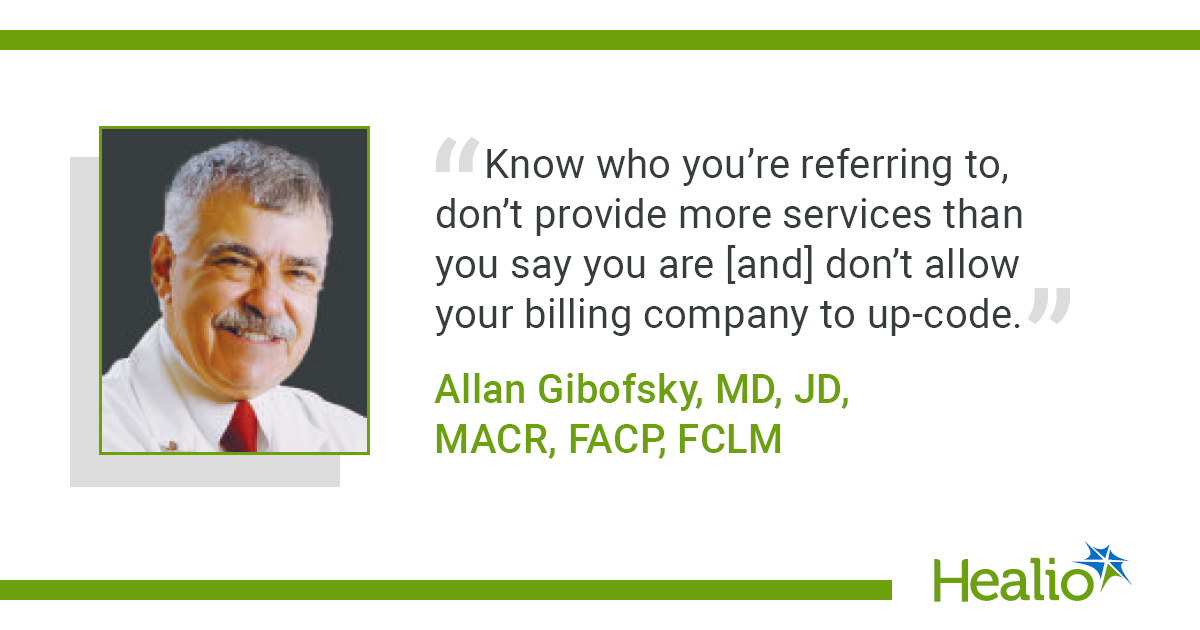
“Know who you’re referring to, don’t provide more services than you say you are, don’t allow your billing company — many people use third-party companies — to up-code, particularly if you are reimbursing them on a portion of recovery,” Gibofsky said.
While AI scribes have been helpful in reducing burnout among clinicians, they do carry risks when unmonitored.
“[Clinicians] have to be certain — particularly if they’re using electronic scribes — that the information they’re entering into the medical record is accurate and complete,” Gibofsky said. “Artificial intelligence has been known to hallucinate and make things up, and once you put something into the record, it’s very difficult to get out.”
Gibofsky emphasized that physicians become responsible for everything in the medical record after they have signed off on it.
Silberman also advised clinicians to have robust compliance programs. He compared fraud prevention with preventive health care.
“Get your routine checkups. If you have risk factors, be honest and take that into consideration, and if you’re having symptoms, don’t pretend you aren’t,” Silberman said.
The biggest mistake clinicians make when they receive a civil investigative demand or request for information is ignoring it or waiting until the last minute to address it, according to Silberman, who advised taking immediate, well-informed action to manage the situation.
“Just as much as they wouldn’t want their patients to rely on a Google search to get medical advice, I would discourage them from thinking they can navigate the legal process without [an expert],” Silberman said.
For more information:
Allan Gibofsky, MD, JD, MACR, FACP, FCLM, is professor of medicine at Weill Cornell Medicine, emeritus professor of law at Fordham University and attending physician and rheumatologist at Hospital for Special Surgery and NewYork-Presbyterian Hospital. He can be reached at gibofskya@hss.edu.
Peter Justen, is founder and CEO of AmeriTrust Solutions. He can be reached at pete@ameritrustsolutions.com.
Mark J. Silberman, JD, is partner and vice chair of the health care practice group at Benesch law firm and a former state and federal prosecutor and health care regulator. He can be reached at msilberman@beneschlaw.com.
Sources/Disclosures
Source:
References:
Disclosures:
Gibofsky reports no relevant financial disclosures. Justen reports being founder and CEO of AmeriTrust Solutions. Silberman reports being partner at Benesch law firm.

Ask a clinical question and tap into Healio AI’s knowledge base.
- PubMed, enrolling/recruiting trials, guidelines
- Clinical Guidance, Healio CME, FDA news
- Healio’s exclusive daily news coverage of clinical data