Key takeaways:
- The alliance between The Obesity Society and American Society for Nutrition offers its respective members discounted prices to major meetings.
- The partnership can advance research areas and policy priorities.
NATIONAL HARBOR, Md. — The American Society for Nutrition and The Obesity Society recently announced a partnership that offers opportunities for discounted pricing and will advance clinical practice.
According to a press release from The Obesity Society (TOS), the alliance allows TOS members to register for the annual NUTRITION meeting at the same price rate as American Society for Nutrition (ASN) members, and ASN members will receive TOS member rates for ObesityWeek.

TOS said the organizations will also “work to accelerate the translation of cutting-edge research into effective practice, education and policy.” Future opportunities may include educational offerings, advocacy efforts and other opportunities to exchange knowledge in nutrition and obesity.
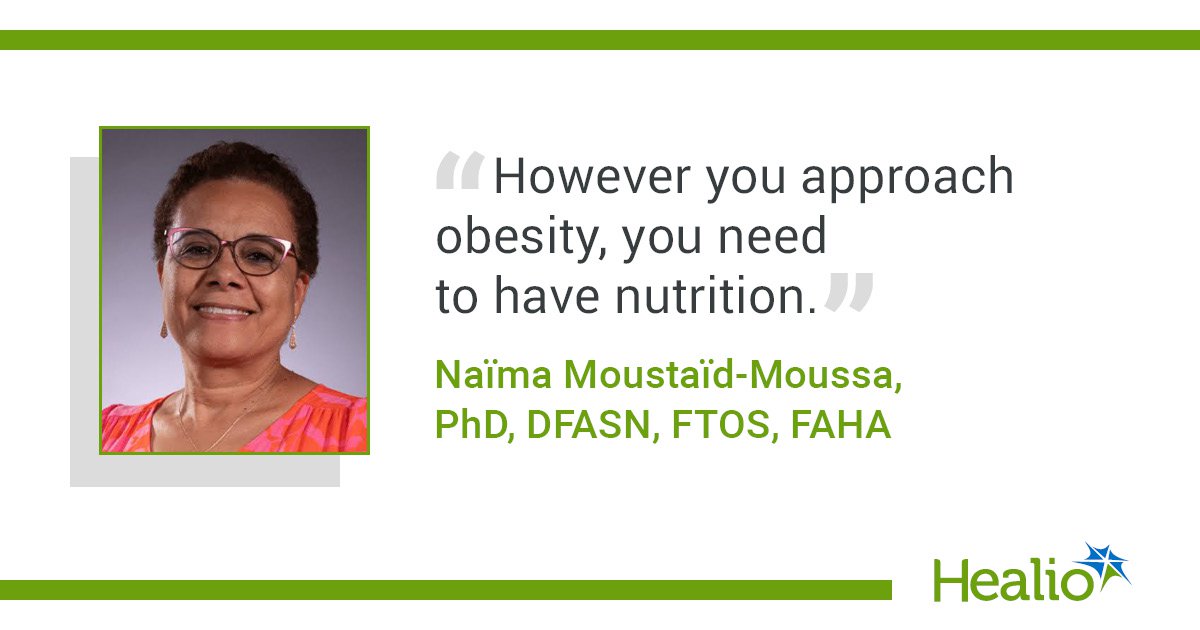
Healio spoke with ASN President Naïma Moustaïd-Moussa, PhD, DFASN, FTOS, FAHA, to learn more about the alliance.
Healio: Why is now the right time to form a strategic alliance?
Moustaïd-Moussa: ASN has always been looking for partnerships and collaborations with societies, partners and organizations that have the same overall mission and vision of impacting and improving health. We have formed several alliances and continue to do that. But both nutrition and obesity science are important and very connected right now. Working together to advance both the nutrition and obesity fields will move science forward and will ultimately improve health care and quality of life of patients.
Right now is also a good time because we see many remarkable scientific advances in both nutrition and obesity — for example, within precision nutrition, advances in metabolomics and implementation science.
As we advance obesity care, we must include nutrition because nutrition is important for prevention and treatment, and while the current medications for obesity are working greatly — they reduce weight efficiently — we need to also keep in mind that this can only be sustained with a healthy diet and lifestyle.
We also know that obesity is an epidemic that has grown so much, and there are a lot of challenges, especially with mistrust and misinformation. So, we need to identify means to rebuild that trust, and only through evidence-based information about nutrition, obesity and health can we do that. Together we can better connect the basic science of obesity, nutrition, clinical research and practice.
Healio: What are some research areas where collaboration between nutrition and obesity researchers could have the greatest impact?
Moustaïd-Moussa: There are lots of questions that remain in nutrition and obesity — we need to have better understanding of the complex biology of obesity as well as metabolism, appetite regulation, energy balance, gut microbiota, precision health and adipose tissue. Advancing precision nutrition can also lead to a better understanding of how different dietary approaches and interventions can work for different individuals, because there is not a one-size-fits-all approach.
Nutrition is very important in general for any disease or health area, but we need to better understand how nutrition can support overall patient health. That can include during obesity throughout weight loss, during weight maintenance and — even more importantly now — during obesity medications that could lead to extreme weight losses in some cases at the expense of healthy eating. By enhancing or facilitating discussions between nutritional scientists and obesity professionals, we can better help the patient and make sure that nutrition is at the center of treatment.
Healio: What policy priorities are most likely to emerge from this collaboration?
Moustaïd-Moussa: We need to translate this research into action, and action means how we impact the patient and the community. Policies are key to achieving public health impact, and we have a shared focus to make sure that policy is informed by strong science. We want to see policies that expand access to effective nutrition and obesity treatment and reduce the burden of chronic diseases. We need to make sure both authorities have this interest in seeing continued federal investment in nutrition and obesity research. That’s critical to making progress in advancing prevention and treatment. We also want to make sure that policymakers have access; that both societies provide them with strong, high-quality and rigorous science.
We see also opportunities to strengthen nutrition education, and there is big emphasis at the federal level in nutrition education for medical professionals. ASN can play a major role by partnering with TOS to strengthen nutrition education for health professionals and support the next generation of investigators.
Healio: Beyond conference discounts, what new opportunities can members expect from this alliance?
Moustaïd-Moussa: The goal for collaborating with societies is by working together, we can better advance the field, improve human nutrition and the care for the patients with obesity through nutrition. One way to do that is to facilitate access to both societies for members, so that’s why we started with discounted memberships.
But this is more than meetings. Through this partnership and strong collaboration, members will have opportunities to connect with colleagues across both organizations. ASN is a global society with members from over 120 countries, so this will also provide access to other members around the globe. We also expect members to get together to develop scientific programs in emerging areas and educational activities.
We also want to amplify opportunities for early career investigators. For example, some who are working specifically in certain fields of nutrition may now see opportunities for applying nutrition to obesity and vice versa, so this is great for mentoring opportunities. We also expect to see more collaborations on workshops, emergent topics, research initiatives, or even white papers or census activities, while the partnership will also create opportunities to work together on policy and public communication.
Healio: What is one misconception about the relationship between nutrition and obesity science, and how can this alliance help address that?
Moustaïd-Moussa: A long-standing misconception about obesity is that it is caused by overeating, and that’s not the case. Obesity is a very complex and multifactorial disease. It’s not due to lack of willpower or individual overeating — you may have a genetic mutation that makes your eating or appetite uncontrolled. If you are in an environment that is not conducive to walking or exercising and that is not safe, it’s not the willpower. Obesity is too complex for one discipline to address it.
On the other hand, many people think that nutrition science is just about addressing deficiency and saying what to eat and not eat. But it is more than that. It’s about how food affects and interacts with your body, metabolism and gut bacteria.
However you approach obesity, you need to have nutrition, and the nutrition field has grown so much. It’s broader than just weight management. Bringing our scientific communities together is critical to not only better understand obesity from every angle but to identify the optimal nutritional strategies to prevent and treat obesity.
For more information:
Naïma Moustaïd-Moussa, PhD, DFASN, FTOS, FAHA, professor at Texas Tech University’s nutritional sciences department, can be reached at primarycare@healio.com.
Sources/Disclosures
Source:
Healio Interviews
Reference:
Disclosures:
Healio could not determine relevant financial disclosures at the time of publication.

Ask a clinical question and tap into Healio AI’s knowledge base.
- PubMed, enrolling/recruiting trials, guidelines
- Clinical Guidance, Healio CME, FDA news
- Healio’s exclusive daily news coverage of clinical data