
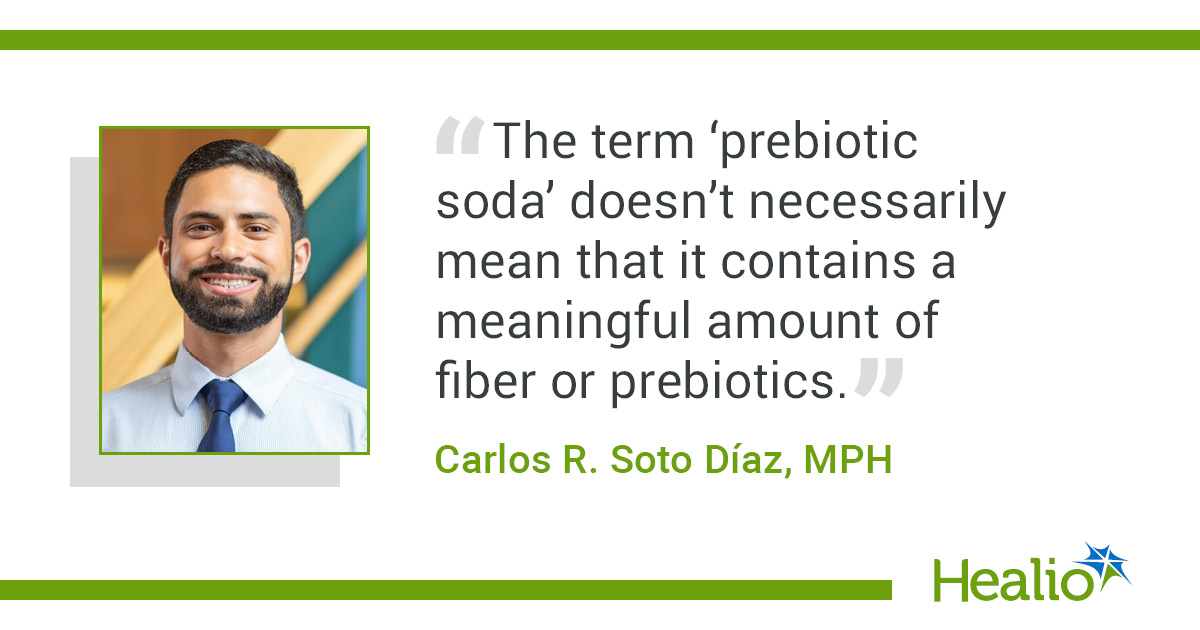

This is a useful and appropriately cautious market analysis. It is important to be clear about what this study actually did: it is a cross-sectional audit of nutrient composition across beverage categories using product database data, not a study of health outcomes, prebiotic efficacy or consumer behavior. Within that scope, the findings are fairly intuitive but worth having documented systematically: prebiotic sodas fall in between regular sodas and diet sodas on calories, sugar and non-nutritive sweeteners while containing more fiber than any of the comparator categories.
A can with 5 g of sugar and 5 g of fiber is nutritionally quite different from, say, a regular soda with 35+ g of sugar and no fiber. The more relevant clinical question isn’t whether sugar and fiber are numerically similar, but what a person is replacing when they choose a prebiotic soda over other options.
I would also flag something the study does not examine but that is directly relevant to interpreting its results: containing fiber and being an effective prebiotic are not the same claim. The International Scientific Association for Probiotics and Prebiotics defines a prebiotic as a substrate that is selectively utilized by gut microorganisms to confer a health benefit — not simply any fiber-containing ingredient. Only a small number of substances, such as inulin-type fructans, galactooligosaccharides and lactulose, currently meet that bar with reasonable evidence behind them.
The word “prebiotic” on a label tells you something about the ingredients, but not necessarily whether the specific fiber, dose and formulation have been shown to produce a meaningful health benefit. The label alone can’t answer that question.
For clinicians, the most useful framing is the one the researchers themselves gesture toward: healthfulness depends on what a product is replacing. For someone who regularly drinks regular soda or sweetened fruit drinks, switching to a prebiotic soda likely represents a meaningful reduction in added sugar and calories. For someone who already reaches for water or unsweetened sparkling water, a prebiotic soda is unlikely to offer a nutritional upgrade.
Whether a prebiotic soda is a healthy choice depends less on the beverage itself than on what it is replacing.
I would also raise a concern the study’s own authors point to: the “health halo” effect. Labeling a product as containing prebiotics may lead consumers to perceive it as broadly healthy, making them more likely to choose it more frequently or in place of beverages with an even healthier nutritional profile, such as water or unsweetened sparkling water. Even though these products are generally an improvement over regular soda, the health halo could diminish some of that benefit if it encourages greater overall consumption.
It is worth noting that nearly two-thirds of prebiotic sodas in this analysis contained non-nutritive sweeteners — notably higher than regular sodas (11.5%) or fruit drinks (27.5%), though still lower than diet sodas (91.9%). That means many of these products achieve their lower sugar profile through a combination of added fiber and non-nutritive sweeteners, rather than fiber alone. Patients may not realize that simply seeing “prebiotic” on the label does not tell them how the beverage was formulated.
Overall, patients should be encouraged to read the full nutrition label rather than relying on “prebiotic” as a shorthand for healthy, and to keep beverages in their proper place: a reasonable tool for reducing added sugar intake for some patients, not a meaningful replacement for whole-food fiber sources or a license to indulge more freely.
This study is a valuable first step in characterizing an emerging product category, but many of the more clinically interesting questions remain open. Fiber type matters, dose matters, an individual’s baseline diet and existing microbiome composition affect response, and none of that was measured here. The authors themselves note that future work should look at marketing, consumer perception, and how these products actually fit into people’s broader dietary patterns — and I would add that future work should also directly test whether the specific fibers and doses used in these products produce measurable microbiome or health effects, rather than assuming that “contains prebiotic fiber” is sufficient evidence of benefit.
Prebiotic sodas may be a reasonable swap for someone cutting back on regular soda, but they should not be mistaken for a primary source of dietary fiber or a guaranteed gut-health intervention.
Finally, because these findings are being presented as a conference abstract, they should be considered preliminary until the full manuscript has undergone peer review.
Leigh A. Frame, PhD, MHS, RYT
George Washington University
Johns Hopkins Medicine Alumni Association
Good Bacteria
Disclosures: Frame reports no relevant financial disclosures.