
August 03, 2026
3 min read

Key takeaways:
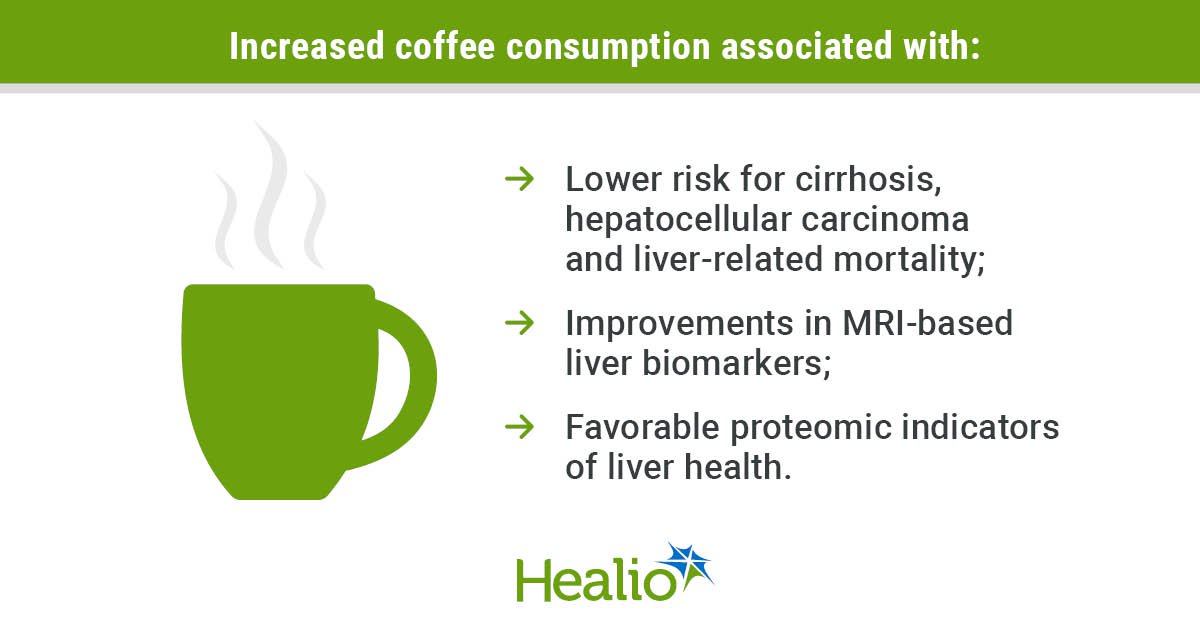
- Drinking five or more cups a day was associated with risk reductions of 32% for cirrhosis and 47% for HCC.
- Benefits were seen with even moderate consumption and regardless of caffeination or use of sweeteners.
A prospective study of more than 350,000 individuals linked higher coffee consumption with lower risk for cirrhosis, hepatocellular carcinoma and liver-related mortality, especially among those who drank at least five cups per day.
Coffee intake also increased likelihood of favorable MRI-based and proteomic indicators of liver health.

Data derived from Kim H, et al. Clin Gastroenterol Hepatol. 2026;doi:10.1016/j.cgh.2026.04.035.
“Previous studies suggested that coffee might benefit the liver, but most were smaller or looked at only one piece of the puzzle,” lead study author Hyun-Seok Kim, MD, MPH, PhD, transplant hepatologist and assistant professor at Cedars-Sinai Medical Center, said in a related press release. “We followed hundreds of thousands of people for more than a decade and looked at their health outcomes along with liver MRI scans and blood protein analyses.”
Though previous research has linked coffee consumption with liver health benefits, few studies accounted for coffee type and additives such as sweeteners, and most relied on cross-sectional or retrospective data.
Also unclear was which components of coffee, including caffeine, chlorogenic acids and diterpenes, could be responsible for these protective benefits due to their anti-inflammatory, antioxidant and antifibrotic qualities.
Kim and colleagues investigated by conducting an analysis of 354,957 individuals (mean age, 57 years; 49.5% men; 93.9% white) in the UK Biobank cohort, who were recruited from 22 medical centers in the United Kingdom between 2006 and 2010. Participants with preexisting cirrhosis or HCC were excluded.
Researchers assessed daily coffee consumption, as well as caffeination preference and additive use, via self-reported questionnaires.
Additional analyses were conducted among 28,961 individuals who underwent MRI after 10 years and 44,633 participants with proteomic profiling data.
Incident cirrhosis, HCC and liver-related mortality served as primary outcomes. Median follow-up reached 13 years.
Nearly half of participants (45.4%) reported drinking one to two cups of coffee per day, with 21.1% consuming three to four cups and 11.5% drinking at least five cups. Just 15% preferred decaffeinated coffee and 3% added sugar or artificial sweeteners.
Results showed a stepwise relationship between increased coffee consumption and positive liver outcomes.
Participants who drank one or two cups of coffee per day had reduced risk for cirrhosis (adjusted HR = 0.8; 95% CI, 0.72-0.89), HCC (aHR = 0.76; 95% CI, 0.57-0.99) and liver-related mortality (aHR = 0.69; 95 CI, 0.58-0.82) compared with nondrinkers, as did those who consumed three to four cups per day (cirrhosis: aHR = 0.65; HCC: aHR = 0.65; liver-related mortality: aHR = 0.59).
The benefits appeared even greater among those who drank five or more cups per day, with significant risk reductions in cirrhosis (aHR = 0.68; 95% CI, 0.58-0.79), HCC (aHR = 0.53; 95% CI, 0.34-0.83) and liver-related mortality (aHR = 0.58; 95% CI, 0.45-0.74).
These associations were similar for individuals who drank caffeinated and decaffeinated coffee, as well as those who added sugar or artificial sweeteners.
In the MRI cohort, higher coffee intake was associated with lower hepatic fat and iron concentrations and reduced likelihood for high corrected T1 (cT1). However, use of artificial sweeteners increased the odds of elevated cT1 (OR = 1.36; 95% CI, 1.08-1.7).
In the cohort that underwent proteomic profiling, individuals who drank coffee exhibited numerous indicators of liver health, including higher levels of hepatocellular synthesis and complement proteins, as well as lower levels of fibrogenic and macrophage-activation markers.
Researchers acknowledged study limitations, including possible recall bias stemming from self-reported data and limited generalizability, given most participants were of European ancestry. Additionally, individuals in the MRI subcohort were younger and had fewer comorbidities than the overall study population, potentially biasing results.
Despite these positive findings, increased coffee consumption may not be appropriate for everyone, researchers noted, especially those with cardiovascular disease or other comorbidities. They also emphasized that coffee should not replace well-documented strategies for improving liver health.
“The next step in our research is to identify the specific compounds in coffee that are responsible for these liver-protective associations,” study author Shelly Lu, MD, director of the Karsh Division of Gastroenterology and Hepatology at Cedars-Sinai, said in the release. “Our findings point to biological pathways involving inflammation and scarring and highlight molecular targets that future research can explore to better understand how coffee may influence liver health and who stands to benefit the most.”
Perspective

This large-scale prospective study provides compelling multidimensional evidence linking coffee consumption to improved liver health.
Researchers found that higher coffee intake was associated with dose-dependent reductions in advanced liver outcomes. Compared with nondrinkers, individuals who consumed five or more cups per day experienced significant risk reductions for incident cirrhosis, HCC and liver-related mortality. These protective benefits were consistent for both caffeinated and decaffeinated coffee.
The study’s primary strength lies in its integration of advanced imaging and molecular data. In the MRI subcohort, high coffee intake correlated with lower hepatic fat, lower liver iron and reduced fibroinflammation. Furthermore, proteomic profiling revealed a clear biological signature. Coffee consumption was associated with higher levels of hepatocyte synthesis and reduced fibrogenic and macrophage-activation markers. While the use of sweeteners correlated with slightly higher cT1 on MRI, additives did not negate the overall clinical protections.
These findings reinforce AASLD guidelines supporting coffee for fibrosis reduction (MASLD guidance) and HCC chemoprevention (HCC guidance). When patients inquire about unproven “liver cleanses,” I suggest regular coffee — an easily accessible, evidence-backed strategy to truly “cleanse” and protect the liver.
By integrating epidemiological data with objective imaging and biological evidence, this study provides further support for coffee’s role in preventing chronic liver disease.
Reference:
Rinella, ME, et al. Hepatology. 2023;doi:10.1097/HEP.0000000000000323.
Singal AG, et al. Hepatology. 2023;doi:10.1097/HEP.0000000000000466.
van Dam RM, et al. N Engl J Med. 2020;doi:10.1056/NEJMra1816604.
Disclosures: Kwo reports no relevant financial disclosures.

Ask a clinical question and tap into Healio AI’s knowledge base.
- PubMed, enrolling/recruiting trials, guidelines
- Clinical Guidance, Healio CME, FDA news
- Healio’s exclusive daily news coverage of clinical data