
August 11, 2026
4 min read
Key takeaways:
- Some dermatologists recommend a more minimalistic approach to laboratory monitoring for isotretinoin.
- The approach includes considering the risk factors and symptoms of patients.
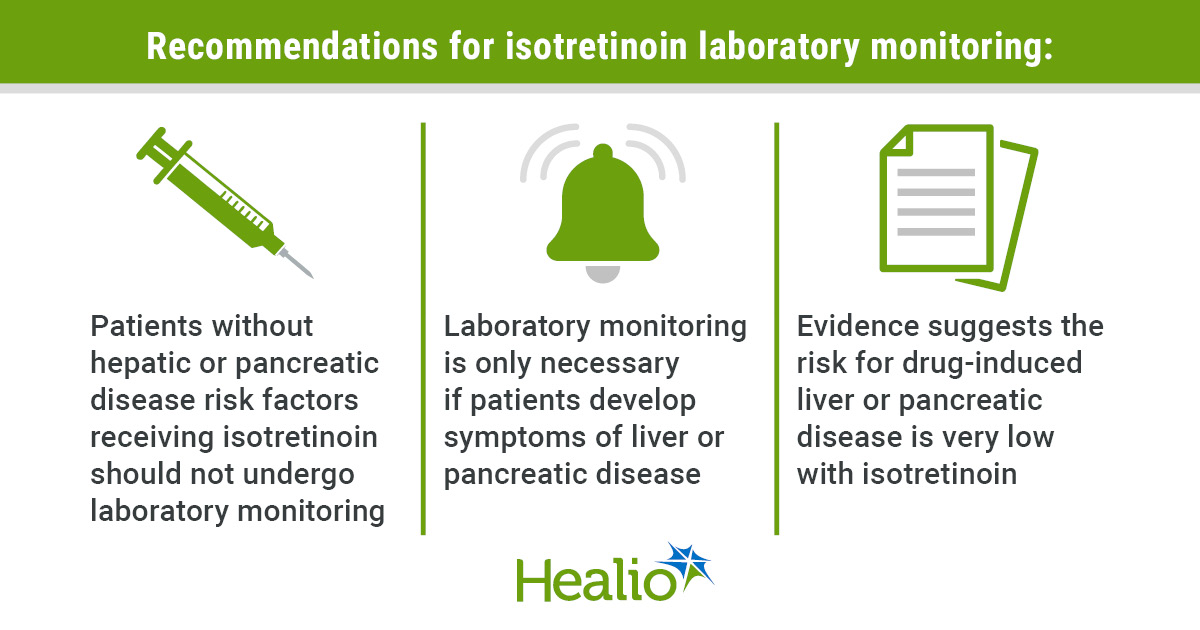
Adults and adolescents without risk factors for hepatic or pancreatic conditions prescribed isotretinoin for acne should not be required to undergo routine laboratory testing, according to a viewpoint published in JAMA Dermatology.
The motivations behind streamlining these clinical practices are to ease patient health anxiety, reduce the financial burden on patients and align more closely with emerging evidence that suggests clinically important hepatic and pancreatic complications associated with isotretinoin are rare or associated with symptoms and identifiable risk factors, according to Joseph C. Pierson, MD, chair of dermatology at the University of Vermont Health, and colleagues.

Data derived from Pierson JC, et al. JAMA Dermatol. 2026;doi:10.1001/jamadermatol.2026.2144.
“The benefits of this symptom-based monitoring may be significant reductions in health anxiety and cost,” the authors wrote. “Patients and parents may deem a medication that requires routine blood monitoring as being unsafe and could also fear blood sample obtainment. Furthermore, cost is increasingly problematic with high-deductible health plans.”

John Barbieri
The recommendation is a departure from the current regulatory guidelines, but the evidence suggests such lab monitoring has limited clinical utility for young and healthy patients, according to John Barbieri, MD, MBA, FAAD, director of the Advanced Acne Therapeutics Clinic at Brigham and Women’s Hospital and a Healio Dermatology Peer Perspective Board Member.
“The current guideline recommendations are to check alanine aminotransferase (liver function tests) and triglycerides (or lipid panel) at baseline and then again at peak dose, which is usually around 2 to 3 months after starting treatment,” Barbieri, who was unaffiliated with the viewpoint, told Healio. “If these are normal, no further testing is required, as they tend to be stable throughout the course of treatment.”
Barbieri said it is reasonable for clinicians to consider less intensive laboratory monitoring — including no monitoring — in appropriate patients after discussing the potential benefits and risks with them.
“The current evidence suggests that checking triglycerides is unlikely to be a practical strategy to avoid pancreatitis and there is no evidence of isotretinoin causing lasting liver injury,” Barbieri said. “I do think over time we may shift toward even less monitoring.”
Supporting evidence
The authors cited a recent review of 125 articles that found adverse events among patients receiving isotretinoin occurred in fewer than 1 in 10,000 people and were linked with systemic symptoms and preexisting conditions. A separate study of 2,682 blood tests from 165 children and a review of laboratory test results from 1,863 patients confirmed the rarity of meaningful laboratory value abnormalities, according to the authors.
“While to our knowledge, a study has not been performed to assess drug-induced liver injury in patients receiving isotretinoin, that only a single case of liver injury has been possibly attributable to isotretinoin globally, despite approximately 10 million patients receiving the treatment in the U.S. alone, suggests that the likelihood of drug-induced liver injury attributed to isotretinoin is near zero,” the authors wrote.
Currently, isotretinoin is assigned a liver injury likelihood score of “D,” indicating the drug may “possibly cause” liver disease, according to the NIH’s LiverTox database. Nevertheless, isotretinoin requires more laboratory monitoring than medications assigned a significantly higher drug-induced hepatotoxicity likelihood score, such as terbinafine, the authors wrote.
Similarly, a systematic review demonstrated that extreme elevations in triglyceride levels were very rare, occurring in only four people who received isotretinoin, all of whom were older than 35 years, according to the viewpoint. Of those who did develop isotretinoin-related acute pancreatitis, 80% did not have elevated triglyceride levels, suggesting that regular lipid panels may do little to prevent injury, the authors wrote.
Given the evidence, the dermatologists recommend a symptom-based approach to laboratory monitoring for both liver and pancreatic disease associated with isotretinoin.
“Prescribers should screen for a history of liver disease, including risk factors for metabolic dysfunction-associated steatotic liver disease or concurrent hepatotoxins and order baseline laboratory tests for patients with any risk factors,” the authors wrote. “Physicians should make clear when counseling patients receiving isotretinoin that the risk of significant liver or pancreatic adverse effects is low.”
Lipid panel monitoring that exceeds standard guidelines from the American Heart Association and American College of Cardiology for the general population is also unnecessary for those receiving isotretinoin, according to the authors.
Regardless of risk-factor status, patients who experience jaundice, abdominal pain, influenza-like symptoms, general malaise, dark urine or severe pruritus should stop taking isotretinoin immediately and seek physician evaluation, the authors wrote.
Addressing ‘medicolegal tension’
Hesitancy to embrace the authors’ recommendations may be driven by the fact that the isotretinoin label still recommends frequent extensive monitoring — a reality that can create medicolegal tension for clinicians, according to Barbieri.
“Ultimately, the more we can have guidelines support broader clinical monitoring practices, including no monitoring, the more clinicians and patients will feel comfortable with such approaches,” Barbieri said. “Although unlikely to occur, updating the isotretinoin labeling could help to support less intensive monitoring practices.”
The authors encouraged dermatologists to consider a minimalistic approach to isotretinoin monitoring in light of the literature.
“We are not the first to propose this idea, but by combining updated evidence with context for why this matters and a rational framework to guide action, it is our hope that clinicians will gain confidence to take the next steps toward ending routine laboratory monitoring for isotretinoin,” the authors wrote. “We have a responsibility to be better stewards of healthcare resources and, when evidence supports it, seize opportunities to conserve, especially when our efforts reduce financial strain on patients and the system overall.”
For more information:
John Barbieri, MD, MBA, FAAD, is assistant professor at Harvard Medical School, director of the advanced acne therapeutics clinic at Brigham and Women’s Hospital and a member of the Healio Dermatology Peer Perspective Board. Barbieri can be reached at jbarbieri@bwh.harvard.edu; YouTube @DrJohnBarbieri; LinkedIn John Barbieri, MD, MBA.

Ask a clinical question and tap into Healio AI’s knowledge base.
- PubMed, enrolling/recruiting trials, guidelines
- Clinical Guidance, Healio CME, FDA news
- Healio’s exclusive daily news coverage of clinical data