August 13, 2026
4 min read

Key takeaways:
- Clinicians should confirm their affiliated labs test for Cyclospora, as it not always included in routine stool panels.
- Most individuals will clear the infection on their own, but some may require treatment.
As a record-breaking cyclosporiasis outbreak continues to surge in the United States, experts warn that failure to suspect the parasite and order the right diagnostic test may be the biggest obstacles to controlling its spread.
The CDC’s most recent update includes 6,358 cases and 278 hospitalizations across 15 states, linked to iceberg lettuce sourced from Taylor Farms in central Mexico. Two deaths have been reported in Michigan, which has notified officials of more than 11,000 cases as of July 30.


Tyler B. Evans
“This is the largest [cyclosporiasis] outbreak we’ve ever seen,” Tyler B. Evans, MD, MS, MPH, DTMH, FIDSA, an infectious disease and public health physician, told Healio.
During the last major cyclosporiasis outbreak in 2020, only 1,241 cases were reported. Since May, the CDC has received reports of 13,895 laboratory-confirmed cases of cyclosporiasis across 47 states. The agency is aware of more than 10,455 additional cases that require further investigation, a backlog it attributes to a lag in reporting due to the parasite’s incubation period.
“This year’s outbreak is significantly larger than we’ve seen in previous years, and probably represents only the tip of the iceberg because many people may have mild symptoms and not present for care, or may even be asymptomatic,” Kira Newman, MD, PhD, clinical assistant professor of gastroenterology at Michigan Medicine, told Healio.
Singling out Cyclospora
Evans, who has led global health responses to crises such as the Ebola outbreak and COVID-19 pandemic, emphasized the importance of cross-disciplinary collaboration in cyclosporiasis management — not only between gastroenterologists, infectious disease specialists and primary care professionals, but also between clinicians and public health officials.
“It’s not just public health explaining where we’re at to clinicians,” he said. “The clinicians, in many ways, are almost like the hub and spoke. They’re the folks who are in the fields, in the weeds, in the foxholes.”
Laboratory testing is crucial, as distinguishing between cyclosporiasis and other causes of acute diarrheal symptoms can be difficult.
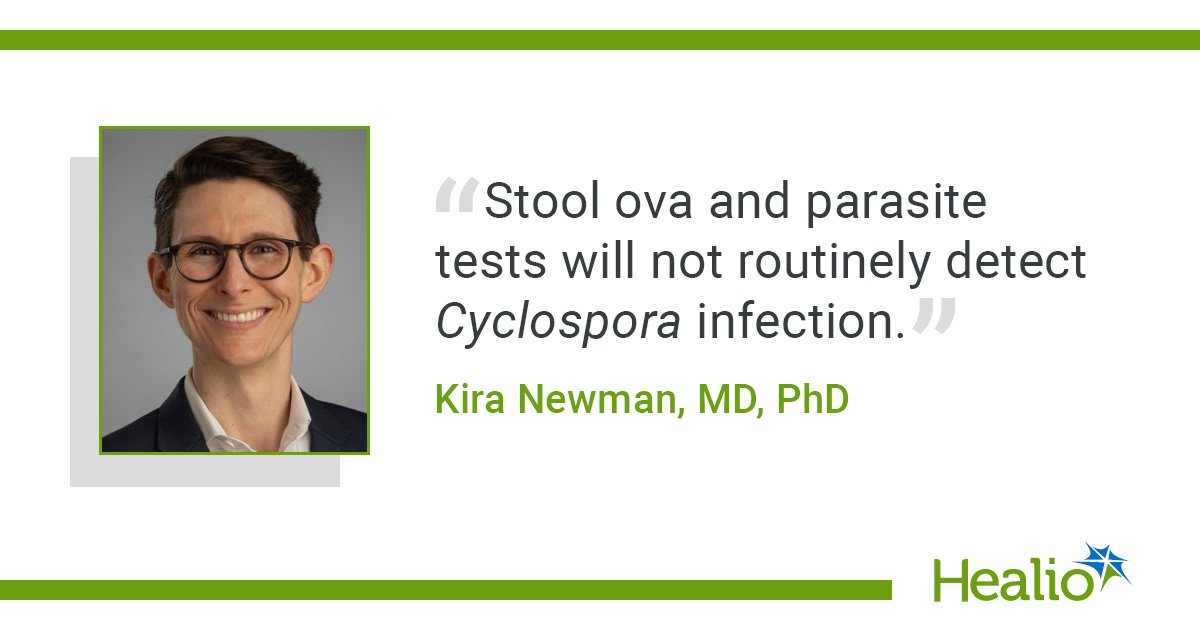
“Stool ova and parasite tests will not routinely detect Cyclospora infection,” Newman said. “Even clinicians who may think they are appropriately testing for it need to confirm with their lab that it’s part of what they are able to detect.
“A high degree of suspicion is important,” she added. “[Cyclosporiasis] can look the same as E. coli, Campylobacter, C. difficile, an IBD flare, norovirus or any viral, bacterial or chronic diarrheal condition.”
Suspicion should be highest when individuals in outbreak epicenters — like Michigan — experience remitting or relapsing course of watery or explosive diarrhea.
“If you are in Michigan, everybody needs to have heightened concern,” Evans said. “If you are not in a state where there are reported cases, then you can just — not relax — but be vigilant, observe and see how it goes.”
Access to stool tests, multiplex panels or serology tests to diagnose Cyclospora can vary, depending on the public health or commercial laboratories clinicians work with.
“Many GI providers may be used to just ordering a stool PCR panel, or may not have that available,” Newman said. “Working with their local infectious disease colleagues or public health specialists can help them identify where they should be sending these samples to ensure they’re not ordering tests with a high degree of suspicion and getting insufficient data back.”
“Stool tests are the most specific,” Evans added. “The problem with them is the delay. It takes time to get the response back.”
Treatment considerations
Given the delay with test results, Evans advised clinicians to be comfortable empirically treating patients for cyclosporiasis.
“Michigan plus watery diarrhea, slam dunk to treat there,” he said. “If you’re in California [and see a patient] with watery diarrhea, I would use a degree of caution. But just look at the data and the symptoms.”
In addition to watery or explosive diarrhea, symptoms of cyclosporiasis include fatigue and loss of appetite and usually begin within a week of becoming infected, according to the CDC. Affected individuals may also experience bloating, flatulence and weight loss.
While most people will clear the infection on their own, children, older adults and those who are immunocompromised may require treatment.
“Treatment is not especially difficult,” Newman said. “Bactrim, ciprofloxacin or other approved antibiotic courses are effective.”
Most individuals with an underlying gastrointestinal condition who contract Cyclospora will respond well to standard courses of antibiotics, she noted.
However, those with inflammatory bowel disease may require special consideration.
“Some IBD patients who are on multiple types of immunosuppression may need [a referral to] an [infectious disease] colleague, or an alternative regimen to truly clear the infection,” Newman said.
Evans also emphasized the importance using risk assessments as a guide for response.
“[Lower-risk] is healthy adults and kids older than 5 years,” he said. “Moderate-risk would include people with underlying health conditions, particularly in higher-risk areas. The third level of risk would be older adults, immunocompromising conditions, in Michigan; if you’re checking all those boxes, then you should be on highest alert.”
For more information:
Tyler B. Evans, MD, MS, MPH, DTMH, FIDSA, is CEO, chair and cofounder of Wellness Equity Alliance, former chief medical officer for New York City, adjunct associate professor in population and public health sciences at University of Southern California Keck School of Medicine, and author of “Pandemics, Poverty, and Politics: Decoding the Social and Political Drivers of Pandemics from Plague to COVID-19.” He can be reached at tyler@wellnessequityalliance.com.
Kira Newman, MD, PhD, clinical assistant professor of gastroenterology at Michigan Medicine, specializes in inflammatory bowel disease and health care equity for sexual and gender minority people with digestive diseases. She can be reached at kinewman@med.umich.edu.
Sources/Disclosures
Source:
Healio Interviews
References:
Disclosures:
Evans and Newman report no relevant financial disclosures.

Ask a clinical question and tap into Healio AI’s knowledge base.
- PubMed, enrolling/recruiting trials, guidelines
- Clinical Guidance, Healio CME, FDA news
- Healio’s exclusive daily news coverage of clinical data