August 18, 2026
5 min read

Key takeaways:
- A virtual smoking cessation intervention resulted in double the quit rates among patients with cancer compared with enhanced usual care.
- Most participants reported not being ready to quit before the trial.
A telehealth-based smoking cessation program significantly improved quit rates among patients with cancer treated at community practices.
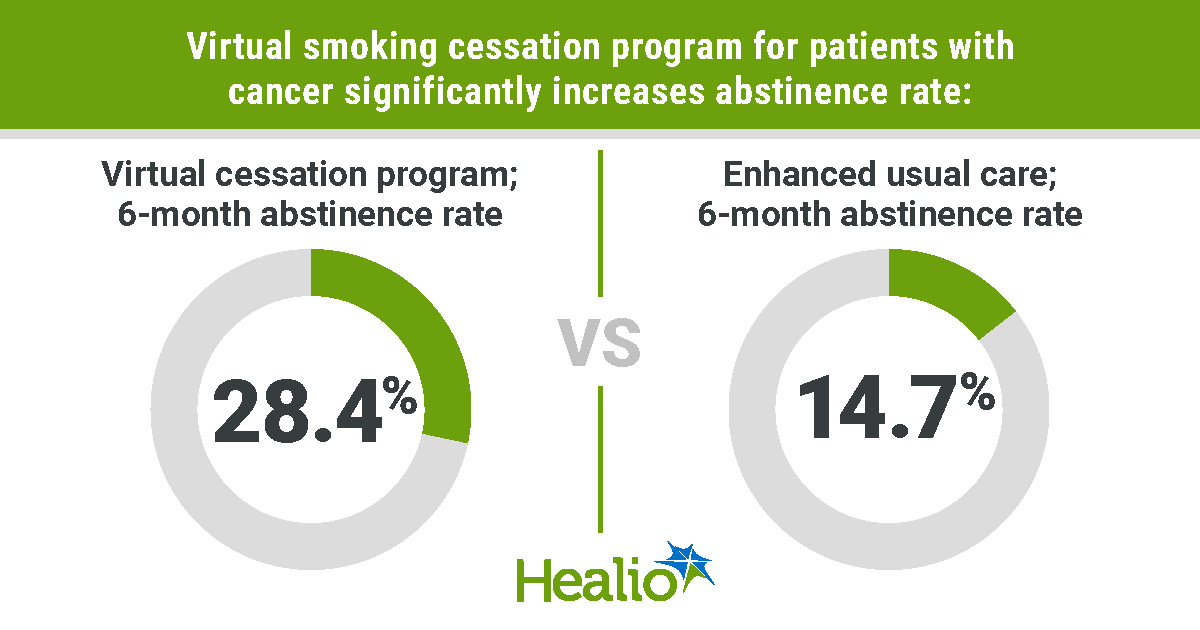
A randomized trial showed patients who received the virtual intervention, which also included no-cost medication, achieved double the abstinence rate at 6 months compared with those who were referred to the NCI quitline.

Data derived from Park ER, et al. J Clin Oncol. 2026;doi:10.1200/JCO-25-02267.

Jamie S. Ostroff
“Helping patients stop smoking after a cancer diagnosis is feasible and impactful, and it can be readily embedded into community oncology care,” Jamie S. Ostroff, PhD, chief of behavioral sciences service and director of the tobacco treatment program at Memorial Sloan Kettering Cancer Center, told Healio.

Elyse R. Park
“Even with patients who might not be ready to quit, and particularly for those who struggle the most with quitting,” Elyse R. Park, PhD, MPH, director of behavioral sciences at the Tobacco Research and Treatment Center at Mass General Brigham and director of the MGB Cancer Institute smokefree support service, added.
Smoking can compromise cancer outcomes
Roughly 15% of patients with cancer report being active smokers, and many of them continue after receiving the diagnosis, according to study background.
“Lots of people feel like after decades of public health messaging that surely nobody smokes,” Ostroff said. “The data show that patients still struggle with tobacco dependence.”
Individuals with cancer who smoke have increased risk for progression and recurrence, secondary malignancies, treatment complications, and death.
Healio previously reported patients who quit smoking after their cancer diagnosis halved their mortality risk compared with those who continued.
“Everyone knows smoking is bad,” Ostroff said. “What fewer patients and the doctors and nurses that care for them appreciate is that smoking has adverse consequences after cancer diagnosis, and that smoking cessation improves outcomes.”
Interventions targeting patients with cancer who smoke have demonstrated effectiveness.
Healio previously reported on the No Smoker Left Behind initiative at The University of Chicago Comprehensive Cancer Center, which referred nearly 900 patients to counseling and/or medication referrals. Among those who responded to follow-up, 58.7% attempted to quit in the prior month, 16.2% stopped smoking for at least 8 days, and 15% reported smoking less than at enrollment.
However, most interventions have been developed and tested at comprehensive cancer centers, despite more than 80% of patients with cancer receiving care at community centers, Park said.
“We thought it was important to prove we could bring this care to the community,” she explained.
Researchers randomly assigned 306 patients (median age, 57 years; 70.9% women; 86.3% white) who were within 4 months of their cancer diagnosis and smoked in the previous 30 days to receive the intervention (n = 156) or enhanced usual care (n = 150).
The virtual treatment intervention included up to 11 telehealth counseling visits with Mass General Brigham providers and free nicotine replacement therapy. Enhanced usual care consisted of a referral to NCI quitline.
“We wanted [the trial] to be rigorous, but we also wanted to provide an evidence-based control condition rather than the typical no-treatment control,” Ostroff said. “We recognize that for some centers, a referral to the quitline will be right-sized for their resources.”
Additionally, 45.4% of participants had nonsmoking-related tumors.
“This is important,” Ostroff said. “A lot of prior studies have only recruited individuals who were diagnosed and treated for lung cancer or a head and neck cancer.”
Abstinence, defined as 7 days without smoking, at 6 months served as the primary endpoint.
‘High-quality part of cancer care’
At baseline, participants smoked a median 12 cigarettes per day and for a median 35 years.
Additionally, 73.2% smoked within 30 minutes of waking up and 48.4% allowed smoking in their homes.
Only 38.8% reported being ready to quit.
The intervention arm had a significantly higher rate of abstinence at both 3 months (24.7% vs. 15%; OR = 1.86; 99.75% CI, 0.76-4.57) and 6 months (28.4% vs. 14.7%; OR = 2.3; 99.8% CI, 1.07-4.97).
“Given the fact that almost half of the individuals were not motivated at all to quit smoking, and a lot of smoking cessation studies do not enroll those individuals, we were really happy with our results,” Park said. “The majority are addicted physically. They live in environments where they’re saturated with smoking, so we were very happy with doubling [the abstinence rate].”
Among participants in the intervention arm, those who completed at least eight sessions had a significantly higher likelihood of being abstinent than those who completed one to four sessions (46.4% vs. 13.3%; OR = 4.91; 95% CI, 1.78-13.54).
Among those who did not quit, the intervention arm had a numerically higher proportion of patients who reduced their smoking prevalence at least 50% at 6 months (45.6% vs. 35.3%).
Overall, 81% of participants in the intervention arm had at least one virtual appointment. Just 5.3% of those in the usual care arm finished a quitline session.
Among those who had at least one virtual session, 85.7% received nicotine replacement therapy.
The intervention arm had a significantly higher rate of any medication use (83% vs. 49.5%; OR = 3.8; 95% CI, 2.13-6.79).
“I was pleasantly surprised that we were able to engage the majority of patients in this virtual sustained treatment,” Ostroff said. “We removed many of the barriers that exist, including lack of local staff by providing the intervention via telehealth, and providing free nicotine replacement with no patient out-of-pocket expenses.”
The intervention arm had a significantly higher rate of treatment satisfaction (P < .001). Among those in the virtual care arm, 85.2% reported that most or all their needs had been met, and 89.9% said they got the assistance they wanted.
The extra cost of the virtual program compared with usual care totaled $158,035 for all 156 patients, with an incremental cost per quit of $7,724.
Researchers acknowledged study limitations, including attrition in the intervention arm and low response rate to follow-up surveys.
Park and Ostroff noted future studies will focus on scalability.
“That’s the million-dollar question,” Ostroff said. “Our findings clearly support the next step in our research, which is to test strategies to understand how to scale up and sustain virtual tobacco treatment across community oncology settings so more patients with cancer can have access to evidence-based support.”
Both researchers described themselves as optimists when discussing smoking cessation care in the coming years.
Park noted improvements in the electronic medical record to identify smokers, better communication and awareness as reasons for her positive outlook.
“I think we’ll continue to build scalable, sustainable strategies for tobacco treatment, and my hope is that in 5 years, we will see an acceptance of tobacco treatment as a high-quality part of cancer care,” Ostroff said.
“My optimism is that patient providers will be less reluctant to have these sensitive discussions with patients, and patients will receive these discussions as well-intended ways of engaging all patients in the best way that we have to offer to save lives and improve quality of life.”
For more information:
Jamie S. Ostroff, PhD, chief of behavioral sciences service, vice chair for research in the department of psychiatry and behavioral sciences services, and director of the tobacco treatment program at Memorial Sloan Kettering, and professor of psychiatry and population sciences at Weill Cornell Medicine, can be reached at ostroffj@mskcc.org.
Elyse R. Park, PhD, MPH, director of behavioral sciences at the Tobacco Research and Treatment Center at Mass General Brigham, director of the MGB Cancer Institute smokefree support service, and professor of psychiatry and medicine at Harvard Medical School, can be reached at epark@mgh.harvard.edu.
Sources/Disclosures
Source:
Park ER, et al. J Clin Oncol. 2026;doi:10.1200/JCO-25-02267.
Disclosures:
Ostroff reports patents, royalties and/or other intellectual property from UpToDate. Park reports honoraria from UpToDate. Please see the study for all other authors’ relevant financial disclosures.

Ask a clinical question and tap into Healio AI’s knowledge base.
- PubMed, enrolling/recruiting trials, guidelines
- Clinical Guidance, Healio CME, FDA news
- Healio’s exclusive daily news coverage of clinical data