August 19, 2026
4 min read

Key takeaways:
- Duvakitug outperformed placebo in endoscopic response and clinical remission at 14 weeks in CD and UC.
- Results were consistent among patients who had been previously treated or were naive to advanced therapy.
An investigational anti-TL1A monoclonal antibody achieved “clinically meaningful” outcomes compared with placebo in patients with inflammatory bowel disease, according to results of the RELIEVE UCCD trial.
Duvakitug (TEV-48574; Teva Pharmaceuticals, Sanofi) demonstrated efficacy in clinical remission at week 14 among patients with ulcerative colitis and in endoscopic response among those with Crohn’s disease, with no new safety concerns identified.

Data derived from Jairath V, et al. Lancet Gastroenterol Hepatol. 2026;doi:10.1016/S2468-1253(26)00119-6.
Existing therapies for moderately to severely active CD and UC often are associated with adverse events, and patients do not always achieve remission or may lose response over time, according to study background.

Vipul Jairath
“When CD is not well controlled, ongoing inflammation and fibrosis may contribute to disease progression, cumulative bowel damage and complications over time, increasing the risk of hospitalization, surgery and added costs for patients and healthcare systems,” Vipul Jairath, MBChB, DPhil, a RELIEVE UCCD investigator and John and Susan McDonald Endowed Chair in IBD Clinical Research at Western University, told Healio. “These challenges underscore the need for therapies that can deliver deeper and more durable disease control.”
Patients with UC also may experience relapsing inflammation, tissue damage and fibrosis, which can result in substantial disease burden and negatively affect quality of life, according to Walter Reinisch, MD, primary coinvestigator of the trial.

Walter Reinisch
“Because disease control can be difficult to maintain, patients may find themselves in a continual cycle of adjusting or switching therapies to address loss of response,” Reinisch, director of the IBD study group at Medical University of Vienna, told Healio.
“These unmet needs motivated us to investigate TL1A-inhibition, targeting a pathway that may contribute to both inflammation and fibrosis in IBD,” Reinisch added.
‘Innovative’ study design
Jairath, Reinisch and colleagues conducted the multicenter, phase 2b RELIEVE UCCD trial to investigate the efficacy and safety of duvakitug among adults aged 18 to 75 years with moderately to severely active CD or UC. Eligible participants were enrolled from 163 investigational sites in 19 countries from Sept. 30, 2022, through Nov. 12, 2024.
“This study used an innovative basket study design to enhance operational efficiency,” Jairath said. “The basket approach uses a single master protocol, facilitating shared infrastructure and resources within sites, to allow the study to be conducted in two different inflammatory bowel disease indications with distinct primary endpoints for each indication.”
The CD cohort included 139 patients (mean age, 39.5 years; 58% men; 95% white), of whom 57% previously had been treated with at least one advanced therapy.
Participants in this cohort were randomly assigned 1:1:1 to receive an initial 2,250 mg loading dose of duvakitug subcutaneously, then biweekly duvakitug 450 mg (n = 46) or 900 mg (n = 46), or a loading dose of placebo, followed by placebo every 2 weeks (n = 46).
Endoscopic response, defined as a 50% or greater reduction from baseline in Simple Endoscopic Score for Crohn’s Disease, at week 14 served as the primary endpoint.
The UC cohort included 137 patients (mean age, 41 years; 63% men; 96% white), of whom 31% previously had been treated with at least one advanced therapy.
Participants in this cohort also were randomly assigned to loading doses, followed by 450 mg duvakitug (n = 47), 900 mg duvakitug (n = 46) or placebo (n = 44) every 2 weeks.
Clinical remission, measured by modified Mayo score, at week 14 served as the primary endpoint for this cohort.
‘Strong efficacy’
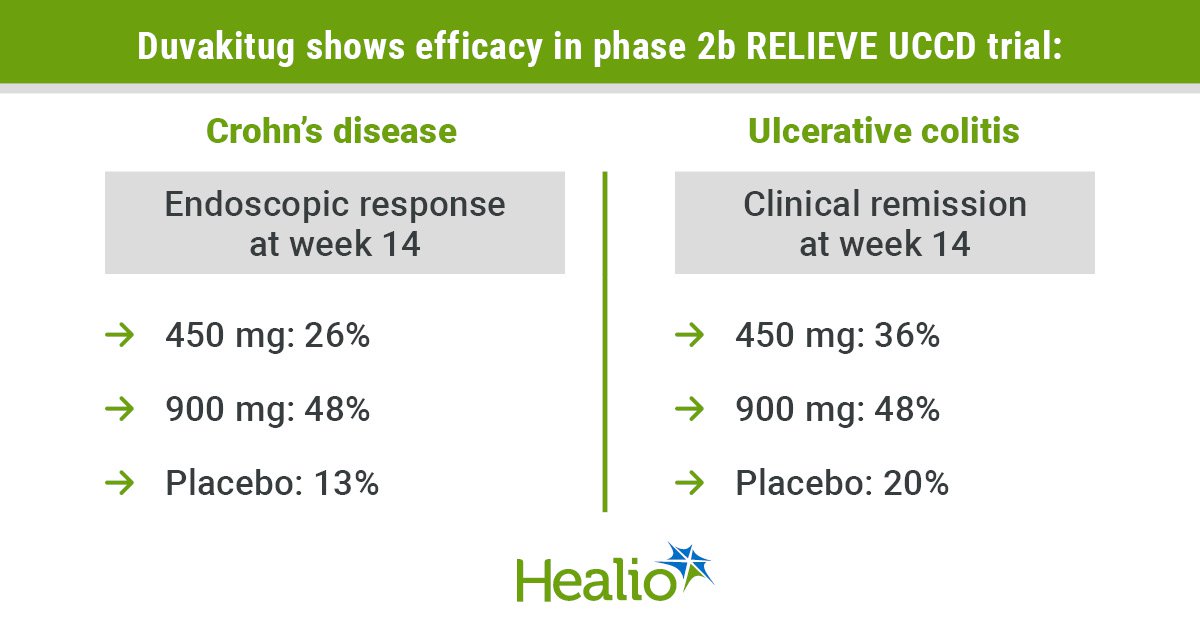
In the CD cohort, 26% of patients in the 450 mg duvakitug group achieved endoscopic response at week 14, as did 48% in the 900 mg group, compared with 13% in the placebo group.
“The robust endoscopic response was particularly encouraging, as endoscopic response is an important treatment goal and is associated with improved long-term outcomes for patients with Crohn’s disease,” Jairath said. “These findings suggest that duvakitug may help address key disease processes underlying CD.”
In a subgroup analysis of previously treated patients, researchers observed a 44% treatment difference between duvakitug 900 mg and placebo groups, compared with a 7% difference between duvakitug 450 mg and placebo.
Among advanced therapy-naive patients, treatment differences were similar between both doses of duvakitug and placebo (25%).
Treatment-emergent adverse events occurred in all groups, the most common of which were anemia, nasopharyngitis and headache. Serious adverse events were reported in 13% of patients in the 450 mg group, 2% in the 900 mg group and 11% in the placebo group.
Duvakitug also outperformed placebo in the UC cohort. At 14 weeks, 36% of patients in the 450 mg group achieved clinical remission, as did 48% in the 900 mg group, vs. 20% in the placebo group.
“Within the UC cohort, the clinical remission data was highly compelling,” Reinisch said.
As in the CD cohort, duvakitug showed “strong efficacy” compared with placebo among both advanced therapy-experienced and naive patients with UC, according to Reinisch.
Subgroup analyses showed treatment differences of 22% and 29%, respectively, among treatment-experienced patients in the 450 mg and 900 mg groups compared with placebo, and 12% and 26% among treatment-naive patients.
“The robust rates of clinical remission are highly encouraging and suggest that duvakitug has the potential to offer a new therapeutic approach for people living with UC, including those who have already cycled through other advanced therapy,” Reinisch said.
Treatment-emergent adverse events were similar among UC groups, as well, and most commonly included anemia, upper respiratory tract infection, nasopharyngitis and vomiting. One patient receiving duvakitug 900 mg experienced noninfective oophoritis, considered a serious adverse event.
Jairath, Reinisch and colleagues acknowledged study limitations, including small numbers of patients for subgroup analyses.
“Building on the phase 2b RELIEVE UCCD results, the ongoing phase 3 clinical program for duvakitug in UC and CD is designed to further evaluate the long-term efficacy, safety and durability of duvakitug in a larger patient population,” Reinisch said.
For more information:
Vipul Jairath, MBChB, DPhil, is professor of medicine at Schulich School of Medicine and Dentistry and the John and Susan McDonald Endowed Chair in IBD Clinical Research at Western University. He can be reached at vjairath@uwo.ca.
Walter Reinisch, MD, is professor of gastroenterology and hepatology and director of the IBD study group at Medical University of Vienna. He can be reached at gastroenterology@healio.com.
Sources/Disclosures
Source:
Jairath V, et al. Lancet Gastroenterol Hepatol. 2026;doi:10.1016/S2468-1253(26)00119-6.
Reference:
Disclosures:
Jairath reports consulting or advisory roles with AbbVie, Amgen, AstraZeneca, Bristol Myers Squibb, Boehringer Ingelheim, Eli Lilly & Co., Ferring, Gilead Sciences, GSK, Janssen, Merck, Pfizer, Roche/Genentech, Sanofi, Takeda Pharmaceuticals, Teva Pharmaceuticals and several other companies; payment for lectures, presentations, speakers bureaus, manuscript writing or educational events from AbbVie, Eli Lilly & Co., Ferring, Fresenius Kabi, Janssen, Pfizer, Takeda and Tillotts; and participation on data safety monitoring or advisory boards for AbbVie, Fresenius Kabi, Gilead Sciences, Janssen, Roche and Takeda. Reinisch reports consulting, advisory board or speaker roles with AbbVie, Amgen, Boehringer Ingelheim, Bristol Myers Squibb, Celltrion, Eli Lilly & Co., Ferring, Galapagos, Gilead Sciences, Janssen, Pfizer, Roche, Takeda, Teva and several other companies; and research funding from AbbVie, Janssen, Sandoz, Sanofi and Takeda. Please see the study for all other authors’ relevant financial disclosures. Sanofi and Teva Pharmaceuticals funded this study.

Ask a clinical question and tap into Healio AI’s knowledge base.
- PubMed, enrolling/recruiting trials, guidelines
- Clinical Guidance, Healio CME, FDA news
- Healio’s exclusive daily news coverage of clinical data