August 21, 2026
4 min read

Key takeaways:
- Excess fructose, especially sugary drinks and high fructose corn syrup, can drive hepatic lipogenesis and MASLD.
- Limit red/processed meat and emphasize whole fruit, fiber and minimally processed foods.
When we think about fatty liver, the intuitive culprit is dietary fat. Yet the dominant dietary drivers for metabolic dysfunction-associated steatotic liver disease are not greasy foods, but rather excess fructose and red and processed meat.
Reframing this risk carries direct clinical implications for a condition estimated to affect roughly 30% of adults worldwide, and one whose largely silent progression makes primary prevention paramount.

Among modifiable exposures, sugar-sweetened beverages — including soda and, importantly, fruit juices with high fructose content — deserve particular emphasis. The same concern extends to products sweetened with high fructose corn syrup, a widely used sweetener in many ultra-processed foods and beverages, particularly in the United States.
For patients, this makes ingredient-label literacy clinically relevant: reducing fructose exposure requires attention not just to soda and juices but also to packaged products such as sweetened snacks, desserts, breakfast cereals, sauces and other processed foods that may contain high fructose corn syrup.
Fructose fuels hepatic lipogenesis, steatosis
The hazard is mechanistic, not merely caloric. Unlike glucose, dietary fructose is transported via the hepatic portal vein directly to the liver, where it stimulates de novo lipogenesis through non-insulin-mediated activation of carbohydrate-responsive element-binding protein.
Because fructose enters hepatocytes independently of insulin signaling, it bypasses the regulatory checkpoints that constrain glucose flux. As a result, fructose is a more potent driver of hepatic de novo lipogenesis than glucose, a finding consistently demonstrated in both human intervention studies and mechanistic animal models.
Fructose catabolism also generates uric acid and promotes mitochondrial oxidative stress, impairing fatty acid oxidation. The resulting surplus of fatty acids promotes triglyceride accumulation, hyperinsulinemia and hepatic inflammation — the substrate of MASLD progression.
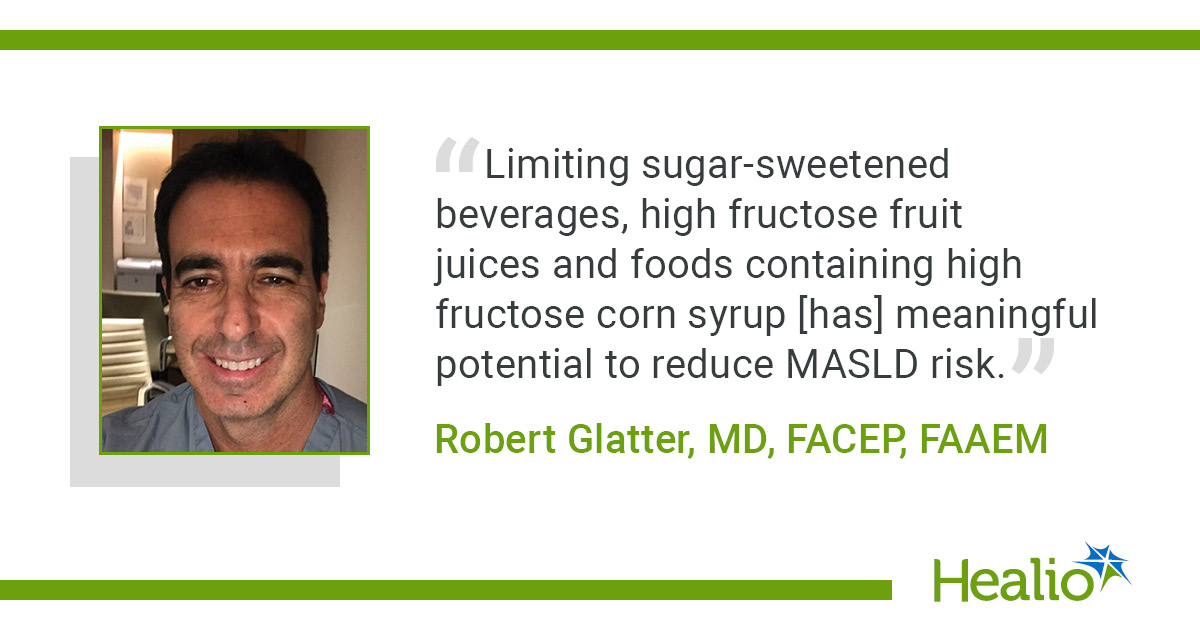
Notably, in a controlled feeding study among adolescents with nonalcoholic fatty liver disease, reducing dietary sugar decreased hepatic de novo lipogenesis from 25% to 17%, with parallel declines in alanine aminotransferase levels and hepatic steatosis. The clinical implication is clear: Limiting sugar-sweetened beverages, high fructose fruit juices and foods containing high fructose corn syrup is a simple, low-cost intervention with meaningful potential to reduce MASLD risk.
Whole fruit, fiber and the gut–liver axis
A crucial distinction, often overlooked in public messaging, is that whole fruit does not pose the same risk despite its naturally occurring fructose. Apples, mangos and grapes have not been linked to hepatic steatosis or incident MASLD, largely because their fiber-rich nutritional matrix slows fructose absorption and reduces metabolic burden on the liver.
Dietary fiber further supports a favorable gut microbiome and helps limit the postprandial metabolic responses that promote lipogenesis. Whole fruits should therefore continue to be recommended; the primary concern is not fruit itself, but liquid, fiber-free sources of fructose.
This dietary distinction also intersects with the gut-liver axis, an increasingly recognized contributor to MASLD pathogenesis. Gut dysbiosis can disrupt intestinal barrier integrity, increase gut permeability and promote the translocation of bacterial products, including lipopolysaccharide, into the portal circulation.
In the liver, these signals can activate Toll-like receptors and NF-kappa B-mediated inflammatory pathways, promoting hepatic insulin resistance, steatosis, inflammation and progression toward metabolic dysfunction-associated steatohepatitis.
Dysbiosis may also alter microbial metabolites, including short-chain fatty acids, bile acids, endogenous ethanol, choline-related pathways and trimethylamine-N-oxide, thereby influencing lipid handling, oxidative stress and inflammatory signaling. These mechanisms further support dietary strategies that promote microbial resilience, including high-fiber foods, prebiotic substrates and Mediterranean-style dietary patterns.
The case for the Mediterranean diet
Red and processed meat constitute the second major dietary contributor to MASLD. In a well-adjusted cross-sectional 2018 analysis published in Journal of Hepatology, high total meat consumption was independently associated with NAFLD (OR = 1.49; 95% CI, 1.05-2.13) and insulin resistance, with similar associations for red and/or processed meat.
Although red meat supplies valuable protein, iron, zinc and vitamin B12, it also is a substantial source of saturated fatty acids, cholesterol, heme iron and advanced glycation end products that promote oxidative stress, insulin resistance and metabolic syndrome. Processed meats add a sodium, nitrate and nitrite burden that compounds cardiometabolic risk beyond the liver, including incident type 2 diabetes and cardiovascular disease.
Consistent with a forward-looking viewpoint, the evidence suggests that not all cohorts exhibit a simple dose-response. For example, a 2026 analysis from southern Italy published in Nutrients found no significant overall association, with elevated risk observed only among men consuming 75 to 90 grams of red meat per day, which underscores the modifying roles of preparation method, processing and sex. Nonetheless, the pragmatic message remains to limit consumption of red meat, and especially processed meat.
Against this background, the Mediterranean diet stands as the most evidence-supported dietary pattern for MASLD. Rich in fish, vegetables, fruits, nuts, legumes and monounsaturated fats — together with limited consumption of red meat and refined sugars — it has repeatedly reduced hepatic fat and improved insulin sensitivity.
In a randomized crossover trial published in Journal of Hepatology in 2013, adherence to the Mediterranean diet reduced intrahepatic lipid content by approximately 39% vs. 7% with a low-fat diet, independently of weight loss. Meta-analyses published in Seminars in Liver Disease have confirmed significant reductions in the fatty liver index and HOMA-IR, while longitudinal analyses from the PREDIMED study published in Frontiers in Nutrition suggest that greater adherence to the Mediterranean diet may delay MASLD progression over 5 years of follow-up.
The benefit is plausibly mediated by monounsaturated and omega-3 fatty acids, polyphenols and fiber, which collectively reduce hepatic oxidative stress, improve insulin sensitivity and favorably modulate the gut microbiome. This pattern is endorsed as a cornerstone of care by AGA, American Association for the Study of Liver Diseases, ACG, American Heart Association, American Diabetes Association and the joint EASL-EASD-EASO guideline.
The clinical message is therefore one of reframing, rather than fat avoidance. Protecting the liver depends less on eliminating dietary fat and more on three actionable levers:
- minimizing sugar-sweetened beverages and high fructose fruit juices;
- limiting red and processed meat; and
- adopting a Mediterranean-style pattern centered on whole, minimally processed, high-fiber foods, with an emphasis on whole fruits.
For a silent and increasingly prevalent disease, these remain among the most accessible and scalable interventions available.
For more information:
Robert Glatter, MD, FACEP, FAAEM, is an attending physician in the department of emergency medicine at Lenox Hill Hospital and assistant professor of emergency medicine at Donald and Barbara Zucker School of Medicine at Hofstra/Northwell. He can be reached at rglatter@northwell.edu.
Sources/Disclosures
Source:
Expert Submission
References:
Disclosures:
Glatter reports no relevant financial disclosures.

Ask a clinical question and tap into Healio AI’s knowledge base.
- PubMed, enrolling/recruiting trials, guidelines
- Clinical Guidance, Healio CME, FDA news
- Healio’s exclusive daily news coverage of clinical data