
August 26, 2026
7 min read
Key takeaways:
- The proposed schedule decreases conversation factors for qualifying and nonqualifying alternative payment models.
- It also would move primary care closer toward hybrid payment system.
CMS recently issued its proposed 2027 Medicare Physician Fee Schedule.
The proposed schedule includes a 0.75% increase to the qualifying alternative payment model (APM) conversion factor and a 0.25% increase to the nonqualifying APM conversion factor.

But because the Working Families Tax Cut Act provided a 1-year conversion factor increase of 2.5% for the 2026 PFS — which does not apply to the 2027 PFS — current law requires a 2.5% decrease in Medicare payments compared with 2026. Therefore, CMS said the proposed qualifying APM conversation factor of $33.17 for 2027 is a projected reduction of $0.40 (–1.19%) from the current $33.57 conversion factor.
The proposed non-APM conversation factor of $32.84 is also a projected decrease of $0.56 (–1.68%) from the current $33.40 non-APM conversion factor.
CMS also proposed:
- reducing payment “when a separately identifiable office/outpatient evaluation and management visit is furnished by the same physician (or a physician in the same practice) on the same day as a 0-, 10- or 90-day global procedure”;
- moving away from relying on AMA surveys to determine practice expenses; and
- requirements for supplying, reporting and reimbursing remote therapy monitoring and remote physiologic monitoring.
Healio spoke with Ann Greiner, MCP, president and chief executive officer of the Primary Care Collaborative, about the positives, concerns and implications of the proposed rule.
Healio: What is encouraging, or concerning, to you about the proposed 2027 PFS?
Greiner: I think it builds on things that the administration did last year that helped to make a more sustainable path for primary care and help beneficiaries get the care that they need. There’s a lot that’s positive, and there’s a number of requests for information (RFIs) that we think signal their future direction and we’re very excited about.
This notion of a hybrid payment — which is a mix of prospective and fee-for-service — included in an RFI is something we see as very positive, and CMS has signaled that they would likely start with Accountable Care Organizations (ACOs) and perhaps expand from there. PCC helped to get the Primary Care Flex Model into the Shared Savings Program as a model test, and now they’re moving forward with that approach, and we think that it could give more payment stability and flexibility to primary care clinicians.
They also are proposing increasing payment for primary care for those in ACOs, and we see that as important because primary care-centric ACOs do such a good job with quality of care for beneficiaries and managing costs. Another part that is good for patients is making it clear to ACOs that they can waive patient cost-sharing, because you don’t want there to be a financial barrier for people getting primary care and that’s what waiving of cost-sharing does.
We also see things that help to better support whole-person primary care in this proposal, like payment support for health coaches, more support for behavioral health — including substance use disorders — and support for shared medical appointments. Shared medical appointments be game changers for patients learning and getting support from both a trusted clinician and fellow patients, while building community.
The perennial challenge is that CMS doesn’t have control over the reduction in the conversion factor. There’s a 1.2% reduction in the conversion factor, and that results in a payment reduction across all of medicine. What has happened in the past is that Congress has had to step in to address that cut, which CMS needs to put in place by law. Frankly, I think they’re getting tired of doing that. That just creates a lot of instability. The legislation usually isn’t passed before the cut goes in, and you have a sort of seesaw for physician and other clinician pay. There is a bill that was introduced called the Patients First Act that would address this, and we’d like the broader Medicare reform to incorporate that as we move forward so we don’t have this payment seesaw.
Healio: Can you expand on the implications of the RFIs?
Greiner: There is a very substantive RFI focused on a number of dimensions related to primary care. It asks how CMS might implement hybrid payment in the fee schedule. We’re a big fan of hybrid payment. We see Advanced Primary Care Management as a step on that path. Internally, we call that a mini hybrid because it is a bundled payment that’s paid monthly. It’s also more predictable, because you know that if your patient panel doesn’t undergo a lot of changes, you know what that payment will be. It does, though, need to be not just moving the deck chairs in terms of changing the payment model with the same amount of dollars. We want more investment in that hybrid payment.
Another aspect of the RFI is about how technology can enable primary care. We’re working with our members and thought leaders around the country to understand this rapid adoption of AI into primary care. We see a lot of use cases on the administrative front, and we’re hopeful that it reduces the administrative burden for primary care. We also see use cases on the clinical front, though with not as many being adopted, and those are important as well.
But the thing we see as important as we move forward with AI is to preserve the aspects of primary care that we know deliver better results. How can AI support care coordination and care integration? How can AI support communication? How can AI support primary care providing a comprehensive set of services? And most important — let me underscore this — is, how can AI support an ongoing human relationship between a primary care clinician and their patient?
We also have some questions about how all practices can adopt and afford AI tools, particularly independent practices that are serving the safety net, because there is an investment required, and it’s not immaterial. So, those are all things that we think about, but we’re excited that we’ve got these RFIs and are eager to respond to them.
Healio: What does CMS’s move away from relying on AMA surveys to determine practice expense methodology, physician work, etc., mean for the long term?
Greiner: It’s really important to make sure that we preserve the clinician’s voice in providing input to CMS on how to price services because the folks who are doing the work have an appreciation for what it entails. In addition, we think that there are others who have expertise to contribute.
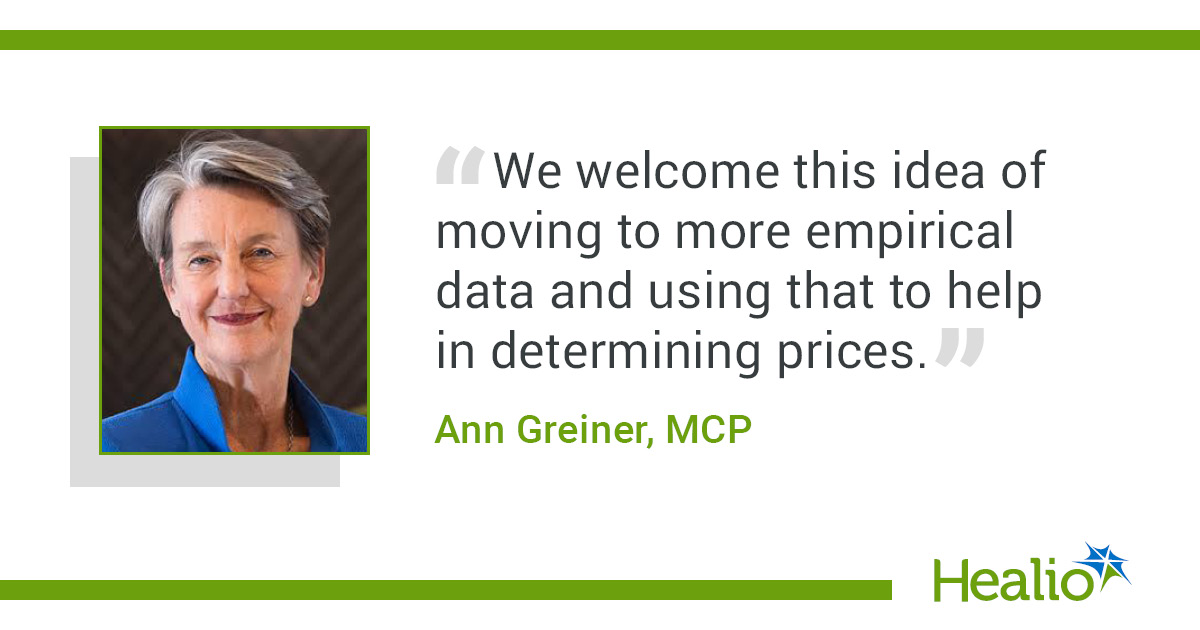
We do have some concerns with the current approach, including how some of the surveys include a low response rate. There’s also other empirical data that should be tapped to inform pricing decisions. For example, we could be extracting electronic data from electronic health records and analyzing claims data in All-Payer Claims Databases to understand how a service is being utilized. Bottom line is that we think that we need to modernize our pricing system and that there needs to be a rebalancing, because there tends to be an undervaluation of the cognitive codes. So, we welcome this idea of moving to more empirical data and using that to help in determining prices.
The other thing is that, right now, the system is based all on inputs. Those inputs are important, but something to also consider is outputs as in what the impact is on patients, and how is that valued? That’s not easy to do, but I believe that it can be done.
To sum up, we’re excited about the notion of modernizing the way that pricing is done, and we see a very important role for clinicians being in a leadership position as CMS moves toward a new way to price services.
Healio: What are your thoughts on CMS seeking comments about potential reconsideration and understanding of factors like relative primary care payment as ways to shift healthcare “toward a focus on preventive rather than reactive medicine”? What is the most important thing that CMS needs to do to truly increase or improve preventive care?
Greiner: Right now, we pay a lot for downstream acute and specialty services. Consequently, we get a lot of those services! So, we think that there needs to be a shift toward better funding for prevention and chronic disease management.
Primary care is delivering, depending upon the study, between 35% and 50% of all services, but primary care’s payment for all those services is less than $0.05 on the dollar.
Medicare is such an important payer in setting the table for all other payers, and I think it’s signaling that it wants to do some rebalancing so that our system better rewards prevention and chronic disease management. Right now, our payment system puts more emphasis on downstream acute and specialty services. Both are important and critical, but we’ve really underinvested in prevention and chronic disease management, and that’s what this administration, prior administrations and now Congress is trying to tackle.
Healio: Is there anything else you’d like to add or emphasize?
Greiner: This whole notion of the relationship being the secret sauce of primary care sounds squishy. How do you value a relationship?
When you’ve got something complicated going on, when you have multiple chronic conditions and you’re trying to navigate a very complex system, if you trust the person who’s giving you advice across the desk — because they’re giving you their recommendations based on how well they know your medical condition, your mental health condition, your family context and your community context — it makes a world of difference. That relationship piece is critical in our very chaotic and complex system, and a strong, continuous relationship is essential for people to get good care.
For more information:
Ann Greiner, MCP, can be reached through Tod Didier, communications director at Primary Care Collaborative, at tdidier@thepcc.org.
Sources/Disclosures
Source:
Healio Interviews
References:
Disclosures:
Greiner reports no relevant financial disclosures.

Ask a clinical question and tap into Healio AI’s knowledge base.
- PubMed, enrolling/recruiting trials, guidelines
- Clinical Guidance, Healio CME, FDA news
- Healio’s exclusive daily news coverage of clinical data