
August 27, 2026
3 min read

Key takeaways:
- Drinking at least one sugar-sweetened beverage daily was linked to 2.5 times the risk for developing gastric cancer.
- Researchers found no link between artificially sweetened beverages and gastric cancer.
A prospective study of more than 110,000 individuals found consumption of at least one 8 oz. sugar-sweetened beverage per day was associated with a nearly 2.5 times greater risk for gastric cancer.
The study, published in Gastro Hep Advances, found no link between intake of artificially sweetened beverages and incidence of gastric cancer.

Dietary factors — including increased consumption of salted fish, pickled vegetables and grilled or charcoaled meats along with lower intake of fruits and vegetables — are known contributors of gastric cancer, the fourth-leading cause of cancer deaths globally, according to study background.
However, prior studies had not investigated the impact that beverages like soda, energy drinks and sweetened juice might have on gastric cancer incidence.
“We already had strong evidence linking sugar-sweetened beverages to a higher risk for colorectal, breast and liver cancers,” Andrew T. Chan, MD, MPH, chief of the Clinical and Translational Epidemiology Unit at Massachusetts General Hospital, director of epidemiology at Mass General Cancer Institute and Daniel K. Podolsky Professor of Medicine at Harvard Medical School, told Healio. “Given how almost 65% of U.S. adults consume at least one of these beverages a day, it seemed important to ask whether that same relationship might extend to stomach cancer.”
Chan and colleagues included artificially sweetened beverages in their analysis, because aspartame — a common artificial sweetener — is internationally recognized as a potential carcinogen, they wrote.
The researchers collected data from the Nurses’ Health Study and Health Professionals Follow-up Study, ongoing U.S.-based prospective cohorts that enrolled female registered nurses in 1976 and male healthcare professionals in 1986, respectively.
Beverage intake was assessed via food frequency questionnaires administered every 4 years. Data from the 1986 questionnaire served as baseline, and analysis — adjusted for confounders such as red and processed meat consumption, BMI and other known risk factors — continued through January 2022.
The researchers defined sugar-sweetened beverages as carbonated drinks, punch, lemonade and sports drinks, and artificially sweetened drinks as low-calorie carbonated beverages.
Among 112,284 individuals (60.8% women) included in final analysis, 278 participants developed gastric cancer in 3,204,001 person-years of follow-up.
Compared with those who never drank sugar-sweetened beverages, researchers observed significantly higher risk for gastric cancer among individuals who consumed at least one 8 oz. serving of a sugary drink daily (HR = 2.45; 95% CI, 1.49-4.04).
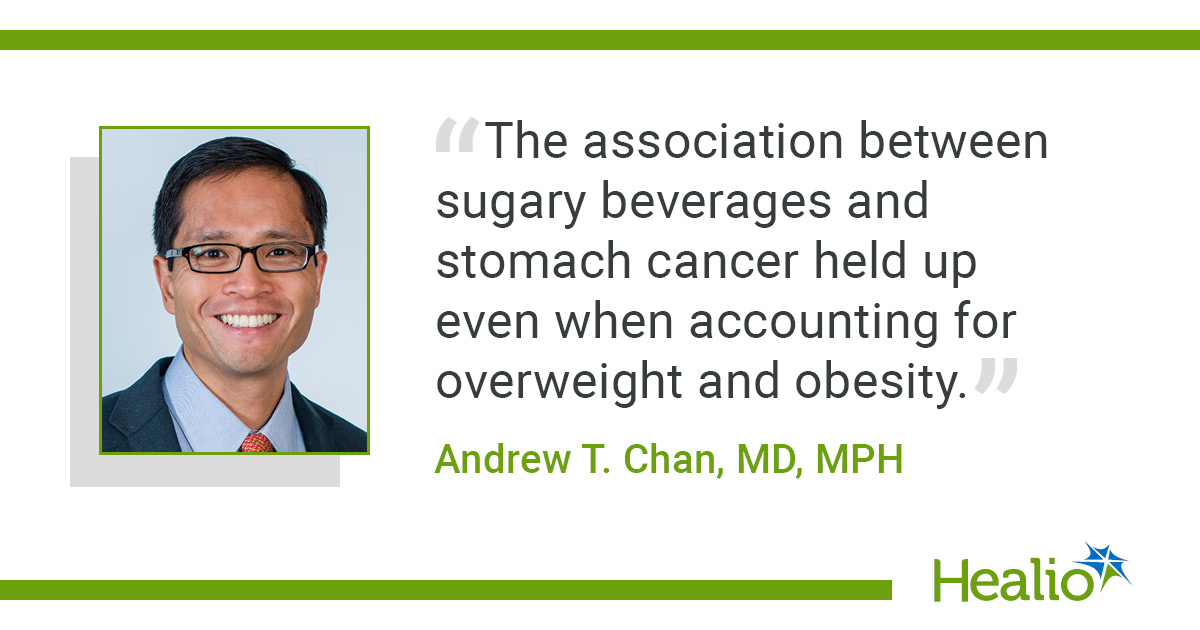
“The association between sugary beverages and stomach cancer held up even when accounting for overweight and obesity, which is an independent risk factor for cancer,” Chan said.
By sex, incidence of gastric cancer also was significantly higher among women (HR = 3.04; 95% CI, 1.46-6.33) and men (HR = 1.99; 95% CI, 1-3.93) who consumed more than 8 ounces daily compared with never-users.
“If this association holds up in future research, it means there may be a meaningful, actionable way for people to lower their risk for a cancer that is often diagnosed late and difficult to treat,” Chan said. “It’s also a reminder that diet’s influence on cancer risk isn’t limited to the cancers we usually think of, like colorectal cancer.”
Age- and multivariable-adjusted analysis showed no link between artificially sweetened beverage intake and gastric cancer incidence.
Chan and colleagues acknowledged study limitations, including lack of data on Helicobacter pylori infection status and family history of gastric cancer. The cohorts also were predominantly composed of white individuals aged 30 to 75 years when enrolled, and results may not be generalizable to non-white or younger individuals.
Additional research is needed to validate these findings and explore underlying mechanisms that may link sugar-sweetened beverage consumption to gastric cancer, the researchers wrote.
“We don’t yet know the precise mechanism, but several biological pathways have been proposed for how sugary drinks might contribute to cancer risk generally, including its effect on weight gain, insulin resistance and changes to the gut microbiome,” Chan told Healio.
For more information:
Andrew T. Chan, MD, MPH, can be reached at gastroenterology@healio.com.

Ask a clinical question and tap into Healio AI’s knowledge base.
- PubMed, enrolling/recruiting trials, guidelines
- Clinical Guidance, Healio CME, FDA news
- Healio’s exclusive daily news coverage of clinical data