
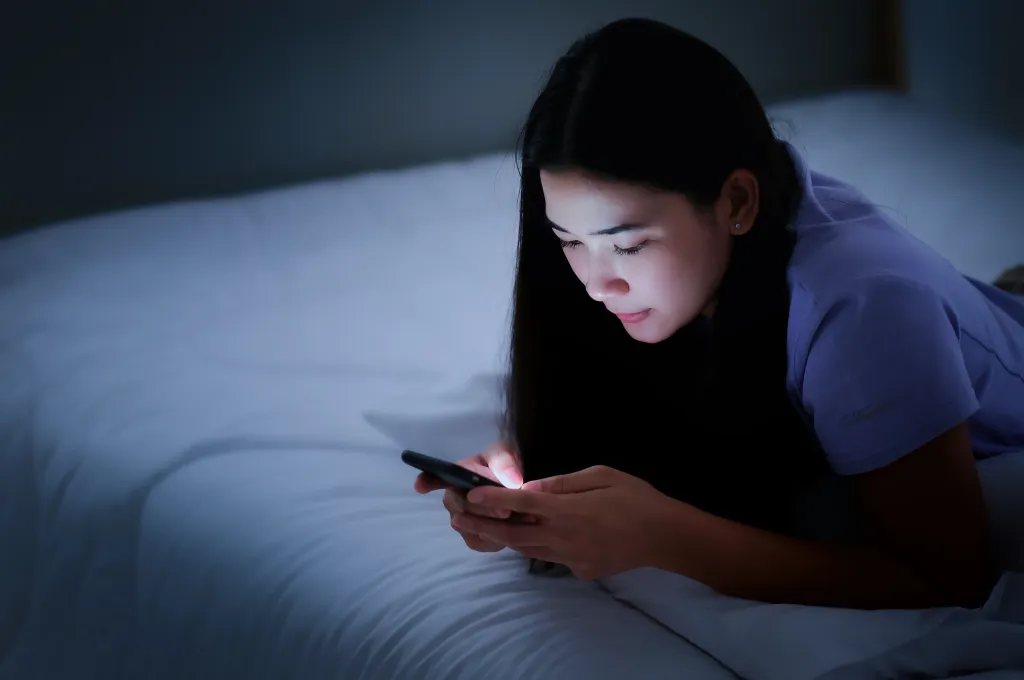
If your teen spent their summer on a screen, they’re not alone.
According to the National Health Interview Survey, half of teens spend four hours a day or more on their phones. In the summer, all that glorious, unstructured free time means it’s likely even longer. When it comes to sleep, those hours of blue light can take a toll.
“Screen use can delay bedtime and the blue light from the phone can disrupt sleep signals, but it’s not just that,” says psychotherapist Katie Rose, LCSW. “Studies have found that teens who keep their phones in their bedrooms get less sleep and report poorer sleep quality, even when the phone is turned off but remains in the bedroom.” Teens may be more likely to think about notifications or feel the urge to check their phone — or else they’ll be woken up by pings or vibrations.

Related story
‘Social Media’s Big Tobacco Moment’: What Parents Say about Meta’s $17.1 Billion Dollar Settlement
And those hours of sleep are critical for teens, whose brains are still developing. “If you shortchange your sleep, you shortchange your health and life,” says clinical sleep educator Lauri Leadley, CCSH, RPSGT, founder and president at Valley Sleep Center.
But phones are addictive and hard to turn off once you’ve fallen deep into a scroll. If your teen likes TikTok (and who doesn’t), it’s even harder. Those short-form videos are “uniquely good at delivering an endless stream of rewards to the teen brain,” says Rose, “which keeps the brain engaged and makes it much harder to disengage, even if teens genuinely want to go to bed.”
But with back-to-school steadily creeping up, your teen’s schedule is about to shift, and late nights of texting and TikTok will hit a lot harder when they’re waking up at 7 a.m. again. So how do we get them back on track?
Start by getting them off their screens from 9 a.m. to 9 p.m., Rose says. In return, give them a little more freedom for the last few weeks of summer. “Think about how you can make their offline life rewarding enough to compete with their online life,” says Rose. This might mean filling the gap with other activities that activate the brain’s reward system, Rose says, like time with friends, sports, creative hobbies, music, exercise, or privileges they’ve earned.
As the parent, you should also lead by example and model good sleep hygiene. “Show them that we’re all putting our phones on the charger — away from the nightstand — and that we’re winding down now for sleep,” suggests Leadley. “No calls after a certain time, and ‘calls’ is synonymous with texts, chats, socials.”
And know that it might take two to three weeks for your teens to recalibrate to their school schedule, Leadley adds.
Remember, too, that this will be a conversation with your teen. As much as you’re enforcing rules, you should also hear them out about their screen time needs; their phone is their connection to their social life, after all. “Work together to find a solution,” Rose says. “Offer plenty of replacements for their phone time … and focus on connection with your teen over controlling them. Teens are much more likely to buy into limits when they feel respected and included in the conversation.”