
August 28, 2026
3 min read

Key takeaways:
- Individuals with European ancestry had significantly higher overall odds of developing colorectal cancer.
- Those with East Asian and American admixed-Latino lineages had greater risk at younger ages.
Genetic ancestry may have significant associations with colorectal cancer incidence and age-specific risk.
An evaluation of more than 300,000 individuals with whole genome sequencing showed that individuals with European ancestry had greater overall odds of developing colorectal cancer, but other lineages, including American admixed-Latino and East Asian, had higher risk for disease at younger ages.

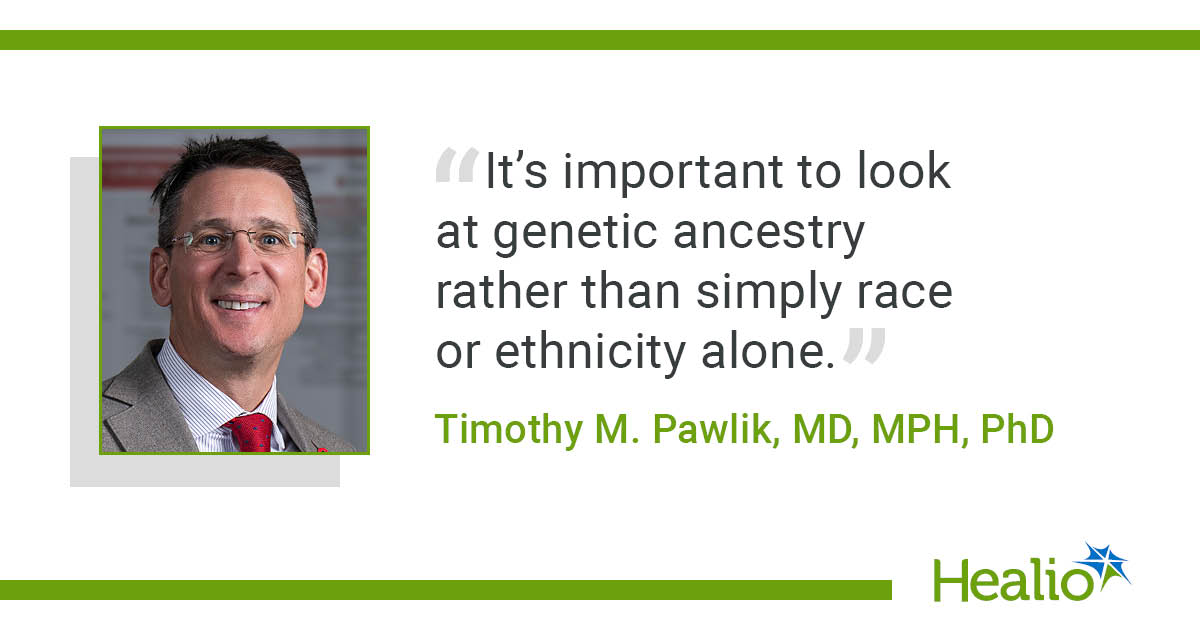
“It’s important to look at genetic ancestry rather than simply race or ethnicity alone,” Timothy M. Pawlik, MD, MPH, PhD, chair of the department of surgery and Urban Meyer III and Shelley Meyer Chair for Cancer Research at The Ohio State University Wexner Medical Center, told Healio. “While those two factors correlate frequently, it’s not a 1:1 correlation. Therefore, moving forward, it is important to look at genetic ancestry as a specific risk factor.”
Genetic ancestry ‘complements’ race, ethnicity
Approximately 2 million individuals are diagnosed with colorectal cancer worldwide every year, according to study background.
Modifiable risk factors for colorectal cancer include obesity, diabetes, diet, smoking and alcohol. Nonmodifiable risk factors exist, too, including age, sex, and race and ethnicity, according to American Cancer Society.
Individuals who identify as American Indian and Alaska Native have the highest incidence rates, then African Americans.
Race and ethnicity do not fully capture a person’s genetic makeup, though.
“Race and ethnicity have really dominated the disparities literature with regards to differences in incidence and outcomes, but many would argue that race and ethnicity represent social constructs that capture cultural lived experiences,” Pawlik said. “It may imperfectly reflect genetic similarity and often include admixed individuals who may come from different genetic lineage. Genetic ancestry really complements these measures and perhaps more precisely captures people’s genetic background.”
Recent studies have investigated genetic ancestry in breast, prostate and skin cancer, but fewer data exist within colorectal cancer, Pawlik and colleagues wrote.
“We wanted to address this gap and specifically characterize any associations between genetic ancestry and colorectal cancer across a large multiethnic cohort,” Pawlik said.
Researchers used data from the All of Us Research Program to investigate.
The study included 316,624 participants (median age, 56.3 years; interquartile range, 40.2-68.2; 61.2% women).
Genetic ancestry categories included European (54.4%), African (19.6%), American admixed-Latino (16.7%), East Asian, South Asian and Middle Eastern (3.1%), and other (6.2%).
Colorectal cancer incidence served as the primary endpoint.
‘Ancestry-based differences’
Overall, 2,914 individuals developed colorectal cancer.
Participants with European ancestry had significantly higher likelihood of being diagnosed than all other lineages combined (OR = 1.5; 95% CI, 1.39-1.62).
Ancestries with significantly lower odds included African (OR = 0.77; 95% CI, 0.7-0.85) and American admixed-Latino (OR = 0.63; 95% CI, 0.56-0.71).
Individuals with European ancestry got diagnosed at substantially older ages (median, 63.4 years) compared with American admixed-Latino (8.4 years earlier), East Asian (7.9 years), African (5 years) and other (4.7 years).
Individuals with East Asian ancestry had the highest colorectal cancer incidence through age 75 years (2.9%), followed by other (2.6%), American admixed-Latino (2.5%), African (2.4%), and European (2.1%).
Through age 90 years, American admixed-Latino had the highest colorectal cancer incidence (5.2%), followed by European (5%).
In cause-specific models using attained-age scale, ancestries with the highest risk for colorectal cancer included East Asian (adjusted HR = 1.61; 95% CI, 1.19-2.18) and American admixed-Latino (aHR = 1.31; 95% CI, 1.13-1.52).
“We know that certain populations may be at risk for cancer at different times of their life,” Pawlik said. “These data suggest perhaps there is ancestry-based differences not only in absolute risk of colorectal cancer, but also in the timing of the onset of that colorectal cancer.”
Researchers also found a multiethnic XGBoost model that incorporated genetic ancestry had “more robust” predictive value than a model that used only race and ethnicity, he added.
“Genetic ancestry probably tracks more closely with specific genetic mutations,” Pawlik explained. “For example, compared with European ancestry, African individuals have been reported to have a higher frequency of certain mutation such as KRAS, APC or PIK3CA.”
Factors independently associated with increased likelihood of colorectal cancer included type 2 diabetes (aOR = 1.95; 95% CI, 1.79-2.13), prior cancer history (aOR = 1.61; 95% CI, 1.48-1.77), smoking pack years (aOR = 1.01; 95% CI, 1-1.01) and older age (aOR = 1; 95% CI, 1-1.01), whereas female sex was associated with lower odds (aOR = 0.86; 95% CI, 0.79-0.93).
“These data should be incorporated in future risk assessment tools to assess patients for their chance of being diagnosed with a colorectal tumor,” Pawlik said.
Researchers acknowledged study limitations, including the cohort being retrospective, which could have resulted in selection bias.
In addition, whole genome sequencing was not performed so Pawlik emphasized the importance of validation studies as well as more granular investigations of locus-specific ancestry.
“Going forward, that will have to be done,” he said.
For more information:
Timothy M. Pawlik, MD, MPH, PhD, can be reached at tim.pawlik@osumc.edu.

Ask a clinical question and tap into Healio AI’s knowledge base.
- PubMed, enrolling/recruiting trials, guidelines
- Clinical Guidance, Healio CME, FDA news
- Healio’s exclusive daily news coverage of clinical data