
August 28, 2026
6 min read
Key takeaways:
- Although the total death count rose from 2024, the death rate for 2025 was the lowest ever, according to provisional data.
- This suggests life expectancy is on track to reach a record high.
The United States’ death rate likely dropped to a record low last year, according to provisional CDC data.
The National Center for Health Statistics (NCHS) released the report, which offers an early estimation of the deaths that occurred in 2025, in late July.

Farida B. Ahmad, MPH, a health scientist and mortality surveillance lead at the NCHS, told Healio that the report “presents provisional 2025 U.S. mortality data on deaths rates” by leading causes and demographic characteristics.
“These data provide information on mortality patterns among U.S. residents by variables such as sex, age, race and Hispanic origin, and cause of death,” Ahmad said. “The findings in this report provide an early look at death trends for 2025; we will be able to analyze and understand more about mortality in 2025 when the final data are released in a few months.”
The numbers
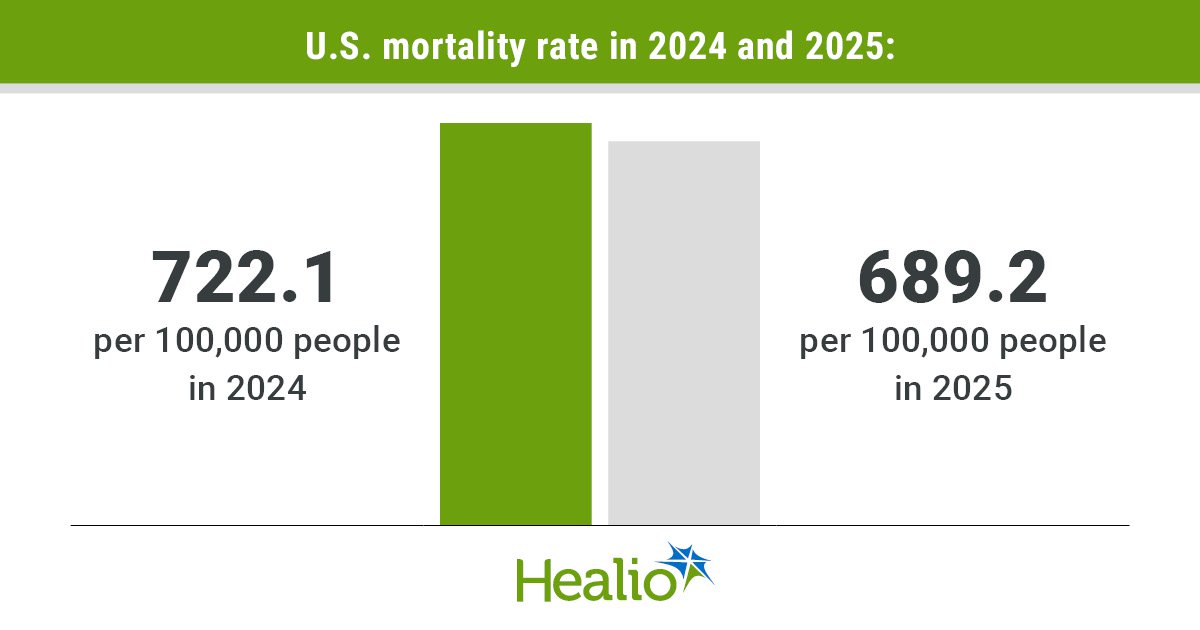
The new data show that, in 2025, there were 3,094,593 deaths, and the overall mortality rate was 689.2 per 100,000 people — 4.6% lower than the 2024 rate of 722.1 per 100,000 people. The leading causes of death remained the same, though, with heart disease, cancer and unintentional injuries in the top three spots.
In the 2025 provisional data, the age-adjusted mortality rate was 582.9 for women and 811.1 for men. It dropped for every age group. Additionally, the age-adjusted mortality rates were the highest in the Black non-Hispanic population at 869 per 100,000 and lowest for “the multiracial non-Hispanic population” at 187.3 per 100,000.
Notably, Gerald Busch, MD, MPH, a member of the American Psychiatric Association’s Council on Addiction Psychiatry and an assistant professor of psychiatry at the Uniformed Services University of the Health Sciences, told Healio that “total deaths actually rose” in 2025.
“The rate actually fell because of population growth and age adjustment,” he said. “And the gains were uneven: rates rose for American Indian and Alaska Native people and for Native Hawaiian or Other Pacific Islander … and Asian people,” but decreased for all other demographic groups.
As Healio previously reported, in 2024, life expectancy in the U.S. rose to 79 years — the highest ever.
Although life expectancy was not included in the data, the reported record-low death rate “makes another record likely,” Busch said.
“But that is a projection” until the life expectancy can be determined from final data, “which for 2025 is about a year away,” he said.
Caveats
Busch noted a few important caveats with the preliminary data.
For example, he said this year’s population denominators “changed methodology” in the report.
“The Pacific Islander rate rose 9.3%. CDC cautions it may be a denominator artifact. It may also not be. From Honolulu, that is a number I want confirmed against final data rather than dismissed, because if it is real it runs against the national story,” he said. “The multiracial death rate appears to fall from 333.9 to 187.3 in a single year. No mortality phenomenon does that. It shows how much caution these year-over-year comparisons need.”
Additionally, even though suicide dropped from the 10th leading cause of death in 2024 to number 11 this year, there was a difference of just 35 deaths.
“The rank changed because influenza and pneumonia rose past it,” he said. “Influenza and pneumonia rose sharply, from 48,139 deaths to 56,511, moving from 11th to eighth. In a story about a record low, that is the countervailing finding.”
It is also important to note that “these are provisional numbers and injury deaths lag,” Busch said. “CDC says the final unintentional injury count will be higher than 184,265.”
Reasons behind the drop
Although nothing is confirmed, some experts have pointed to the decline in overdose deaths as a reason for the lowered mortality rate.
According to another set of NCHS provisional data, 2025 saw approximately 69,973 drug overdose deaths, representing a major drop — nearly 14% — from 2024’s 81,313 drug overdose deaths. Nearly every state had decreases, and several — Alabama, New York, North Carolina, Rhode Island and Vermont — experienced a decline of at least 25%. However, Arizona, Colorado and New Mexico saw increases of at least 10%.
“Unintentional injuries fell from 197,449 to 184,265, and the overdose decline of roughly 11,300 accounts for essentially all of it,” Busch said. “The age pattern confirms it: the steepest declines were in 25- to 34-year-olds, down 10.8%, and 15- to 24-year-olds, down 7.9%, against 4.6% overall. That is the signature of overdose, not of heart disease or cancer, both of which killed more people in 2025 than in 2024.”
This downward trend in overdose deaths “is not really unexpected,” Busch said. “This is the third straight year. What nobody predicted in 2022 is that it would be this large or last this long, so that is good news.”
Reducing overdose deaths
Busch said “nobody really knows” why overdose deaths have dropped so suddenly.
“I have heard vigorous discussions at a number of national meetings,” he said. “Competing explanations point to different policies.”
Some of the common explanations include a shrinking exposed population, he said, “both because many vulnerable people who used drugs have died and because adolescent initiation is at historic lows,” or reduced supply.
“Fentanyl potency and purity fell … and precursor regulation in China tightened,” he said. “Fentanyl-positive deaths dropped 31.7% from 2023 to 2024 while fentanyl-negative deaths rose slightly, which is hard to explain any other way.”
Infrastructure like settlement money, over-the-counter naloxone, and wider access to medications for opioid use disorder is another potential explanation, Busch said.
“Its best evidence is that cocaine and methamphetamine deaths fell too, which a fentanyl-specific mechanism does not predict,” he said.
But Busch stressed that “nearly every one of those mechanisms acts on lethality, not on incidence.” For example, Naloxone use “does not prevent a case of opioid use disorder; it prevents that case from ending in death.”
“We have improved survival in an epidemic whose incidence we barely measure. Imagine the COVID epidemic without the daily incidence data we had to determine disease spread. This is not only not daily, but almost none at all,” he said. “If the decline is mostly about supply, it is reversible on the timescale of a supply change. Arizona, Colorado and New Mexico already went the other way, by 10% or more.”
Deaths that drop this quickly can rise just as quickly, Busch warned, “and the adulterants now entering the supply, including nitazenes, medetomidine and xylazine, are not reliably reversed by naloxone,” so it is important to “not demobilize or undo any measures currently taken.”
He offered several tips for clinicians:
- prescribe buprenorphine, since “the waiver has been gone since 2023, and most people with opioid use disorder still get no medication at all”;
- suggest naloxone “the way you would recommend a smoke detector, not as a comment on the patient”;
- “take stimulants seriously”;
- screen for alcohol and tobacco use “with the same urgency” because “between them they kill roughly nine times as many Americans as every drug overdose combined, and both have effective medications that go unprescribed”; and
- check on pediatric patients because even though adolescent use is “near a 30-year low,” overdose deaths in the same group “have not returned to pre-pandemic rates,” indicating a mortality problem. “One counterfeit pill can be fatal on first exposure,” Busch said.
“We have cut the case fatality rate of an epidemic that is still transmitting, with new cases arising constantly,” Busch said. “Roughly 11,000 people are alive who would not have been. That is worth saying plainly, and it is not the same as ending the epidemic.
“Overdose is the smallest of our three substance epidemics [including alcohol and tobacco], not the largest,” he continued. “Attention has followed the crisis that kills fastest rather than the ones that kill most.”
For more information:
Farida Ahmad, MPH, and Gerald Busch, MD, MPH, can be reached at primarycare@healio.com.
Sources/Disclosures
Source:
Healio Interviews
References:
Disclosures:
Ahmad and Busch report no relevant financial disclosures.

Ask a clinical question and tap into Healio AI’s knowledge base.
- PubMed, enrolling/recruiting trials, guidelines
- Clinical Guidance, Healio CME, FDA news
- Healio’s exclusive daily news coverage of clinical data