August 31, 2026
6 min read

Key takeaways:
- Parental refusal of the newborn HBV vaccine spiked from 2024 to 2025.
- Newborn girls are slightly less likely to receive the vaccine compared with newborn boys.
Parental refusal of the newborn hepatitis B virus vaccine surged in recent years, the latest in an ongoing trend that has more than doubled refusal rates since 2018, according to study results published in JAMA Network Open.
An analysis of live birth data from three centers in the University of Pennsylvania health system found that parental refusal rates in 2025 were more than double those recorded in 2018. Researchers launched the study after clinicians observed an uptick in parents withholding the HBV vaccine before hospital discharge over the last 12 months.

“The study was a reaction to clinical observations that neonatologists in my group and those more widely across the country have noted amid rising parental refusal of various recommended newborn preventive care interventions,” Sarah A. Coggins, MD, MSCE, a neonatologist at Children’s Hospital of Philadelphia and assistant professor of pediatrics at University of Pennsylvania Perelman School of Medicine, told Healio.
Coggins and colleagues noted that parents planning circumcision for their newborn sons were less likely to decline vitamin K prophylaxis, which is routinely recommended due to the bleeding risk associated with the procedure. However, this observation raised a broader question: Did parental acceptance of one newborn care intervention make them more receptive to others, including HBV vaccination, and would preventive care patterns be skewed by sex?
In a retrospective cohort study of 93,163 newborns in Philadelphia from 2018 to 2025, the researchers reported that 777 (8.3 per 1,000) did not receive vitamin K prophylaxis, while 9,400 (100.9 per 1,000) failed to receive HBV vaccination.
Notably, Coggins and colleagues found that 83% of the newborns whose parents refused vitamin K prophylaxis also refused HBV vaccination, indicating that parents who declined one preventive intervention often declined others as well.
Study results demonstrated that newborn girls were twice as likely not to receive vitamin K prophylaxis vs. newborn boys (adjusted OR = 2.03; 95% CI, 1.74-2.35) and were slightly less likely to receive the HBV vaccine (aOR = 1.06; 95% CI, 1.01-1.1).
Female infants were slightly less likely to receive the HBV vaccine than boys in 2025 (173.7 vs 166.3 per 1,000 births).
Healio spoke with Coggins about potential drivers behind increasing parental refusal of the HBV birth dose, strategies clinicians can use to improve vaccine acceptance and how confusion surrounding national vaccine recommendations may be contributing to the trend.
Healio: How has this increase in parental hesitancy toward newborn preventive-care interventions at your institution sparked concern?
Coggins: It’s not just my institution. We’ve noticed nationally the growth of parental hesitancy toward preventive care interventions like vaccines and the newborn vitamin K prophylaxis shot. However, there hasn’t been much numerical data to amplify the magnitude of the problem. Within the last year, there has been quite a bit of research that’s come out trying to quantify rates of newborn hepatitis B vaccine hesitancy.
This is something that neonatologists are jumping on because we’re taking care of these newborns in the early part of life. We promote a bundle of interventions that are recommended in this critical period to make sure we have evaluated for conditions that could pose significant risks to their health. We’re also there to help parents identify potential issues that need to be followed up to optimize their child’s development.
We give the HBV vaccine to prevent infection with the hepatitis B virus, which, when acquired in the perinatal period, can cause lifelong liver disease or progress to liver cancer. Recently, however, we have noticed that more parents are declining one or more parts of the recommended newborn care interventions. We have the benefit of history to understand why those interventions were initially implemented, which is why we are worrying now. If refusal of newborn preventive care interventions continues to rise, we are going to see a resurgence of predictable, preventable infant morbidity.
Healio: What reasons do parents give for refusing the HBV vaccine?
Coggins: Vaccine hesitancy is multifactorial. My colleagues and I frequently hear parents say that since they tested negative for HBV while they were pregnant, there is no way their baby could be infected. The reality is that most of those tests are done during the first trimester of pregnancy and generally aren’t repeated. There is a small percentage of people that do acquire HBV later in pregnancy, and won’t be identified because the test isn’t performed again before delivery.
Another misconception we often hear from parents is that HBV is only spread through sex, and since their baby isn’t having sex, they don’t need the vaccine. In that case, we remind them that contact with an infected person’s bodily fluids can lead to infection. Exposure to HBV-infected bodily fluids could occur at daycare, via shared use of toothbrushes, or via contaminated surfaces like park benches or bus seats. Without disinfection, the HBV virus can live on these surfaces for up to 7 days. In short, the sex argument is not fully accurate.
Even after education, some parents feel that the overall risk of their baby acquiring HBV is low and still choose to forego this vaccine. In that instance, we remind them about how incredibly serious perinatal HBV infection is. Compared with adults who get infected with HBV, infants with HBV infection are much more likely to be asymptomatic and much more likely to develop chronic hepatitis B infection, which can ultimately cause liver cirrhosis and liver cancer.
We also hear parents say they prefer to wait to get the HBV vaccine from their pediatrician, which is a reasonable request. Parents should view their primary care pediatrician as one of their most important partners in promoting and educating about childhood vaccines.
Ultimately, HBV vaccination is a preventive-medicine argument: I’ve asked parents, “Do you wear a seatbelt?” and most people say yes. But you don’t expect to be in a car accident every time you get in a car; the seatbelt is for the one in a million chance that it does happen.
The HBV vaccine is a preventive intervention for what may be an unlikely exposure. But the consequences of that rare exposure are so significant that the American Academy of Pediatrics has long championed the importance of the birth HBV vaccine dose.
Healio: How might changes in national recommendations for the newborn HBV vaccine have influenced parental acceptance and clinical counseling?
Coggins: I think that many clinicians feel that some of these decisions made by the CDC were not rooted in evidence, but rather motivated by a larger agenda of perspectives on vaccination in general.
The CDC recommendation for shared-decision making regarding the birth HBV vaccine is not supported by the American Academy of Pediatrics, nor is it supported by any available evidence. From a practical standpoint, the change confused people.
When these CDC recommendations came out, new parents in our newborn nursery shared that they didn’t know which advice to follow. Many parents came to us and said, “I trust you, the pediatrician.” However, there were also families who were already hesitant about the birth HBV vaccine, and the CDC’s announcement could have swayed their decision toward vaccine refusal. It fed into this existing environment of distrust in the medical system and misinformation. For some families that had no preexisting concerns about the HBV vaccine, the announcement may have actually introduced doubts.
For my whole lifetime, the CDC has been a highly trusted authority on all aspects of healthcare in the United States. Recent changes to preventive care policies with decades of safety and efficacy data have caused growing tension between the CDC and healthcare professionals. It’s an uncomfortable situation, and I’m not surprised that parents are confused.
Healio: What are the potential long-term consequences of declining childhood HBV vaccination rates?
Coggins: Like all other vaccine-preventable diseases, we’re likely to see a resurgence of HBV infection if HBV vaccine refusal continues to climb. Hepatitis B infection has never been something I worried about when taking care of a young infant with abdominal issues or jaundice — because vaccination rates were so high. But our differential diagnoses are going to have to broaden to include vaccine-preventable illnesses.
There is currently a large measles outbreak in central Pennsylvania. I’ve never seen measles in my career. But we’re just in this place now where pediatricians and emergency medicine doctors are having to go back to the textbooks and familiarize themselves with what measles looks like so they are prepared to identify it quickly.
We’re seeing the same thing with HBV. On some level, we are now having to shift our differential diagnoses.
Healio: Are there any other HBV prevention strategies in place if vaccine uptake continues to decline?
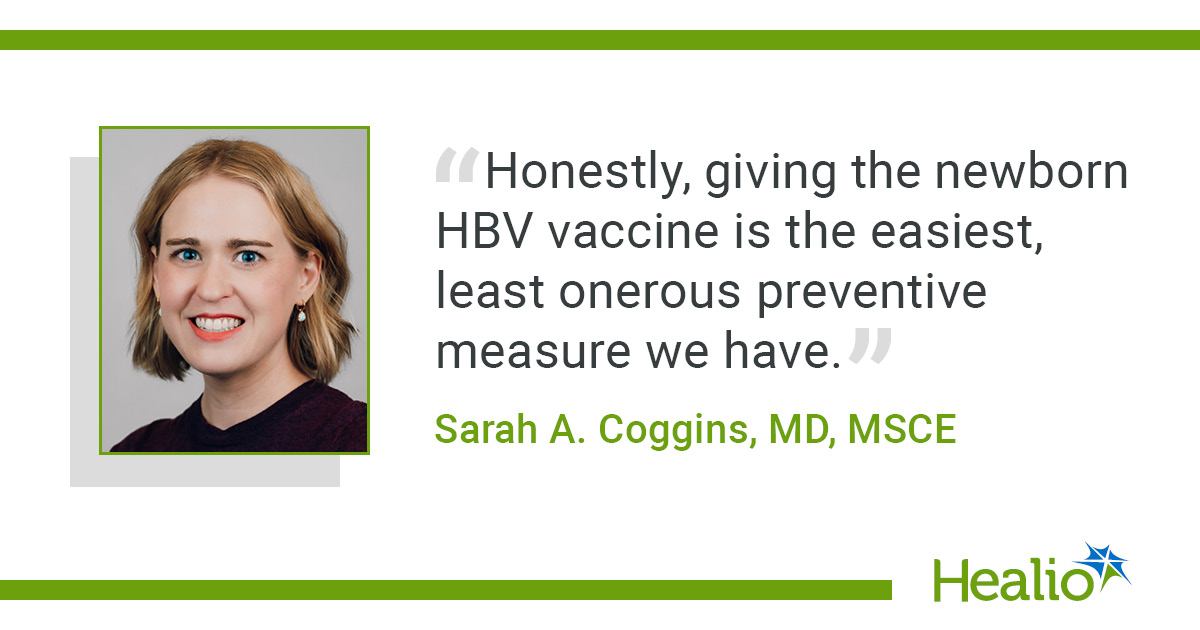
Coggins: Not routinely. Honestly, giving the newborn HBV vaccine is the easiest, least onerous preventive measure we have. It’s the simplest, most effective, data-driven way to prevent HBV seroconversion in newborns. Any other sort of intervention would likely be more costly and less effective.
For more information:
Sarah A. Coggins, MD, MSCE, can be reached at cogginss@chop.edu.

Ask a clinical question and tap into Healio AI’s knowledge base.
- PubMed, enrolling/recruiting trials, guidelines
- Clinical Guidance, Healio CME, FDA news
- Healio’s exclusive daily news coverage of clinical data